
Why the word “income” produces conflicting answers
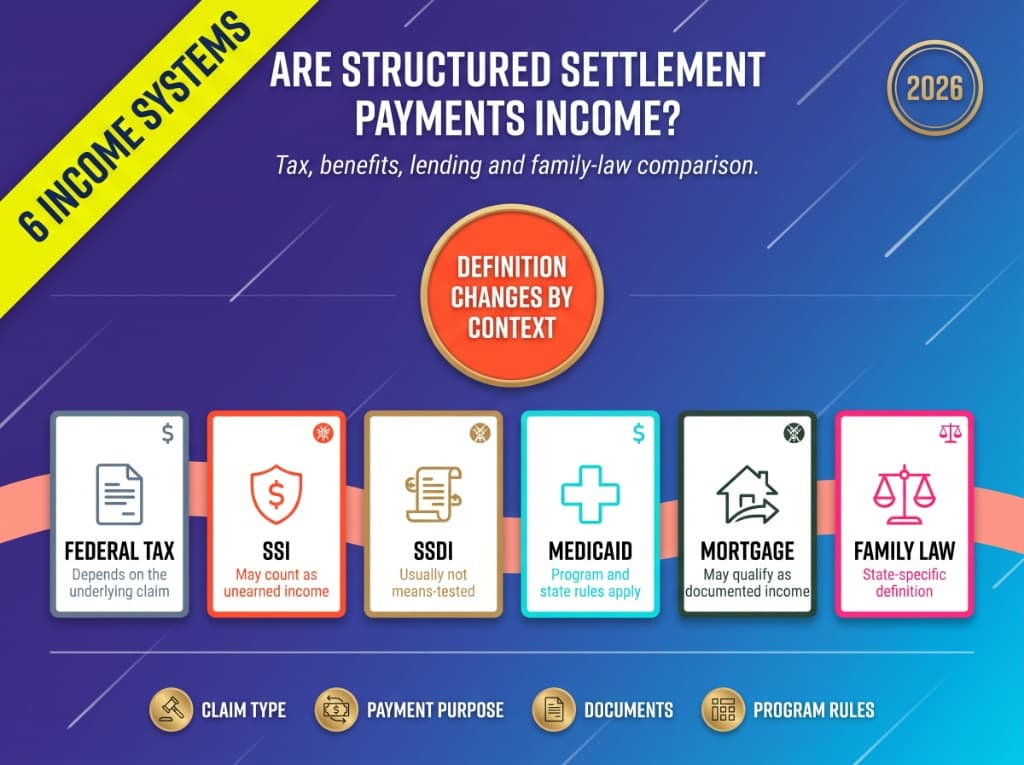
People often ask whether structured settlement payments are income as though the word has one universal legal meaning. It does not. Federal tax law defines gross income and specific exclusions. Supplemental Security Income uses program-specific definitions of earned income, unearned income and resources. Medicaid rules depend on the eligibility category and state administration. Lenders apply underwriting standards, and family courts apply state support laws.
A payment can therefore be tax-exempt yet relevant somewhere else. For example, a qualifying personal physical injury payment may be excluded from federal gross income under Internal Revenue Code Section 104. Social Security may nevertheless analyze a settlement award as unearned income for SSI unless an exclusion or qualifying trust arrangement applies.
The right question is not simply “Is this income?” It is: “Is this payment treated as income under the particular rule, program or decision I am dealing with?”
Federal income tax: what was the payment intended to replace?
Internal Revenue Code Section 61 begins with a broad rule that gross income includes income from whatever source derived unless another provision creates an exclusion. Section 104 provides important exclusions for specified injury-related amounts.
Section 104(a)(2) excludes damages, other than punitive damages, received on account of personal physical injuries or physical sickness. The statute expressly applies whether the damages are received through a lawsuit or agreement and whether paid as lump sums or periodic payments.
That language is central to qualifying structured settlements. The periodic format does not by itself make the payment taxable. If the underlying compensatory damages qualify under Section 104, receiving them periodically can preserve the exclusion.
The IRS explains that the facts and circumstances must be considered. Its central question is what the settlement and corresponding payments were intended to replace. The complaint, settlement agreement, allocation, release and court documents can all matter.
Physical injury and physical sickness damages
Compensatory damages received on account of personal physical injury or physical sickness can qualify for exclusion. The IRS states that compensatory damages, including certain lost wages attributable to the physical injury, may be excludable when the required connection exists.
The analysis is not limited to hospital bills. It examines why the damages were paid. A settlement resolving claims arising from a physical accident can be treated differently from an employment, defamation or purely emotional-distress settlement.
Emotional distress without physical injury
Section 104 states that emotional distress is not itself treated as a physical injury or physical sickness. Damages for emotional distress arising from a nonphysical claim are generally not excluded under Section 104(a)(2), although reimbursement for qualifying medical care attributable to emotional distress can require separate analysis.
Punitive damages
Punitive damages are generally not covered by the physical-injury damages exclusion. Section 104(c) contains a narrow exception for certain wrongful death actions under qualifying state law. The exception should not be applied without professional review.
Employment and nonphysical claims
Payments resolving discrimination, wrongful termination, defamation, contract or other nonphysical claims can be taxable. Wage components can also create withholding and employment-tax consequences. Calling a taxable settlement “structured” does not automatically make it tax-free.
Separately stated interest
Interest added to a judgment or settlement can have a different tax character from the underlying compensatory damages. Likewise, if a recipient invests settlement payments after receiving them, bank interest, dividends or investment gains generated later are separate from the original payment.
Federal tax treatment at a glance
| Payment origin | General federal-tax direction | Key qualification |
|---|---|---|
| Compensatory physical-injury damages | May be excluded from gross income | Must be received on account of physical injury or sickness |
| Workers’ compensation | Potential Section 104(a)(1) exclusion | Must qualify under applicable workers’ compensation law |
| Nonphysical emotional-distress damages | Generally taxable | Medical-cost reimbursement can require separate analysis |
| Employment or wage damages | Often taxable | Wage portions may be subject to payroll reporting |
| Punitive damages | Generally taxable | Narrow statutory wrongful-death exception may apply |
| Post-judgment or separately stated interest | Generally taxable | Separate from the underlying damage award |
| Investment earnings after receipt | Potentially taxable | Original payment and later earnings are different items |
SSI: tax-free does not necessarily mean non-countable
Supplemental Security Income is a needs-based program. Its analysis focuses on countable income and resources, not merely federal taxable income. A person can receive money that is excluded from federal income tax but still relevant to SSI eligibility or payment amount.
Social Security’s Program Operations Manual System, POMS SI 00830.515, states that an award or settlement is generally unearned income subject to the usual rules and exclusions. The agency verifies the amount, payment date and, when needed, the purpose of the payment.
The POMS also identifies situations where the full amount may not count. Examples include essential expenses connected with obtaining the award, amounts for replacement of a lost or damaged resource, exclusions created by federal law and payments directed into certain non-countable trusts.
In an SSA example, structured settlement payments paid directly into a qualifying pooled trust were not counted as income or a resource when the stated trust conditions were satisfied. That does not mean every trust or every direct deposit receives the same result.
Income this month versus a resource next month
SSI commonly distinguishes income received during a month from funds retained into a later month. A payment can first be evaluated under income rules and then become a countable resource if retained. Spending, transferring or depositing the money does not automatically avoid the program rules.
Recipients should report settlement payments and provide the actual documents. Do not rely solely on a tax-exemption letter because SSI uses a separate legal framework.
SSDI: generally not means-tested, but offsets can exist
Social Security Disability Insurance is based primarily on insured work history and disability status rather than financial need. Conventional personal injury structured settlement payments usually do not reduce SSDI merely because the recipient has additional money.
Workers’ compensation and certain public disability benefits are different. Federal offset rules can reduce SSDI when combined disability benefits exceed applicable limits. The settlement’s allocation and wording can matter.
Do not treat SSI and SSDI as interchangeable. A person can receive both, and the settlement may affect the SSI portion even when it does not affect SSDI in the same way.
Medicaid: eligibility pathway and state rules matter
Medicaid is administered through federal and state law and contains multiple eligibility categories. Some categories are closely linked with SSI methodology, while others use modified adjusted gross income or specialized long-term-care rules.
A structured settlement payment can be examined as income when received and as a resource if retained. Trust ownership, direct payment arrangements, transfer rules and Medicaid recovery rights can also matter.
Federal income-tax exclusion under Section 104 does not automatically establish Medicaid exclusion. A recipient should identify the exact Medicaid category and obtain state-specific advice before changing a payment destination or spending settlement funds.
Special needs and pooled trusts
A properly established first-party special needs trust or pooled trust can protect eligibility in qualifying circumstances. The trust must satisfy legal requirements, and distributions must be administered correctly. Creating a trust after payments have already been received may not undo prior income or resource consequences.
ABLE accounts
An ABLE account can provide tax-advantaged savings for an eligible person with a qualifying disability onset. Contribution limits, account-balance rules and qualified disability expenses apply.
Directing a structured settlement payment to an ABLE account does not automatically make every payment non-countable. SSA may review whether the payment arrangement is irrevocable, court-ordered and outside the recipient’s control. Obtain benefits-planning advice before relying on a direct-deposit strategy.
Mortgage and lending income
Mortgage underwriting asks whether money is stable, documented and expected to continue—not simply whether it appears on a federal tax return. A tax-free structured settlement stream may potentially help demonstrate repayment capacity when it satisfies the lender’s applicable requirements.
A lender may request the settlement agreement, annuity payment letter, bank statements, proof of payment history and evidence that the stream will continue for the required period. Life-contingent payments can create additional questions because continuation depends on survival.
Some underwriting systems can gross up qualifying nontaxable income, but the permitted percentage and documentation requirements depend on the loan program and lender. Never assume that tax-free status automatically produces a specific qualifying-income amount.
Child support, alimony and family-law calculations
State family-law definitions of income can be broader than federal taxable income. Courts may consider recurring structured settlement payments, particularly when they are available for living expenses or replace lost earnings.
Other portions may be analyzed differently when they compensate for medical expenses, disability-related care or loss of a particular asset. The answer can depend on the state statute, court precedent, purpose of the damages and facts of the family.
A tax-free label does not control a family court. Likewise, inclusion in a support calculation does not make the payment federally taxable. These are separate legal decisions.
Does a Form 1099 settle the question?
A Form 1099, W-2 or other information return is an important record, but it should be reviewed with the settlement documents. A payer’s reporting position does not replace the legal analysis of what the payment represents.
The IRS notes that settlement characterization and payer intent can matter, particularly when the agreement is unclear. Preserve every document explaining the claims and allocation.
If an information return appears inconsistent with a qualifying physical-injury settlement, do not ignore it. Ask the payer about a correction and consult a qualified tax professional before filing.
What if the settlement contains several damage categories?
A settlement can resolve physical injury, emotional distress, lost wages, punitive damages, property damage, interest and attorney-fee claims at the same time. Different components can receive different treatment.
A clear, supportable allocation can help explain the payment’s character. An allocation created solely to obtain favorable tax treatment without support from the underlying claims may be challenged.
Structured payments do not combine every component into one universal category. Trace each stream to the obligation and damages it funds.
Are inherited structured settlement payments income?
When guaranteed payments continue to a beneficiary after the original payee dies, the tax and program analysis should begin with the underlying settlement and beneficiary rights. Inheritance terminology alone does not provide the complete answer.
A beneficiary should obtain the settlement records, annuity schedule, beneficiary confirmation and issuer’s payment explanation. The recipient’s own SSI, Medicaid, tax and family-law circumstances can also affect treatment.
What happens after selling structured settlement payments?
In a court-approved transfer, the seller receives a discounted lump sum in exchange for specified future payment rights. The seller should obtain tax advice addressing the original claim, qualification of the transfer and intended use of the lump sum.
Even when the transaction does not create federal taxable income, the lump sum can affect means-tested benefits, financial-aid calculations, creditor issues or eligibility programs. Receiving more cash at once can create a larger resource issue than receiving periodic payments.
A five-document income-classification file
Keep a permanent file containing:
- The original complaint, petition or claim showing the basis of the case.
- The settlement agreement and release describing the damage categories.
- The qualified assignment and annuity payment schedule.
- Tax forms, benefit notices and written professional advice.
- Records showing where payments were deposited and how retained funds were held.
These records answer different questions. The complaint and settlement establish why damages were paid. The schedule establishes timing. Benefit notices show program treatment, and bank records document receipt and retention.
Questions to ask the correct professional
Tax professional
Which damage categories qualify under Section 104? Is any portion punitive, wage-based, interest or nonphysical? Is reporting required?
Benefits planner
How will the payment be treated as SSI or Medicaid income and as a resource? Can a qualifying trust or ABLE arrangement help?
Mortgage professional
What proof of amount, history and continuation is required? Can qualifying nontaxable income be grossed up under the loan program?
Family-law attorney
Does state law include the payment in support income? Does the purpose of the damages or medical-cost component change treatment?
Common mistakes
Assuming tax-free means invisible everywhere
Tax exclusion does not automatically control SSI, Medicaid, mortgage underwriting or family court.
Confusing SSI with SSDI
SSI is means-tested. SSDI generally is not, although workers’ compensation offsets can apply.
Ignoring retained funds
Money that is not countable as income under one rule can become a countable resource after it remains in an account.
Creating a trust without specialized advice
An incorrectly drafted or funded trust can fail to protect benefits. Timing, control and distribution rules matter.
Using the word “settlement” as the entire tax analysis
The relevant question is what each payment was intended to replace, not merely what the document is called.