
Moved to Another State? Which Court Approves Your Structured Settlement Sale?
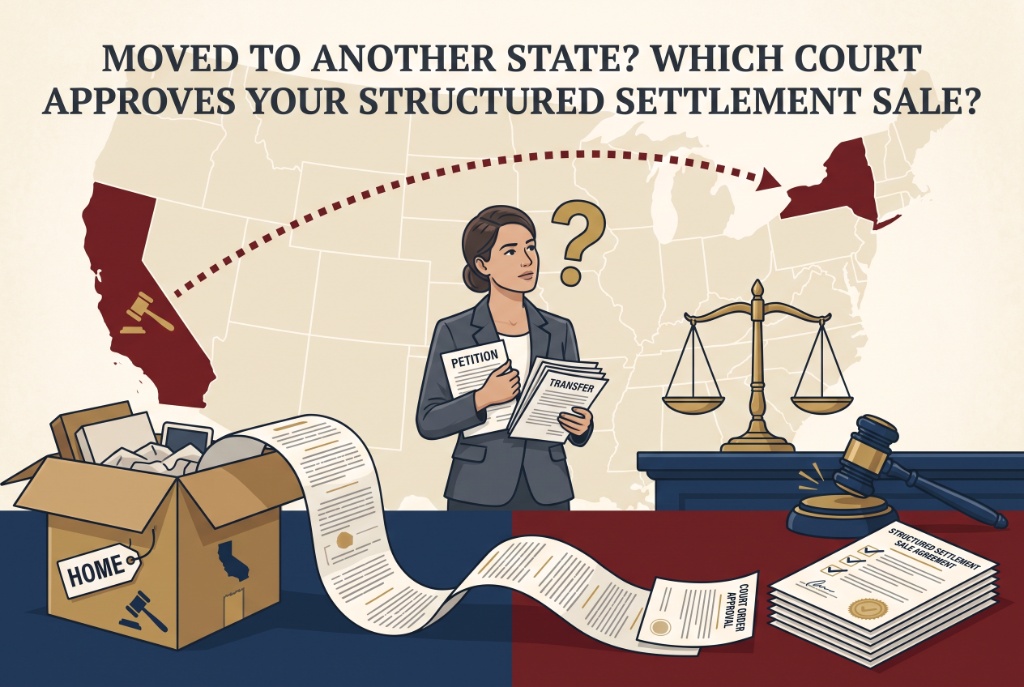
Quick answer. Moving to another state generally does not prevent you from selling eligible structured settlement payments. Your current domicile is ordinarily the starting point for identifying the applicable state transfer law. That law can affect where the petition is filed, which disclosures you receive, who must receive notice and how the judge reviews the transaction.
Disclosure: SettlementDecisions.com is compensated by DRB Capital, LLC for qualified referrals. We are not a purchaser or funder of structured settlement transactions. This article provides general educational information and is not legal, tax or financial advice.
Determine the state that is genuinely the recipient’s permanent legal home and collect consistent supporting documents.
Federal law generally starts with the payee’s domicile. State law then supplies the detailed transfer requirements.
The transaction must follow the applicable rules for venue, disclosure, notice and independent professional advice.
The court evaluates the proposed transfer under the applicable statutory and best-interest standards. Approval is not automatic.
Your current domicile is usually the starting point
Federal law defines the applicable state statute primarily by reference to the state where the structured settlement payee is domiciled. Domicile generally means your permanent legal home, which may differ from where the original lawsuit occurred or where you are staying temporarily.
Structured settlements can continue for decades. A recipient might settle a case in California, attend college in Arizona, work temporarily in Nevada and eventually establish a permanent home in Texas. The address on the original settlement agreement does not necessarily determine which state transfer statute applies years later.
Section 5891 of the Internal Revenue Code establishes the federal framework for structured settlement factoring transactions. The federal rule generally requires a qualifying court order for a transfer to avoid the forty-percent excise tax imposed on the factoring discount when the statutory exception is not satisfied.
Federal law does not replace state law. It works with the Structured Settlement Protection Act in the relevant jurisdiction. State law provides many of the practical details, including venue, disclosure, notice, waiting periods and the findings the court must make.
Domicile means more than a mailing address
Domicile normally means the state you intend to make your permanent home. A changed mailing address is evidence, but it may not be sufficient when your official records point to several different states.
Documents used to establish current residence may include a driver’s license, state identification card, lease, deed, utility bill, voter registration, vehicle registration, tax records or bank statements. Requirements vary by transaction and jurisdiction.
No single document controls every case. Courts and transaction counsel can consider the full picture. A license from one state, a lease in another and tax records using a third address can create questions that should be resolved before a petition is filed.
Never use a relative’s address or temporary mailbox merely to obtain a supposedly more favorable court. An inaccurate address can delay the transaction, create credibility concerns or result in dismissal.
| Factor | What may change | What generally stays the same |
|---|---|---|
| Current domicile | Applicable state statute, court venue and disclosures | Your underlying right to scheduled payments |
| Court location | The state or county where a petition may be filed | The need for a qualifying judicial order |
| Consumer protections | Waiting periods, advice rules and notice requirements | The court’s focus on the payee and dependents |
| Annuity issuer | Your mailing address and delivery of legal notices | The issuer and original payment schedule |
| Transaction timing | Document review and local court scheduling | The need to complete the statutory process |
The original settlement state does not always control
The state where the lawsuit settled remains relevant, but it does not automatically determine where a future transfer petition must be filed. The original documents explain how the payments arose; current domicile and applicable venue rules generally guide the transfer proceeding.
The settlement agreement, qualified assignment and annuity contract remain essential. They identify the parties, payment schedule, annuity issuer, structured settlement obligor and any transfer-related language.
A contractual anti-assignment provision is not necessarily the end of the analysis. Federal and state law provide a supervised process for eligible structured settlement transfers. Whether a transaction qualifies depends on the documents, current facts and governing law.
What happens if you moved recently?
A recent move does not automatically disqualify you. It may, however, require additional evidence that the new state is your genuine permanent home rather than a temporary address selected for the transaction.
Be prepared to explain when you moved, whether the move is permanent, where your dependents reside and which state appears on your official records. Consistent documentation can prevent a domicile dispute from appearing after legal work has already started.
There is no universal rule requiring every recipient to live in a state for the same number of months. Residency, domicile and venue language varies. The applicable statute should be checked before filing.
What if your current state has no applicable statute?
Federal law includes a fallback when the payee’s domicile does not have an applicable structured settlement transfer statute. The analysis may then consider a state where a party to the structured settlement or the issuer of the funding asset is domiciled or has its principal place of business.
This is a specialized legal scenario, not permission to choose any convenient jurisdiction. The federal definitions, state statute, court jurisdiction and transaction facts must align.
Documents to gather after moving
- Government-issued identification with your current address
- A lease, deed, utility bill or similar residence evidence
- The original settlement agreement and release
- The qualified assignment, if available
- The annuity contract or current benefits letter
- Recent evidence that payments are being received
- Documents from any previous transfer
- Information about dependents and support obligations
- Details of any bankruptcy, lien or pending legal proceeding
If the annuity contract is unavailable, contact the issuer and request a current benefits letter. It can confirm the payment schedule and help distinguish guaranteed payments from life-contingent payments.
How moving can affect the timeline
Moving does not necessarily make a transfer substantially slower. Delays are more likely when addresses, domicile evidence, legal analysis or settlement documents are incomplete or inconsistent.
The transferee generally prepares the statutory disclosures, identifies the appropriate court, provides required notices and waits through the applicable statutory periods. The petition is then reviewed according to local court procedure.
Under federal law, a qualified order must find that the transfer is in the payee’s best interest while taking into account the welfare and support of the payee’s dependents. Approval is never automatic.
Three common moving scenarios
You permanently moved after the original settlement
Your current domicile is generally the starting point. Retain the original settlement records, but prepare current residence evidence before a petition is drafted.
You are temporarily working or studying elsewhere
Temporary presence does not necessarily change domicile. Your permanent home, intent and official records may remain connected to your original state.
You moved while a transfer was already underway
Inform the transferee promptly. The disclosures, petition, address, jurisdiction and notices may need to be reviewed. Concealing the move can create a larger problem later.
Questions to ask before signing
- Which state transfer statute applies, and why?
- Which court and county will receive the petition?
- What evidence of domicile is required?
- Does my recent move change the disclosure process?
- Could the annuity issuer or obligor question the venue?
- Does the jurisdiction require independent professional advice?
- Is the offer subject to revision after legal review?
- What happens if another court must hear the petition?
Frequently asked questions
Can I sell structured settlement payments after moving to another state?
Moving generally does not make structured settlement payment rights unsellable. Your current domicile can affect which state transfer statute applies, where a petition may be filed and which disclosures and notices are required.
Does the state where my original lawsuit settled always control?
Not necessarily. The original settlement state remains relevant to the documents and transaction history, but federal law generally begins with the state where the payee is domiciled when identifying the applicable state transfer statute.
What does domicile mean?
Domicile generally means the state you consider your permanent legal home, not simply a place where you are staying temporarily. Courts may consider identification, housing, tax, voter, vehicle and financial records.
Can I choose the state with the easiest transfer law?
Normally no. A petition must have a legitimate jurisdictional and venue basis. Using a temporary or inaccurate address can delay the transaction and create credibility problems.
What if I moved recently?
A recent move does not automatically prevent a transfer, but additional documents may be needed to establish that the new state is genuinely your permanent home.
Will my annuity issuer need to approve my move?
An address change is different from a transfer of payment rights. The annuity issuer and structured settlement obligor generally follow the applicable notification process and a qualifying court order for a transfer.
What documents should I gather?
Gather your settlement agreement, qualified assignment if available, annuity contract or benefits letter, recent payment evidence, identification, proof of current residence and documents from any previous transfer.
Is court approval guaranteed after I move?
No. Moving does not guarantee or prevent approval. The court must apply the governing law and determine whether the proposed transfer satisfies the required legal standards.
Primary legal source
The federal framework appears in 26 U.S.C. § 5891. State-specific requirements should be checked against the current Structured Settlement Protection Act and court rules in the relevant jurisdiction.
Continue with the structured settlement state-law tool, the selling process guide or the structured settlement document checklist.
Cite this page
APA. SettlementDecisions.com. (2026). Moved to Another State? Which Court Approves Your Structured Settlement Sale?. https://www.settlementdecisions.com/blog/sell-structured-settlement-after-moving-states-court-jurisdiction