Issuer and servicing verification guide
What Happens When Your Annuity Company Merges or Changes Names?
A new company name, logo or service center does not automatically change your structured settlement—but you should document the legal successor and verify every new instruction.
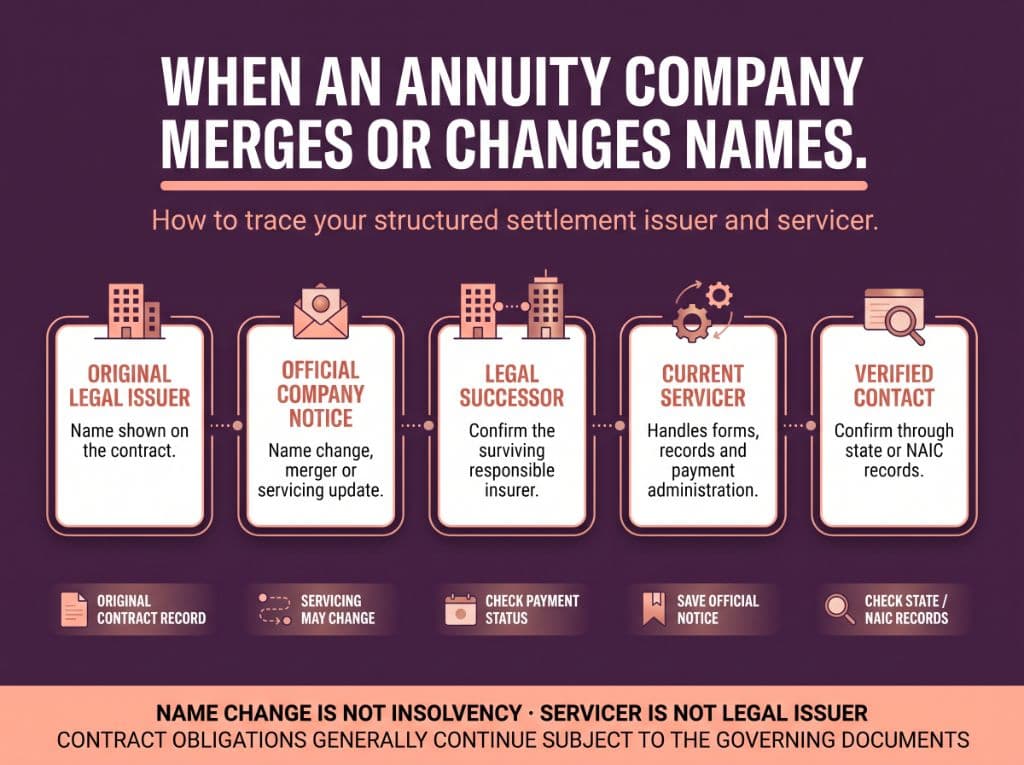
Direct answer: a merger or name change ordinarily does not erase the annuity contract or scheduled payment obligation. Identify the surviving legal insurer, distinguish it from the servicer, preserve the official notices and verify contact information independently.
Interactive issuer-verification workflow
Build the Issuer Identity Trail
Select what happened, then trace the contract from its original legal issuer to the company currently responsible for administration.
Selected scenario
Start with the contract identity trail
If letters, deposits and online search results use different names, build a documented chain from the original contract to the current legal issuer and servicer.
What may change
- Brand, affiliate or service-center name
- Legal insurer through a completed merger
- Contact details used for administration
What usually remains
- Payment rights without supporting legal documents
- Contract terms based solely on a new logo
- Your need to verify sensitive instructions
First verification steps
- 1Find the original contract and assignment
- 2Record every old and new company name
- 3Check NAIC and state insurance records
Original contract
Official notice
Legal successor
Current servicer
Verified contact
Document readiness
0 of 6 checked
Fraud-prevention rule
Never send personal information, change direct deposit or redirect payments using only contact details in an unexpected email, text or letter. Verify the company through existing contract records, the state insurance department or another independent official source.
Four different events that look similar
A letter with a new logo can describe several legally different events. It may announce a simple company name change, a merger into a surviving insurer, a transfer of administration to an affiliate, or a change in the customer-service brand. Those events should not be treated as interchangeable.
The most important question is not which brand appears largest on the envelope. It is which legal insurance company issued or now carries the annuity obligation and which entity is currently authorized to service the contract.
Name change
The same legal company may continue under a new approved name.
Merger
A surviving legal entity may succeed to the predecessor's obligations.
Servicing transfer
Administration may move while the legal issuer remains unchanged.
Brand change
A parent-company brand may appear even though a subsidiary issued the annuity.
Does the payment obligation continue?
A corporate change does not ordinarily permit the insurer to discard existing annuity terms. In a completed merger, the surviving legal entity generally succeeds to the predecessor's contractual obligations according to the transaction, regulatory approvals and governing law.
New York Department of Financial Services guidance illustrates the regulatory documentation involved. For an existing life insurance or annuity contract affected by a merger and name change, the endorsement must identify that the merger occurred and provide that the policy's terms and conditions have not changed. Other states use their own filing and approval procedures.
Continue monitoring deposits. A corporate announcement is not a reason to ignore a late or missing payment. Contact the verified current servicer promptly if the amount, date or payment destination changes unexpectedly.
Legal issuer, parent brand and servicer are different
Large insurance organizations often contain multiple subsidiaries. The parent brand used in advertising may not be the legal insurer named in the annuity contract. The NAIC Consumer Insurance Search warns consumers that an insurance company may have subsidiaries with different names and recommends checking the policy for the correct company name.
A servicer performs administrative work such as answering questions, processing address changes or sending payment records. A payment processor may place yet another description on a bank deposit. Neither name automatically replaces the legal issuer.
| Identity | Primary function | Best evidence |
|---|---|---|
| Legal issuer | Issued or legally succeeded to the annuity | Contract, endorsement and regulator record |
| Assignment company | Owns funding annuity in many qualified assignments | Qualified-assignment document |
| Parent brand | Identifies the broader corporate group | Company disclosures and legal footer |
| Servicer | Handles administration and customer requests | Verified official servicing notice |
| Payment processor | Transmits deposits or checks | Issuer confirmation and bank record |
How to identify the current responsible company
Step 1
Start with the oldest contract
Record the exact issuer, owner, payee, contract number and original service address.
Step 2
Collect every official notice
Preserve endorsements, merger letters, tax forms and servicing-transfer notices.
Step 3
Build the name chain
Write predecessor → successor → current legal issuer instead of replacing the old name.
Step 4
Check NAIC records
Search the exact legal names and examine subsidiaries rather than relying on a brand search.
Step 5
Check the state regulator
Confirm licensing and request assistance when the successor chain is unclear.
Step 6
Contact the verified servicer
Use independently confirmed contact information and request written confirmation.
Records worth preserving permanently
Keep the original name even after the company changes. Historical records, court files, assignments and bank deposits may continue using it. Removing the predecessor from your files can make later verification harder.
Contract identity
Original issuer, contract number, owner, payee and measuring life.
Corporate history
Former names, surviving company, effective dates and official endorsements.
Current administration
Servicer, verified telephone number, address, website and last verification date.
Payment evidence
Recent deposits, check stubs, annual statements and payment correspondence.
Beneficiary records
Current designation, confirmation and claim instructions.
Authority documents
Trust, guardianship, power-of-attorney or estate documentation where applicable.
A merger is not the same as insolvency
A routine merger, acquisition, reorganization or name change should not be described as an insurer failure. Insolvency involves a regulatory and court-supervised process such as rehabilitation or liquidation.
NOLHGA explains that state insurance departments oversee insurer financial condition and that a domiciliary insurance commissioner acts as receiver when an insurer enters receivership. State guaranty associations address covered obligations when the legal insolvency system is triggered—not whenever a company changes its logo or parent.
Guaranty-association coverage varies by state and is subject to eligibility rules, exclusions and limits. For annuities, NOLHGA notes that limits generally apply to the present value of covered annuity benefits. Do not advertise a single nationwide coverage amount or assume every structured settlement arrangement receives identical treatment.
Fraud warnings after a company change
Corporate transitions create opportunities for impersonation. Fraudulent communications may copy a real merger announcement and then direct the recipient to a false telephone number, website or payment account.
Do not provide a Social Security number, bank credentials, death certificate, signature or beneficiary information until the requester is independently verified. Do not use only the link or number included in the unexpected communication.
Stop and independently verify if:
- • You are told to redirect a payment urgently.
- • The sender requests gift cards or cryptocurrency.
- • The email domain differs from verified records.
- • The caller refuses to provide a legal company name.
- • You are asked to pay to preserve scheduled benefits.
- • The notice contains no contract-identifying information.
What if you cannot locate the company?
Start with the exact legal name printed on the oldest annuity, assignment or payment statement. Search the NAIC Consumer Insurance Search and the insurance department for your state. If the company no longer appears under that name, ask the regulator to help trace mergers or successor entities.
If the annuitant or payee has died and records are incomplete, the NAIC Life Insurance Policy Locator may be useful for locating participating company records. It is not a substitute for preserving the contract, beneficiary confirmation and company notices.
Frequently asked questions
Does a merger cancel my structured settlement?+
A merger does not by itself cancel the payment obligation. The surviving legal company generally continues applicable obligations under the merger, contract and governing law.
Why does my deposit show a different company name?+
The deposit may display a parent brand, affiliate, successor, servicer or payment processor. Ask the verified servicer to identify the legal issuer and explain the deposit description.
Is the servicing company now the annuity issuer?+
Not necessarily. Servicing can move without transferring the underlying annuity obligation.
Can the successor change my payment schedule?+
A corporate change alone does not rewrite the settlement agreement or annuity schedule.
Should I complete new direct-deposit forms?+
Only after independently verifying that the request is authentic and confirming where the completed form must be sent.
Does guaranty-association coverage begin after a merger?+
No. Routine corporate changes do not activate the insolvency safety net. Coverage is governed by state law and a qualifying insurer-failure process.
What identifier should I save besides the company name?+
Save the contract or policy number and, when available, the insurer's NAIC company code along with predecessor and successor names.
Official verification resources
Bottom line
When an annuity company changes names or merges, preserve the original contract identity and build a documented chain to the current legal issuer. Separate the issuer from the parent brand, assignment company, servicer and payment processor. Verify every new contact or banking instruction through independent official sources.
Get Free Competing Offers Save $3K$12K
Compare pre-screened professionals in 60 seconds. No obligation.
What type of settlement or claim do you have?
Select the category that best matches your situation
This guide provides general educational information, not legal, insurance, tax or financial advice. Corporate transactions, contract terms, regulatory orders and state guaranty-association laws control.