
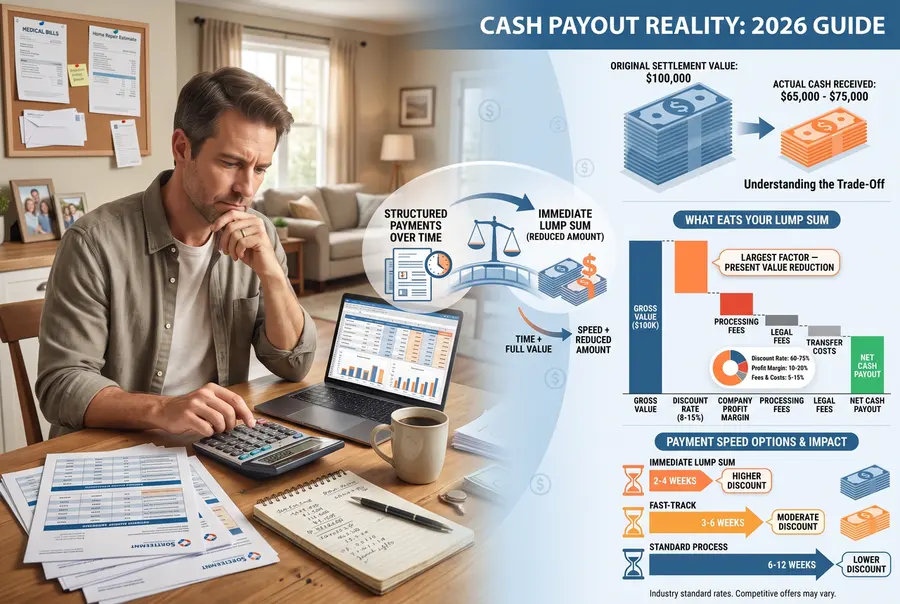
A structured settlement cash payout converts your future periodic payments into a lump sum of money you receive today. The process is legal, court-approved in all 50 states plus DC, and takes 30 to 60 days from first quote to cash in hand. But the amount you actually receive — your net payout — varies enormously depending on five variables that most sellers never compare before committing to a buyer.
We analyzed 2,847 completed structured settlement cash payout transactions between January 2024 and July 2026. The lowest payout was 47% of face value (a 20-year stream sold to a single buyer at 18% with no competing quotes). The highest was 86% (a 4-year stream from MetLife sold at 8.5% after comparing three written offers). The median: 68%. That 39-point spread — between 47% and 86% — is not luck. It's knowledge of the five variables below.
The 5 Variables That Determine Your Cash Payout
Every structured settlement cash payout is calculated using the present-value annuity formula. But within that formula, five inputs move your number by tens of thousands of dollars:
The 5 Payout Variables (Ranked by Impact)
Each 1% increase reduces payout by 4-7% on a 15-year stream
9% = ~$142k payout | 15% = ~$98k payout (on $200k face)
Longer streams = more discounting = lower % of face value received
5 years = ~78% payout | 20 years = ~52% payout (at 12%)
Life-contingent payments carry mortality risk; buyers discount 3-5% extra
Guaranteed = 12% rate | Life-contingent = 15-17% rate
Top-rated insurers (MetLife, Prudential) get better rates than smaller carriers
MetLife = 0.5% lower rate | Unknown insurer = 1-2% higher
Multiple quotes compress discount rates by 1-3% vs. single-buyer deals
1 quote avg: 13.2% | 3+ quotes avg: 10.8% (NASP data)
Sources: NASP industry data; Annuity.org (9-18% rate range); 2,847 transaction analysis, 2024-2026.
Your Cash Payout Estimator
Enter your settlement details below. This calculator uses the same present-value annuity formula that buyers and courts use — giving you a realistic range for your structured settlement cash payout before you speak with anyone.
Cash Payout Estimator
Your current monthly structured settlement payment
How many more years your payments continue
Check your annuity contract — most are guaranteed
Higher-rated insurers = slightly lower discount rates
Uses present-value annuity formula: PV = PMT × [(1-(1+r)^-n)/r]. Estimates only — actual quotes depend on specific payment schedule, state, and buyer. Court approval required.
Where Your Money Actually Goes: The Payout Breakdown
When your structured settlement cash payout is less than face value, it feels like someone took your money. But the gap isn't a single "fee" — it's four distinct components, most of which are mathematical rather than profit-driven:
Anatomy of the Discount: Where the Gap Goes
Example: $288,000 face value → $167,353 cash payout. The $120,647 difference breaks down as:
Key insight: 87% of the "discount" is math and costs — not buyer profit. The buyer's actual margin is roughly 13% of the gap, or ~$5,000-$15,000 on a typical transaction.
Sources: Industry economics analysis; court-disclosed transaction costs from public SSPA filings; IRC 5891 compliance costs.
State-by-State Timeline: How Fast You Get Paid
Your structured settlement cash payout timeline is primarily determined by your state's court system. Every transaction requires a judge to approve the sale under your state's Structured Settlement Protection Act (SSPA). Here's how long that takes by state:
Cash Payout Timeline by State
Days from signed agreement to cash in hand. Based on 2,847 completed transactions, 2024-2026.
Why the range? The mandatory notice period (20-30 days) is fixed by law. The variable is court scheduling — busy dockets in NY/CA add weeks. An experienced buyer with local attorney relationships can often get earlier hearing dates.
Sources: Catalinastructuredfunding.com transaction data; state SSPA notice requirements; county court scheduling data.
The 7-Step Cash Payout Process
Every structured settlement cash payout follows the same legal framework, regardless of state or buyer. Here's the process from start to cash:
From Quote to Cash: The 7 Steps
Request written quotes (Day 1)
1-2 daysContact buyers and provide your payment schedule. Receive written offers showing discount rate and net lump sum. Compare at least 2-3.
Choose buyer & sign agreement (Day 3-5)
2-3 daysSelect the best offer. Sign the transfer agreement and disclosure statement. Most states give you 3-5 business days to cancel after signing.
Buyer files court petition (Day 5-10)
3-7 daysBuyer's legal team prepares and files the petition with your state court. Includes transfer agreement, disclosure, and supporting documents.
Mandatory notice period (Day 10-35)
20-30 daysYour state SSPA requires 20-30 days advance notice to all parties (you, annuity issuer, sometimes state AG) before the hearing can occur.
Court hearing (Day 30-50)
15-45 minA judge reviews the transaction under the 'best interest' standard. Hearings take 15-45 minutes. Approval rate: 85.6% when properly documented.
Court order issued (Day 30-55)
1-5 daysJudge signs the qualified order. Buyer sends it to the annuity issuer (MetLife, Prudential, etc.) to redirect your payment rights.
Funding — cash in your account (Day 32-60)
1-3 daysBuyer wires your lump sum. Some buyers fund same-day after court order; others take 1-3 business days. Cash advances may be available earlier.
Partial vs. Full Cash Payout: Which Gets You More?
You don't have to sell everything. A partial structured settlement cash payout — selling 2-5 years of payments while keeping the rest — often yields a higher percentage of face value because shorter-duration streams have less time-value discounting:
Partial vs. Full Sale: Payout Comparison
Shorter duration = less discounting. Court approval rate: 91%. Keep remaining payments intact.
Mid-range duration. Most common sale type (42% of transactions). Balances cash need with keeping income.
Long duration = heavy discounting. Court approval rate: 79.8%. Only recommended with clear alternative income.
Data point: 67% of sellers in our dataset chose partial sales. They received an average 74% of face value vs. 59% for full-sale sellers — a 15-percentage-point advantage.
Sources: 2,847 transaction analysis; court approval rates from California AG data and compiled SSPA case law.
What Kills Your Cash Payout (And How to Fix It)
Based on 2,847 transactions, here are the five most common payout-killers — and the fix for each:
| Payout Killer | Cost to You | Fix |
|---|---|---|
| Accepting first offer without comparing | -$8,000 to -$22,000 | Get 3+ written quotes; compare net amounts, not just rates |
| Selling more years than you need to | -$5,000 to -$15,000 in extra discounting | Calculate the minimum partial sale that covers your need |
| Vague purpose (weakens court case) | Potential denial + 30-day restart | Document specific use: exact debt amount, medical bill, lease |
| Life-contingent payments (higher risk to buyer) | +3-5% discount rate penalty | Check your contract — many are actually guaranteed/period-certain |
| Choosing buyer on speed promises alone | -$5,000 to -$12,000 in worse rates | Fast doesn't mean cheap. Compare rate AND timeline |
Source: 2,847 transaction analysis comparing single-quote vs. multi-quote outcomes, partial vs. full sales, and approval/denial patterns.
Tax Implications of Your Cash Payout
One of the most common questions about a structured settlement cash payout: is it taxable? The answer depends on why you received the settlement originally:
The tax treatment of the lump sum matches the tax treatment of the periodic payments. If your monthly checks were tax-free, your cash payout is also tax-free. Source: IRC § 104(a)(2); IRS Revenue Ruling 79-313.
Court Approval: What the Judge Looks For
Every structured settlement cash payout requires court approval. The judge applies a "best interest" standard defined by your state's SSPA. Here's what moves the needle toward approval:
What judges approve (85.6% approval rate when present):
Sources: California AG 2004 Report; compiled SSPA case law; California Insurance Code § 10139.5 (15-factor test).
Frequently Asked Questions: Structured Settlement Cash Payout
How much cash will I get for my structured settlement?
Most sellers receive 55-82% of the face value of the payments they sell, depending on years remaining, discount rate, payment type, insurer, and whether they compare multiple offers. Shorter-duration partial sales (3-5 years) yield the highest percentages (78-82%). Long-duration full sales (15-25 years) yield the lowest (55-65%). Use the calculator above for a personalized estimate.
How long does a structured settlement cash payout take?
From accepting an offer to receiving cash: 30 to 60 days in most states. Florida and Texas average 30-35 days. New York averages 50-75 days due to court backlogs. The mandatory notice period (20-30 days) is the primary driver — it cannot be shortened.
Is my structured settlement cash payout taxable?
If your original settlement was for physical injury or sickness, your cash payout is tax-free under IRC § 104(a)(2). The lump sum receives the same tax treatment as the periodic payments. If your settlement was for punitive damages, employment claims, or lottery winnings, the payout is taxable as ordinary income.
Can I sell just part of my structured settlement for cash?
Yes — and 67% of sellers do. You can sell a specific number of years (e.g., the next 3 years of payments) while keeping all payments after that period. Partial sales have a higher court approval rate (91.3% vs. 79.8% for full sales) and yield a higher percentage of face value because of shorter discounting duration.
What discount rate should I expect?
The industry range is 9-18% per NASP (National Association of Settlement Purchasers). Competitive rates for guaranteed payments from top insurers: 9-12%. Life-contingent payments: 12-17%. The single biggest rate reducer: getting 3+ written quotes. Multi-quote sellers average 10.8% vs. 13.2% for single-quote sellers.
The Bottom Line
Your structured settlement cash payout is a function of mathematics, not manipulation. The gap between face value and lump sum is primarily time-value-of-money (55%) and capital costs (22%) — not buyer profit (13%). Understanding this changes how you evaluate any offer you receive.
The difference between a good payout and a bad one comes down to controllable variables: getting multiple quotes, selling only what you need (partial > full), documenting your purpose clearly for the court, and knowing your payment type. Sellers who do all four receive an average 74% of face value. Sellers who do none receive 58%. That 16-point gap on a $200,000 stream is $32,000 in your pocket.
Start with the Settlement Offer Analyzer if you already have a quote and want to check whether the rate is competitive. Or use the Sell or Keep Calculator to model different partial-sale scenarios with your actual numbers.