
Contract and beneficiary guide
What Is a Structured Settlement Commutation Rider?
A commutation rider can replace specified future payments with a contract-calculated lump sum after a defined event—but it is not a personal cash-out option.
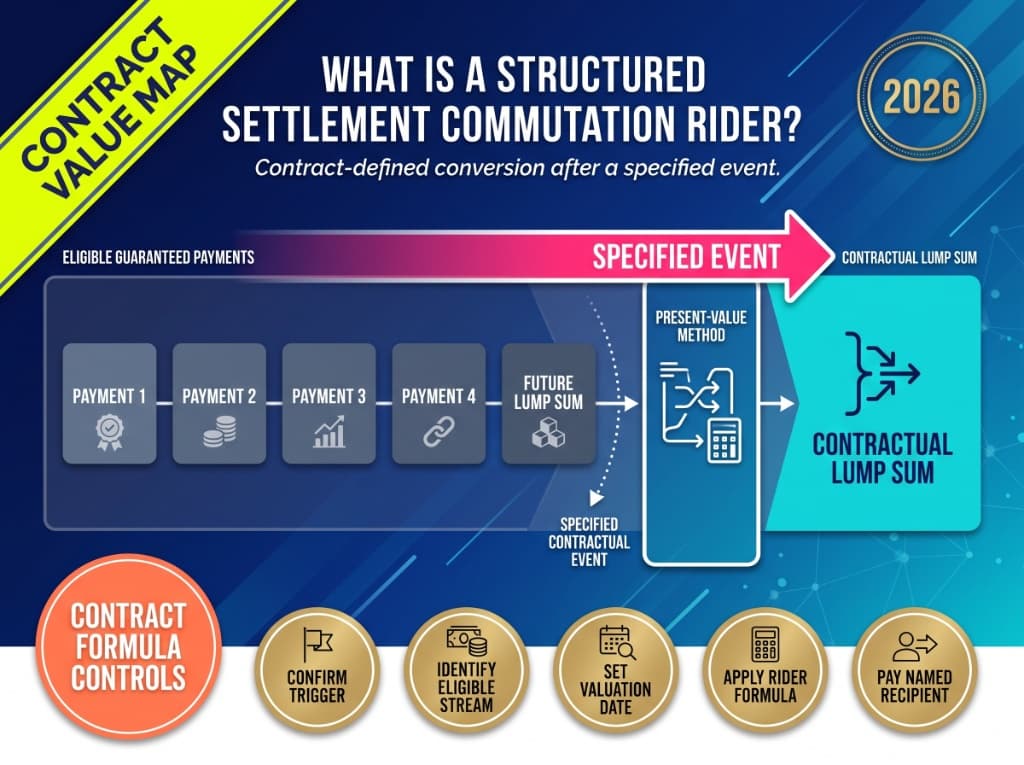
Direct answer: a structured settlement commutation rider is a provision that may convert eligible remaining payments into a lump sum when its specified trigger occurs. The rider—not a generic industry formula—determines the trigger, valuation, percentage, recipient and payments included.
Interactive contract illustration
Commutation Value Waterfall
See why the sum of future scheduled payments, their present value and a rider's calculated lump sum are different figures.
Your contract controls
This model uses a standard present-value formula for education. An actual rider can define a different discount method, percentage, trigger, payee, valuation date and eligible payment set.
Undiscounted scheduled total
$300,000
Illustrative present value
$235,703
Illustrative rider payment
$212,133
Timing difference
$64,297
Difference between the undiscounted stream and this model's present value.
Rider-percentage difference
$23,570
Difference created by applying the selected percentage to present value.
Illustration result
$212,133
This is not a quote, cash value, guaranteed death benefit, sale offer or prediction of an insurer's calculation.
Eligible payments
Present-value method
Rider percentage
What does commutation mean?
In this context, commutation means replacing a series of future payments with a single calculated payment. The future installments stop to the extent they are included in the commutation, and the contract pays the person, estate or trust identified under the governing documents.
The most familiar structured settlement commutation provision is triggered by the death of the measuring life while guaranteed payments remain. Instead of requiring the recipient or estate to wait years for every remaining guaranteed installment, the rider may provide a present-value lump sum.
This is not universal. Some structured settlement annuities have no commutation rider. Others use different triggers, percentages, valuation dates or recipients. Product availability and contract language can also vary by issuing company and state.
The five moving parts
Trigger
The event that activates the provision.
Eligible stream
The payments subject to commutation.
Valuation
How present value is determined.
Percentage
How much of the calculated value is payable.
Recipient
The estate, trust or other named payee.
Guaranteed payments versus life-contingent payments
The distinction between guaranteed and life-contingent payments is essential. A guaranteed or period-certain payment remains payable on its scheduled date even if the measuring life dies before that date. The beneficiary or other designated recipient can therefore have a right to the remaining guaranteed installments.
A life-contingent payment exists only while the measuring life remains alive. When that person dies, the future life-contingent obligation ends. Because no post-death payments remain under that feature, there ordinarily is no remaining life-contingent stream to convert.
| Payment feature | After measuring life dies | Commutation relevance |
|---|---|---|
| Guaranteed installments | Continue for the guaranteed term | May be included if the rider says so |
| Guaranteed future lump sums | Remain payable on scheduled dates | May be included under the formula |
| Life-contingent payments | End when the measuring life dies | Ordinarily no post-death value remains |
| Mixed payment stream | Treatment differs by component | Documents must separate each component |
Why present value is lower than the scheduled total
Adding every remaining payment produces an undiscounted scheduled total. That number treats a dollar payable many years from now as though it were available today. A present-value calculation instead recognizes payment timing by discounting future amounts to a valuation date.
The discount rate matters. A higher discount rate generally produces a lower present value, while a lower rate generally produces a higher present value. Payment frequency and timing also matter because a payment due next month is discounted for less time than one due in twenty years.
The rider may then apply a percentage to the contract-defined present value. Therefore, three figures must not be confused: the sum of remaining scheduled payments, the calculated present value and the final commutation amount.
Illustrative payment waterfall
Stage one
Identify eligible payments
Separate guaranteed payments covered by the rider from life-contingent or otherwise excluded payments.
Stage two
Calculate present value
Apply the rider's valuation method, rate source, timing rules and valuation date.
Stage three
Apply the rider percentage
Apply the contractual percentage and any additional conditions before determining the payment.
The settlement documents must work together
A structured settlement commonly involves several related documents: the settlement agreement and release, qualified assignment, annuity contract, payment schedule, beneficiary designation and any rider endorsement. A commutation provision should not be interpreted from a marketing summary alone.
The documents should consistently address which payments are subject to commutation and who receives the proceeds. Inconsistent beneficiary, estate or trust language can produce delay at the exact moment the rider was intended to provide liquidity.
Review 1
Settlement agreement
Does it authorize or require commutation?
Review 2
Qualified assignment
Does the assigned obligation reflect the same terms?
Review 3
Annuity contract
Which payment promises fund the settlement obligation?
Review 4
Rider endorsement
What are the trigger, formula and eligible payments?
Review 5
Beneficiary record
Who receives remaining benefits under current records?
Review 6
Trust documents
Does a trustee receive or control the payment?
Why special needs trusts may require extra planning
When structured settlement payments are directed to a special needs trust or supplemental needs trust, death can create expenses, administration costs and potential government-benefit reimbursement obligations. A commutation provision may be considered as a source of estate or trust liquidity.
But automatically converting every guaranteed payment may have tradeoffs. Commutation can produce less than the total amount that would have been paid over time. If the trust has sufficient liquid assets, the consequences may differ from a trust facing an immediate shortfall.
Trust-specific riders and responsive formulas can be complex. The trustee, settlement planner, benefits attorney and tax professional should review the exact language before settlement documents become final.
Commutation is not a factoring transaction
| Question | Commutation rider | Payment-rights sale |
|---|---|---|
| Source of right | Existing contract provision | Later transfer agreement |
| Common trigger | Specified event, often death | Recipient seeks current liquidity |
| Calculation | Contract-defined formula | Purchaser's transaction offer |
| Court review | Not inherently a factoring petition | Generally required by protection law |
| Timing | Designed with original settlement | Requested after settlement |
Tax treatment needs separate review
A commutation rider does not by itself determine federal tax treatment. Internal Revenue Code Section 104 addresses exclusions for qualifying personal physical injury or physical sickness damages, whether received as lump sums or periodic payments. Other claims and nonqualified settlements can be treated differently.
The recipient, underlying claim, settlement language, assignment, estate administration and trust arrangement can all matter. Pacific Life's published material for nonqualified structured settlements, for example, describes payments as containing return of purchase amount and taxable earnings and separately notes the availability of a commutation rider.
Do not assume that a post-death lump sum is automatically tax-free, taxable, included in an estate or excluded from an estate. Those conclusions require review of the complete transaction and current law.
Questions to ask before agreeing
What event activates the rider?
Which guaranteed payments are included?
Are future lump sums included or excluded?
What present-value method and rate source apply?
What percentage of calculated value is payable?
Who receives the lump sum?
Can the election be changed after issuance?
What happens to payments not commuted?
How does the rider coordinate with a trust?
What tax and estate review has been completed?
Frequently asked questions
What is a structured settlement commutation rider?+
It is a contractual provision that may convert specified future payments into a lump sum after a defined trigger. The exact rider controls every material term.
Does the rider pay all remaining scheduled dollars?+
Not necessarily. The rider may first calculate present value and then apply a stated percentage, so the result can be lower than the undiscounted total.
Can life-contingent payments be commuted after death?+
Payments that end at death ordinarily leave no remaining post-death obligation. Riders generally focus on guaranteed or period-certain payments, subject to the contract.
Can I activate the rider because I need cash now?+
Usually not. A death-triggered rider operates only after its contractual event and is not a recipient-controlled early withdrawal feature.
Can a rider be added after the annuity is issued?+
Do not assume it can. Commutation is generally coordinated in the settlement, assignment and annuity documents when the structure is established.
Is court approval always required for commutation?+
Not merely because a pre-existing rider operates according to its terms. Separate probate, guardianship, trust or other legal procedures may still apply.
Who receives the commutation payment?+
The rider and related beneficiary, estate or trust documents determine the recipient. It should never be inferred from the word beneficiary alone.
Sources and primary references
Bottom line
A commutation rider is a prearranged contract mechanism—not an ordinary withdrawal feature. It may convert eligible guaranteed payments into a lump sum after a defined event using a contract-specific present-value method and percentage. Review the rider together with the settlement agreement, assignment, annuity, beneficiary designation and any trust documents.
Get Free Competing Offers Save $3K$12K
Compare pre-screened professionals in 60 seconds. No obligation.
What type of settlement or claim do you have?
Select the category that best matches your situation
This article and interactive model provide general educational information, not legal, tax, estate-planning, benefits, insurance or financial advice. The issued contract and governing law control.