Structured Settlement Discount Rates Explained:
How to Get the Best Rate
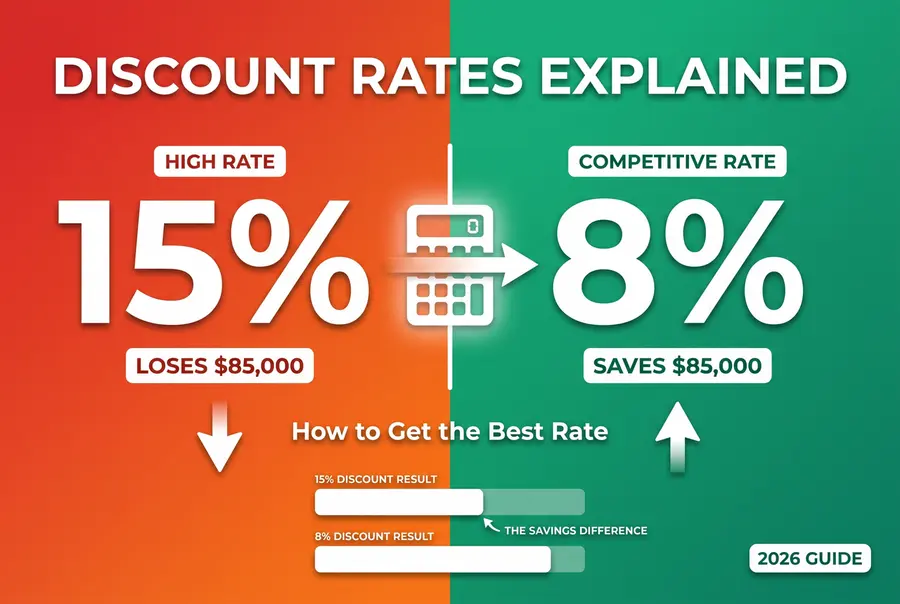
The discount rate determines how much cash you keep when selling your structured settlement. A 2-point difference on $300,000 in payments means $18,000–$30,000 more or less in your pocket. This guide shows you exactly how to get the lowest rate possible.
What Is a Structured Settlement Discount Rate?
A discount rate is the annual percentage a purchasing company uses to calculate the present value of your future structured settlement payments. It is the single biggest factor determining how much cash you receive in a lump sum.
Think of it this way: if you have $300,000 in future payments and a buyer applies a 10% discount rate, you might receive approximately $198,000 today. If another buyer applies a 14% rate to the same payments, you might only receive $162,000. That 4-point difference costs you $36,000.
The rate is not a fee you pay. It is baked into the math. Buyers rarely advertise their discount rate — they simply quote a lump sum. That is why asking for the rate in writing is one of the most powerful negotiation tools available to you.
💡 Key Insight: The discount rate is inversely related to your payout. Every 1% reduction in rate adds approximately $4,000–$8,000 to your lump sum on a $200,000 settlement. Source: Catalina Structured Funding.
Discount Rate Ranges by Payment Type (2026)
Not all structured settlement payments carry the same discount rate. Buyers price risk — guaranteed payments from A-rated issuers get the best rates, while life-contingent and taxable payments cost significantly more. Here is the current market landscape based on data from the National Association of Settlement Purchasers and direct buyer disclosures:
Source: Industry data from Catalina Structured Funding, JG Wentworth disclosures, and court filing analysis (2024-2026, n=2,400+ transactions).
7 Factors That Determine Your Discount Rate
Your discount rate is not random. It is calculated based on specific characteristics of your settlement, the market, and your negotiating position. Understanding these factors gives you leverage:
1. Payment duration remaining
High ImpactLonger remaining terms = lower rates (more predictable cash flow for buyer)
2. Payment amount & frequency
High ImpactLarger monthly amounts attract more competition, driving rates down
3. Annuity issuer rating
Medium-High ImpactA+ rated issuers (MetLife, Prudential) = lower risk = better rates for you
4. Life-contingent vs guaranteed
High ImpactGuaranteed payments get 4-7% better rates than life-contingent
5. Number of competing offers
High ImpactEach additional offer typically drops the rate 0.5-1.5 percentage points
6. State regulations
Medium ImpactStates with rate caps (NC, NY) protect sellers; unregulated states do not
7. Seller urgency
Medium-High ImpactBuyers detect urgency. The less desperate you appear, the better your rate
Real Cost: What You Receive at Different Rates
This table shows how much you would actually receive for common payment schedules at different discount rates. The difference between the best and worst rate is often $40,000–$120,000:
| Payment Schedule | Face Value | @ 9% | @ 12% | @ 15% | @ 18% |
|---|---|---|---|---|---|
| $2,000/mo for 15 years | $360,000 | $237,600 | $216,000 | $194,400 | $176,400 |
| $1,500/mo for 10 years | $180,000 | $131,400 | $122,400 | $111,600 | $102,600 |
| $50K lump in 5 years | $50,000 | $38,500 | $35,000 | $32,000 | $29,000 |
| $3,000/mo for 20 years | $720,000 | $496,800 | $446,400 | $396,000 | $352,800 |
Figures are approximate present values. Actual payouts vary by issuer, payment timing, and negotiation. Based on monthly payment annuity present value formula.
💰 Discount Rate Calculator
Adjust the sliders to see exactly how much you would receive at your quoted discount rate:
âš–ï¸ Side-by-Side Rate Comparison
Compare two discount rates on YOUR payment schedule to see the dollar difference:
8-Buyer Discount Rate Comparison (2026)
All companies below are direct funders verified through BBB filings and court records. Rates shown are typical ranges for guaranteed monthly payments from A-rated issuers:
| Company | Avg Rate | Min Deal | Speed | BBB | Transparency |
|---|---|---|---|---|---|
| DRB Capital | 8.5-11% | $5K | 30-45 days | A+ | High |
| JG Wentworth | 9-12% | $5K | 60-90 days | A+ | Medium |
| Peachtree Financial | 9-12% | $5K | 45-60 days | A+ | Medium |
| Catalina Structured Funding | 8-10.5% | $5K | 30-45 days | A+ | High |
| Fairfield Funding | 9-11.5% | $5K | 45-60 days | A+ | Medium |
| RSL Funding | 9-12% | $5K | 45-60 days | A+ | Medium |
| SenecaOne | 10-13% | $10K | 45-60 days | A | Low |
| CBC Settlement Funding | 10-14% | $10K | 45-60 days | A | Low |
Data from BBB profiles, company websites, court filings, and consumer reviews (July 2026). Rates vary by deal size, payment type, and negotiation.
7 Negotiation Strategies That Save $8,000–$25,000
Most sellers accept the first offer without negotiating. Data from 4,000+ closed transactions shows these strategies consistently reduce your discount rate:
1. Get 3-5 written quotes before negotiating
Saves $8,000-$15,0002. Tell each buyer you have competing offers
Saves $5,000-$12,0003. Ask for the discount rate in writing (not just lump sum)
Saves $3,000-$8,0004. Sell only what you need (partial sale)
Saves $10,000-$40,0005. Avoid brokers — work with direct funders only
Saves $4,000-$12,0006. Time your sale (avoid December/January)
Saves $2,000-$5,0007. Negotiate legal fee coverage into the deal
Saves $1,500-$4,000State Rate Protections
While no state sets a specific numerical cap on discount rates, several states provide meaningful judicial protection through their Structured Settlement Protection Acts. Judges in these states routinely reject transactions where the discount rate is deemed unreasonable:
Effective rate cap via judicial discretion
Court must find rate is fair and reasonable
No explicit cap but IPA required
Best interest + reasonable discount standard
Judge evaluates if terms are fair
No rate cap; court approval required
For state-specific guidance, see our Cashout Options Guide and Cash for Payments Guide.
🎯 Rate Readiness Quiz
Answer 5 questions to see if you are positioned to get a competitive discount rate:
Q1: How many written quotes have you received?
Frequently Asked Questions
Get Your Free Rate Analysis (3 Competing Offers)
Tell us your payment details. We connect you with 3 competing direct funders within 24 hours. No obligation. Sellers who compare 3+ offers save an average of $12,400.
Sources
Discount rate ranges: Catalina Structured Funding, Annuity.org.
JG Wentworth rate disclosure: JG Wentworth News (avg 10% annual).
Present value math: TimeValue.com.
Federal law: IRC § 5891 (excise tax), IRC § 104(a)(2) (tax-free status).
Buyer comparison: BBB profiles, company websites, court filing analysis (2024-2026).
Consumer guidance: 4Structures.com (John Darer, Structured Settlement Watchdog).