
Mortgage income documentation guide
Can Structured Settlement Payments Help You Qualify for a Mortgage?
Yes, documented recurring payments may help—but tax treatment, payment duration, guarantees and underwriting documentation are separate questions.
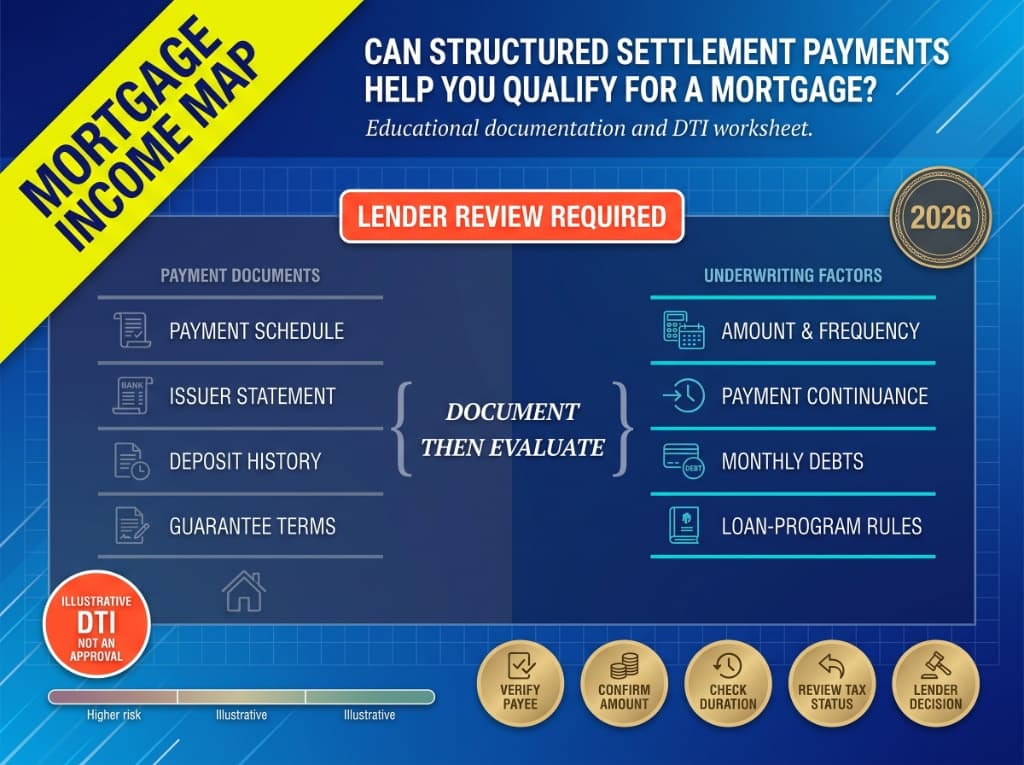
Direct answer: a structured settlement payment stream may be usable as mortgage qualifying income when the lender can verify the payment amount, frequency, entitlement and required continuance. The existence of an annuity does not guarantee approval.
Interactive underwriting worksheet
Structured Settlement Mortgage Income Lab
Test how payment duration, documented monthly income, debts and a proposed housing payment interact. This tool does not issue an approval or reproduce any lender's complete underwriting system.
Illustrative continuance screen
At least 36 months remain
Many conventional underwriting rules require income used for qualification to be expected to continue for at least three years. Passing this screen does not guarantee that the income is acceptable.
Settlement income used
$2,800
illustrative monthly
Total income modeled
$7,000
illustrative monthly
Modeled back-end DTI
40.7%
Housing + debts ÷ modeled income
Housing ratio
31.4%
Settlement share of raw income
40.0%
This is not an approval calculator
Loan type, credit, assets, property, reserves, payment history, insurance, taxes, lender overlays and automated underwriting can change the result. No universal DTI cutoff applies to every borrower or mortgage.
Why lenders may recognize structured settlement payments
Mortgage underwriting is designed to determine whether a borrower has stable, documented income and a reasonable ability to repay the proposed loan. A structured settlement can produce recurring payments under a written settlement agreement, qualified assignment and annuity schedule. Those records can provide evidence that is different from ordinary employment income but still potentially useful in underwriting.
The lender does not merely ask whether money reaches your bank account. It asks who is legally entitled to receive it, how much is payable, how often it is paid, whether the amount changes, whether payment depends on survival and how long the stream will continue. A predictable monthly payment with clear documentation is generally easier to evaluate than an uncertain future payment.
Fannie Mae's current guidance for annuity, pension or retirement income identifies acceptable documentation such as an issuer statement, benefit statement, bank statement, tax return, W-2 or 1099. Its guidance distinguishes fixed payments from variable distributions and requires certain annuity income to continue for at least three years from the mortgage note date. A lender must still decide how the specific structured settlement fits the applicable income category.
The five-part underwriting test
Right to receive
Are the payments legally payable to the borrower?
Amount
What fixed or variable amount can be documented?
Frequency
Monthly, quarterly, annual or irregular?
Continuance
Will qualifying payments last long enough?
Consistency
Do deposits and documents tell the same story?
Payment continuance can be the deciding issue
A borrower may receive a substantial payment today yet have little or none of it counted if the stream ends too soon. Current Fannie Mae guidance states that income from an insurance or personal annuity used for qualification generally must be documented as continuing for at least three years from the note date. Freddie Mac likewise describes stable monthly income as income reasonably expected to continue for at least the next three years.
This does not mean the mortgage itself must be repaid within the remaining settlement term. It means the income must satisfy the program's minimum continuance requirement when the loan is underwritten. A stream ending thirty months after closing may receive different treatment from one ending ten years later.
Bring the exact payment schedule. A bank statement showing recent deposits cannot establish the final payment date. Conversely, a schedule alone may not prove that deposits are currently being received when payment history is required.
Guaranteed and life-contingent payments are not identical
Guaranteed payments remain due on their scheduled dates without requiring the measuring life to survive. Life-contingent payments depend on the measuring person remaining alive. That distinction can affect how confidently an underwriter can establish continuance.
A lifetime stream may appear to have no stated ending date, but it contains a survival condition. The lender may request the annuity contract, payment letter or other issuer documentation describing that condition. Do not describe a payment as guaranteed merely because it has arrived reliably for many years.
Fixed, increasing and irregular payment schedules
| Payment pattern | Likely underwriting question | Useful documentation |
|---|---|---|
| Fixed monthly | Amount and remaining duration | Issuer letter, schedule and deposits |
| Predetermined increases | Which amount may be used now? | Complete step-up schedule |
| Annual payment | How should it be converted monthly? | Payment record and governing agreement |
| Future lump sum | Income, asset, reserve or unavailable? | Date, amount, guarantee and access terms |
| Life-contingent | Can sufficient continuance be supported? | Issuer confirmation and contract terms |
Can nontaxable payments be adjusted upward?
Some loan programs permit verified nontaxable income to be “grossed up,” meaning the lender uses an adjusted amount to reflect the fact that no equivalent income-tax withholding reduces the payment. This is an underwriting calculation, not additional money received by the borrower.
Fannie Mae's general income guidance states that a lender must verify that the particular income is nontaxable and that both the income and its tax-exempt status are likely to continue. Its published guidance describes adding an amount equivalent to 25% of qualifying nontaxable income, subject to its full requirements.
Never assume every structured settlement is tax-free. Federal tax treatment depends primarily on the underlying claim and what the damages were intended to replace. Employment claims, punitive damages, interest and nonphysical claims can receive different treatment. Supply the lender with reliable documentation and obtain tax advice when the characterization is uncertain.
Documents to prepare before applying
DOCUMENT 1
Settlement agreement
Shows the underlying obligation and payment terms.
DOCUMENT 2
Qualified assignment
Identifies the assigned payment obligation when applicable.
DOCUMENT 3
Current annuity schedule
Lists amounts, dates, guarantees and survivorship terms.
DOCUMENT 4
Issuer benefit letter
Confirms the current payment amount and frequency.
DOCUMENT 5
Bank statements
Show actual deposits and help reconcile the payment history.
DOCUMENT 6
Tax documentation
Supports any claimed nontaxable treatment or reporting position.
DOCUMENT 7
Identity and payee records
Confirm that the borrower is entitled to receive the income.
DOCUMENT 8
Transfer orders
Show which rights remain after any prior factoring transaction.
Prior sales of payment rights can change the answer
If you previously sold some structured settlement payments, the original schedule may no longer show what you currently own. The mortgage lender needs the remaining payment rights, not the gross schedule that existed before the transfer.
Provide the final transfer order, servicing records and a current issuer or servicer statement. Payments assigned to a factoring company should not be presented as the borrower's continuing income. A partial transfer may leave other payments intact, but the dates and amounts must be reconciled precisely.
Structured settlement income does not replace the full mortgage review
Acceptable income is only one part of qualification. The lender may evaluate credit history, monthly obligations, down payment, reserves, loan-to-value ratio, occupancy, property type, appraisal, homeowners insurance, taxes and mortgage insurance. Automated underwriting and lender-specific overlays can also affect the result.
Debt-to-income ratio is generally calculated by dividing applicable monthly obligations by gross monthly qualifying income. The proper debts, housing expenses and income amounts are determined under the selected program. A consumer calculator can help organize questions, but it cannot reproduce the lender's final analysis.
Common mistakes to avoid
Showing only bank deposits
Deposits prove receipt but may not establish entitlement, guarantees or the final payment date.
Calling every payment tax-free
Tax character depends on the underlying claim and supporting documents.
Ignoring the end date
A reliable payment can still be excluded if it does not satisfy required continuance.
Using sold payments
Previously transferred rights are not income still payable to the borrower.
Treating lump sums as monthly income
Future lump sums may receive different treatment from recurring payments.
Assuming a calculator means approval
Income ratios are only one part of underwriting and program eligibility.
Frequently asked questions
Can structured settlement payments count as mortgage income?+
They may count when the lender can verify the amount, frequency, entitlement and required continuance under the applicable program. The lender makes the final determination.
Must the payments continue for the full mortgage term?+
Not necessarily. Many conventional rules focus on whether qualifying income will continue for at least three years, rather than for the entire 15- or 30-year loan term.
Can payments beginning after closing be counted?+
Some annuity guidance allows income scheduled to begin on or before the mortgage's first payment date when the required benefit statement confirms the type, amount, frequency and start date. The lender must apply the relevant rule.
Can tax-free settlement income be grossed up?+
Possibly. The lender must verify that the income is nontaxable, likely to continue and eligible for adjustment under the selected program.
Do life-contingent payments qualify?+
They may require additional analysis because payment depends on the measuring life. The issuer's documents and the loan program control the result.
Will a future lump sum help with a down payment?+
It may help only if it is available, documented and acceptable under source-of-funds rules at the required time. A payment due after closing generally is not current cash for closing.
What if I sold only part of my payments?+
Provide the court order and a current payment statement showing exactly which payments remain payable to you.
Authoritative sources
Bottom line
Structured settlement payments can potentially support a mortgage application when they are legally payable to the borrower, documented, stable and expected to continue for the period required by the loan program. The strongest application connects the current schedule, issuer verification, deposit history, tax treatment and any prior transfer orders into one consistent record.
Get Free Competing Offers Save $3K$12K
Compare pre-screened professionals in 60 seconds. No obligation.
What type of settlement or claim do you have?
Select the category that best matches your situation
This article and calculator provide general educational information, not mortgage, legal, tax or financial advice. Lending requirements change, and individual lenders may apply additional standards.