Payment-documentation guide
How to Get a Structured Settlement Income Verification Letter
Learn whom to contact, what information to request, what documents to prepare and why one verification letter may not satisfy every lender, landlord or government program.
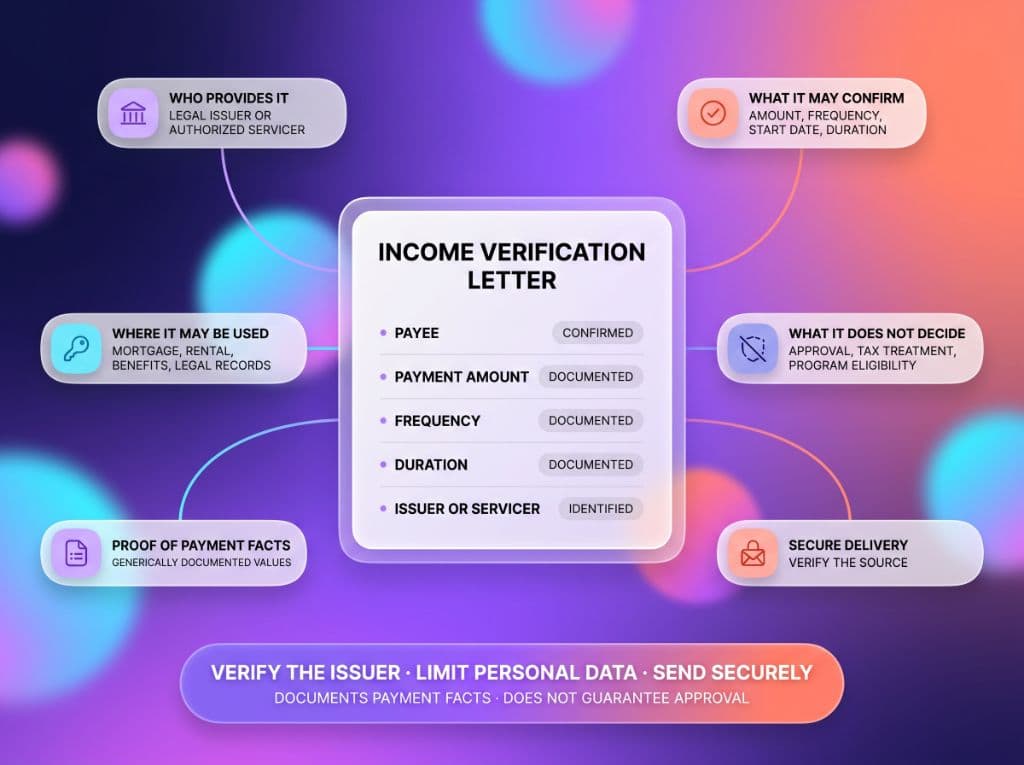
Direct answer: request a current written verification from the legal annuity issuer or its authorized structured settlement administrator. Identify the purpose of the request and ask for the payment amount, frequency, duration and payee information needed by the receiving organization.
Interactive document-request planner
Verification Letter Request Builder
Choose why you need verification, identify the useful fields, and prepare before contacting the annuity issuer or current servicer.
Intended recipient
Mortgage lender or loan processor
Useful information to request
- Current gross payment amount
- Payment frequency
- Initial payment date
- Scheduled ending date or duration
- Whether the amount is fixed or changes
- Issuer or administrator contact information
Important limitations
- A verification letter does not guarantee underwriting acceptance.
- The lender may request contracts, deposits or tax documents separately.
- Tax treatment and qualifying-income treatment are separate questions.
Request readiness
0 of 6 prepared
Suggested request
“Please provide a current written verification of my structured settlement payments for use by a mortgage lender or loan processor. Please identify the payee, current gross payment amount, frequency, remaining duration or scheduled ending date, and the legal issuer or authorized administrator. Please tell me if a separate authorization form is required.”
Do not include a full Social Security number, bank credentials or medical history in an ordinary email.
What is a structured settlement verification letter?
A structured settlement income verification letter is a document from an annuity issuer or authorized administrator confirming information about scheduled payments. It may be called an income verification letter, benefit verification letter, payment verification, proof-of-income letter or annuity payment statement.
The terminology varies by company. Prudential, for example, provides an online process through which structured settlement contract holders can view, print or download an income verification letter. Other companies may require a telephone request, secure portal, written form or identity verification.
The letter confirms information maintained by the company. It does not change the annuity, guarantee approval by a third party, decide tax treatment or create payment rights absent from the governing documents.
Who should issue the letter?
Start with the legal annuity issuer or the company currently authorized to administer the structured settlement. The name on a recent deposit may be a parent brand, affiliate, successor company or payment processor, so compare it with the contract and official company-change notices.
If the original company merged or changed names, trace the predecessor to the current legal successor. The current servicer may issue the letter on behalf of the responsible insurer. Confirm that relationship rather than assuming every company appearing in correspondence is the annuity issuer.
A broker, attorney or factoring company may possess copies of records, but its letter is not necessarily issuer verification. When a lender or agency specifically requests issuer confirmation, obtain it from the insurer or authorized administrator.
Information commonly included
Payee identity
The person or entity currently receiving the payments.
Payment amount
The gross amount payable for the identified recurring payment.
Frequency
Monthly, quarterly, semiannual, annual or another schedule.
Start date
When the recurring payment stream began or will begin.
Duration
The ending date, remaining term or applicable payment period.
Payment pattern
Whether payments are fixed, increasing, guaranteed or life-contingent.
Not every issuer includes every field in its standard letter. Ask the receiving organization what it needs before submitting the request. A custom request may require additional processing, authorization or supporting documentation.
How to request the letter
Step 1
Identify the current company
Use the contract, recent statement and official merger or servicing notices.
Step 2
Verify the contact channel
Use the issuer's official website, existing portal or independently verified telephone number.
Step 3
Prepare identification
Have the payee name, contract number and identity-verification information available.
Step 4
State the purpose
Explain whether the letter is for a mortgage, rental, benefits review, court or personal records.
Step 5
Request the needed fields
Specify amount, frequency, duration, start date and other required details.
Step 6
Choose secure delivery
Use the issuer's portal, encrypted delivery, mail or another approved method.
Step 7
Review the letter
Check names, dates, amounts and payment terms before forwarding it.
Step 8
Save confirmation
Keep the request date, reference number and final letter with the contract records.
Using the letter for a mortgage
Mortgage lenders analyze whether income is documented, stable and expected to continue for the period required by the loan program. Fannie Mae's current guidance for annuity income permits documentation such as a statement from the organization providing the income, a benefit statement, bank statement, tax return, W-2 or 1099.
For fixed annuity distributions, Fannie Mae states that no minimum receipt history is required, while variable distributions generally require a twelve-month history. Its guidance also requires certain annuity income used for qualification to continue for at least three years from the note date.
A verification letter can address amount, frequency and continuance, but the lender may still request the payment schedule, settlement documents, bank deposits or tax evidence. It may also ask whether payments are guaranteed or dependent on the measuring life.
Using the letter for benefits or public programs
A benefits agency may request payment verification to determine how an award is treated under its own rules. The verification letter supplies facts; it does not decide whether a payment counts as income, a resource, excluded property or trust income.
Ask the agency which payment periods, lump sums, guarantees and trust arrangements must be documented. Do not assume that federal tax exclusion means a payment is ignored for SSI, Medicaid or another means-tested program.
Verification letter versus other records
| Document | What it helps establish | What it may not establish |
|---|---|---|
| Verification letter | Current payment facts | Complete legal or tax analysis |
| Payment schedule | Dates, amounts and payment pattern | Current receipt by itself |
| Bank statements | Recent deposits | Future payment duration |
| Settlement agreement | Underlying obligation and claim terms | Current servicing information |
| Qualified assignment | Assignment company and obligation | Every later administrative change |
| Tax form or return | Reported tax information | Complete future schedule |
If you previously sold part of the payments
A historical payment schedule may include installments that were later transferred. If you completed a factoring transaction, request verification of the payments that remain payable to you—not merely a copy of the original schedule.
The issuer or servicer may need the final transfer order and its internal payment records to reconcile the remaining stream. Review the verification letter carefully so a lender, agency or court does not rely on payments that now belong to a purchaser.
Privacy and fraud precautions
Verification requests can involve Social Security numbers, dates of birth, contract numbers and bank information. Use the issuer's official portal, verified fax number or mailing address rather than sending sensitive documents to an unconfirmed email address.
A legitimate verification process may require identity checks. However, it should not require payment by gift card, cryptocurrency or wire transfer. Independently verify unexpected requests before providing personal data.
Frequently asked questions
How do I obtain proof of structured settlement income?+
Contact the legal annuity issuer or authorized administrator and request a current income or payment verification letter.
What information should I have before calling?+
Prepare the payee's legal name, contract or policy number, current address, payment amount if known, purpose of the request and secure delivery details.
Can I download the letter online?+
Some issuers provide online access. Prudential, for example, offers structured settlement income verification through its website. Other issuers use forms, telephone requests or secure portals.
Is the letter sufficient for mortgage qualification?+
Not necessarily. A lender may also request the annuity schedule, settlement agreement, bank statements and evidence that the income will continue.
Does the letter prove the payments are tax-free?+
No. Payment verification and tax characterization are different inquiries.
What if the annuity company changed names?+
Trace the original issuer to its legal successor and confirm which company currently services the contract.
How recent must the letter be?+
The requesting organization sets its own recency requirement. Ask before ordering the letter and request a newly dated version when necessary.
Official and primary resources
Bottom line
Request structured settlement income verification from the legal annuity issuer or authorized administrator. Tell the company why you need the letter, specify the required payment fields, verify the company's contact channel and expect the receiving organization to request supporting records when necessary.
Get Free Competing Offers Save $3K$12K
Compare pre-screened professionals in 60 seconds. No obligation.
What type of settlement or claim do you have?
Select the category that best matches your situation
This guide provides general educational information, not legal, tax, mortgage, benefits or financial advice. The issuing company, receiving organization, governing documents and applicable rules determine what verification is required.