
Structured settlement role guide
Annuity Owner vs. Payee vs. Beneficiary: Who Controls What?
Receiving structured settlement payments does not necessarily mean you own the annuity—and being named as beneficiary does not create control over current payments.
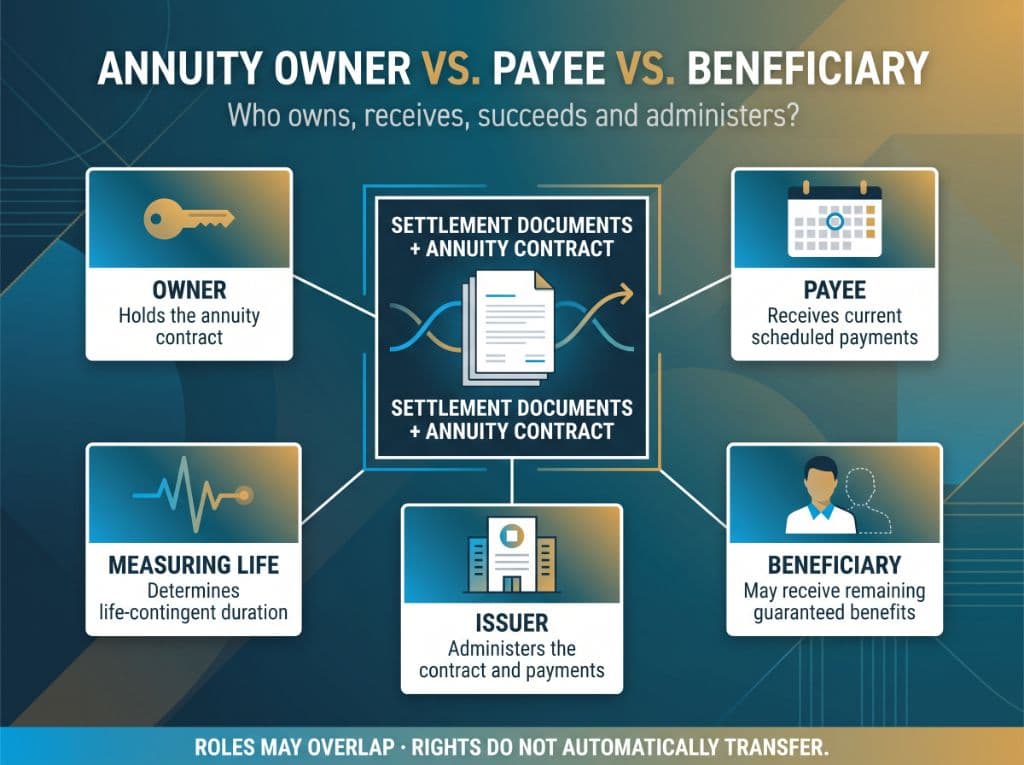
Direct answer: the owner holds the annuity contract, the payee receives scheduled payments, and the beneficiary may receive qualifying guaranteed payments later. These roles can belong to different people or entities and carry different rights.
Interactive contract-role explorer
Who Controls What?
Select a role to see its usual authority and limits. The issued documents control when your arrangement differs.
Selected role
Payment recipient
The person, trust or other recipient to whom scheduled payments are directed. A payee can receive money without owning the annuity that funds it.
Typical authority or function
- Where permitted, address and direct-deposit instructions
- Claim and identity documentation
- Beneficiary instructions if authorized by the contract
Does not automatically control
- Changing fixed payment dates or amounts at will
- Withdrawing an annuity cash value that is not personally owned
- Redirecting restricted payments without required authority
Documents to check
- Payment schedule
- Issuer records
- Direct-deposit form
- Settlement agreement
| Action or right | Owner | Payee | Beneficiary |
|---|---|---|---|
| Receive scheduled payments now | Not necessarily | Usually | No, until entitled |
| Own the funding annuity | Yes | Often no | No |
| Change bank instructions | Sometimes | Often, if permitted | After entitlement |
| Change payment dates or amounts | Restricted | Generally no | No |
| Receive remaining guaranteed payments | Not as recipient | While entitled | After trigger |
| Receive life-contingent payments after death | No | No | No |
“Usually,” “often” and “sometimes” are intentional. Contract forms, settlement terms, assignments, trusts, court orders and state law can alter administrative authority.
Why these roles are easy to confuse
Ordinary retail annuities often place ownership, payment and beneficiary decisions in the hands of one purchaser. A qualified structured settlement commonly works differently because the annuity is a funding asset supporting a separate legal obligation to make periodic payments.
In a typical qualified assignment, the defendant or insurer assigns its periodic-payment obligation to an assignment company. The assignment company purchases and owns an annuity whose payments correspond to that obligation. The issuing life insurance company then sends scheduled payments to the claimant or another designated payee.
The person receiving the checks can therefore be the payee without being the owner of the annuity contract. That distinction explains why the recipient may update an address or bank account but usually cannot withdraw the annuity, surrender it or rewrite its schedule.
Role 1: the annuity owner
The owner is the person or entity identified in the annuity contract as holding the contractual ownership interest. In many qualified structured settlements, the owner is the assignment company that assumed the defendant's periodic-payment obligation.
Ownership does not mean the owner may disregard the settlement agreement or assignment. The annuity exists to fund scheduled payment obligations. The owner's rights are therefore read together with the settlement, assignment, tax requirements, endorsements and any applicable court order.
Nonqualified arrangements, attorney-fee structures, installment sales and trust-owned contracts can use different ownership models. Never infer ownership solely from who receives the payment.
Role 2: the payee
The payee is the person, trust, estate, guardian account or other recipient to whom the issuer directs scheduled payments. The payee may be the injured claimant, but that is not required in every arrangement.
Payees commonly handle administrative matters such as identity verification, mailing addresses, direct-deposit instructions and tax forms. Those service rights do not necessarily include ownership rights.
Internal Revenue Code Section 130 requires qualified periodic payments to be fixed and determinable as to amount and time. It further provides that the recipient cannot accelerate, defer, increase or decrease those payments. Consequently, an address change is fundamentally different from a schedule change.
Role 3: the beneficiary
A beneficiary is a successor recipient named to receive benefits that remain payable after a specified death. Beneficiary status ordinarily creates an expectancy while the current payee is alive, not present ownership of the payment stream.
The beneficiary's actual rights depend on whether payments are guaranteed. If a monthly payment is guaranteed for twenty years and the measuring life dies in year twelve, the contract may continue the remaining guaranteed payments to the effective beneficiary. If a payment is purely life-contingent, it ends at death and leaves nothing from that feature for the beneficiary.
MetLife's structured settlement materials explain that guaranteed structured settlement payments can be received by a named beneficiary. Pacific Life likewise provides beneficiary service materials for structured settlement contract payees and owners. The actual contract and current designation remain controlling.
Measuring life is a separate role
The measuring life is the person whose survival determines whether a life-contingent payment continues. The measuring life is often also the claimant and payee, but the concepts are not identical.
A trust might receive payments measured by an injured individual's life. In that arrangement, the trust is the payee, while the individual is the measuring life. Being the measuring life does not itself establish ownership of the annuity or authority over trust funds.
The issuer administers rather than rewrites
The issuing life insurance company administers the annuity contract. It processes scheduled payments, direct-deposit changes, beneficiary records, death claims and other authorized service requests.
The issuer generally cannot rewrite the settlement bargain simply because a payee requests different payment dates. It must reconcile requests with the contract, ownership, assignment, court or trust restrictions and applicable law.
Who can change the beneficiary?
The correct answer comes from the issued documents. Some structured settlement arrangements permit a claimant or payee to change a revocable beneficiary through the issuer's administrative process. Others restrict that authority or require action by an owner, trustee, guardian, court or another authorized party.
An irrevocable beneficiary, minor's settlement, special needs trust, divorce order, anti-assignment provision or court-approved structure may require additional analysis. A beneficiary form does not override a controlling settlement agreement or court order.
Contract authority
Who does the annuity identify as authorized to make the change?
Revocability
Is the existing designation revocable or irrevocable?
Court restrictions
Does an order limit changes involving a minor or protected person?
Trust authority
Must a trustee or successor trustee act?
Current records
Has the issuer accepted and recorded the latest designation?
Confirmation
Did the issuer provide written confirmation of completion?
Guaranteed does not always mean payable to the estate
Guaranteed payments remain contractually payable, but the recipient after death depends on the effective designation and contract. A named beneficiary may receive them directly. If no effective beneficiary survives, the contract may direct payment to the estate or apply another succession provision.
Probate treatment, creditor exposure, trust administration and tax reporting can differ depending on who receives the payment. Keep beneficiary records current and avoid assuming that a will alone overrides an annuity designation.
Quick comparison
| Role | Primary function | What it does not prove |
|---|---|---|
| Owner | Holds the annuity contract | Right to ignore settlement obligations |
| Payee | Receives current scheduled payments | Ownership of the funding annuity |
| Beneficiary | May receive remaining guaranteed benefits | Control over current payments |
| Measuring life | Determines life-contingent duration | Ownership or payment authority |
| Issuer | Issues and administers the annuity | Authority to rewrite the settlement |
Documents that answer the question
Document 1
Settlement agreement
Defines the payment obligation and negotiated terms.
Document 2
Qualified assignment
Identifies the assignee responsible for periodic payments.
Document 3
Annuity contract
Identifies the owner, issuer and funded payment schedule.
Document 4
Payment schedule
Separates guaranteed and life-contingent benefits.
Document 5
Beneficiary designation
Shows the successor recipient currently on record.
Document 6
Trust or court documents
May allocate authority to a trustee, guardian or court.
Frequently asked questions
Do I own my structured settlement annuity?+
Often not. In a typical qualified assignment, the assignment company owns the funding annuity while the claimant or another designated payee receives the payments.
Can the owner take my payments?+
The owner's rights are constrained by the annuity, settlement agreement, assignment and applicable law. Ownership should not be confused with an unrestricted right to disregard the payment obligation.
Can a payee change the payment schedule?+
Generally not in a qualified structure. Section 130 requires qualifying periodic payments to be fixed and prevents the recipient from accelerating, deferring, increasing or decreasing them.
Can a beneficiary receive lifetime payments after death?+
No. A life-contingent payment ends at the measuring life's death. A beneficiary may receive payments that remain guaranteed.
Can I change my beneficiary?+
Possibly, if the contract and related documents authorize the change. Irrevocable designations, trusts, minors and court orders can limit that authority.
Is the payee always the injured claimant?+
No. A trust, estate, guardian account or another authorized recipient may be the payee.
Does direct deposit prove annuity ownership?+
No. Direct deposit shows where payments are delivered, not who owns the funding contract.
Sources and references
Bottom line
Owner, payee and beneficiary are not interchangeable labels. The owner holds the annuity contract, the payee receives current payments, and the beneficiary may receive remaining guaranteed benefits later. The measuring life and issuer have separate functions. Read every role across the settlement agreement, assignment, annuity, beneficiary record and any trust or court documents.
Get Free Competing Offers Save $3K$12K
Compare pre-screened professionals in 60 seconds. No obligation.
What type of settlement or claim do you have?
Select the category that best matches your situation
This guide provides general educational information, not legal, tax, estate-planning, benefits or insurance advice. Contract language, settlement documents, court orders and governing law control.