How Strong Are the Protections When You Sell a Structured Settlement? A State-by-State Look
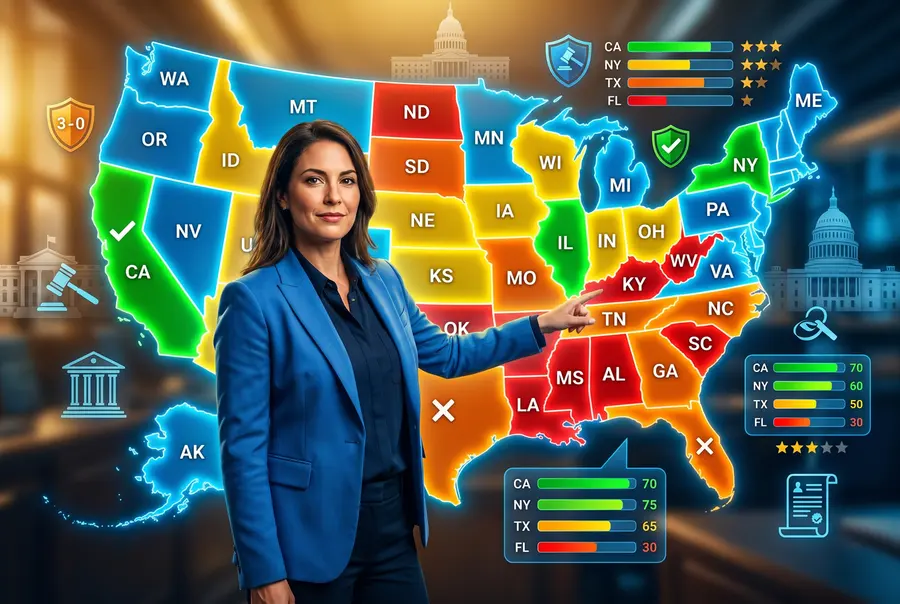
49 states and the District of Columbia have a Structured Settlement Protection Act — but some are dramatically stronger than others. Maryland's AG oversight, North Carolina's rate cap, Minnesota's cognitive-impairment protections, and Florida's in-person court requirement create vastly different experiences for sellers depending on where they live. This interactive guide classifies every state and shows you exactly what protections you have.
1. What Is a Structured Settlement Protection Act?
A Structured Settlement Protection Act (SSPA) is a state law that regulates the sale of structured settlement payment rights. Every state plus the District of Columbia has one. The core purpose: ensure that when a tort victim sells future payments for a lump sum, the transaction is genuinely in their best interest — not the result of high-pressure tactics, information asymmetry, or predatory pricing.
The need for these laws emerged in the 1990s when “factoring companies” began aggressively purchasing settlement payments from injured people — often at extreme discounts. A landmark Columbia Law Review study documented cases where victims received as little as 20% of their settlement's present value, with one Baltimore lead-paint victim selling $435,000 in payments for just $54,000. The legislative response was the Model SSPA, created by the National Council of Insurance Legislators (NCOIL), which most states adopted in some form between 1997 and 2021.
At the federal level, IRC §5891 backs up state laws by imposing a 40% excise tax on any buyer who acquires settlement payments without court approval — effectively making non-court-approved transfers economically impossible. This federal-state framework means every legitimate structured settlement transfer in the United States goes through a judge.
How Common Are These Protections?
Source: Annuity.org, NCOIL Model SSPA, individual state statutes. Analysis: SettlementDecisions.com, June 2026.
While all 50 states share certain baseline protections (court approval, written disclosure, cooling-off period, best-interest standard), the variance above that baseline is enormous. Some states simply require a buyer to “recommend” that you seek advice — then proceed with the sale regardless. Others mandate independent attorneys, cap discount rates, require in-person court appearances, and criminalize violations. Where you live significantly affects how well-protected you are.
Understanding your state's specific protections is not academic — it's worth tens of thousands of dollars. A seller in North Carolina (capped at ~13% rate) will receive $20,000+ more for the same payment stream than a seller in a state with no cap who accepts the first offer at 17%. The law is your first line of defense; knowledge of the law is your second.
2. Find Your State's Protection Level
Use the tool below to look up your state's specific protections. Each state is evaluated on six criteria: whether independent professional advice is mandatory (vs. merely recommended), whether a discount rate cap exists, the length of the cooling-off period, whether workers' compensation transfers are blocked, whether in-person court appearance is required, and any unique provisions that provide additional protection.
Find Your State's Protection Level
Select your state to see its specific protections
If your state shows “Basic Protection,” don't panic — the court approval requirement alone prevents the worst abuses. But you'll need to be more proactive about comparing quotes and seeking independent advice, because your state's law won't do it for you. If your state shows “Strong Protection,” the law provides meaningful guardrails — but it's still not a substitute for getting competing quotes and understanding fair market rates.
3. Protection Tiers: How We Classify the 50 States
We classify states into three tiers based on the cumulative strength of their protections above the NCOIL Model SSPA baseline. This is not a subjective rating — it's based on measurable legal provisions in each state's statute.
Protection Tiers: All 50 States Classified
CA
California
FL
Florida
IL
Illinois
LA
Louisiana
MD
Maryland
MI
Michigan
MN
Minnesota
NY
New York
NC
North Carolina
VA
Virginia
WI
Wisconsin
Strong-protection states have multiple safeguards: mandatory independent advice, rate caps, court appearance requirements, AG oversight, and/or workers' comp transfer bans combined.
STRONG PROTECTION (10 states + DC)
States with three or more protections beyond the baseline. Includes: mandatory independent advice AND rate caps, court appearance requirements, AG oversight, cognitive-impairment protections, or comprehensive anti-abuse provisions. These states make predatory transactions structurally difficult.
MODERATE PROTECTION (16 states)
States with one or two meaningful protections beyond the baseline. Common additions: mandatory independent advice alone, extended cooling-off periods, enhanced disclosure requirements, beneficiary notification, or fair-market-value findings. These laws help but don't comprehensively prevent exploitation.
BASIC PROTECTION (24 states)
States that closely follow the Model SSPA without significant additions. Protections include: court approval, written disclosure, 3-day cooling-off, best-interest standard, and a written recommendation (not mandate) to seek advice. The seller bears primary responsibility for due diligence.
The tier classification matters because it tells you how much the state does for you versus how much you must do for yourself. In a Strong-protection state, the system actively prevents bad deals through multiple checkpoints. In a Basic-protection state, the court is a single checkpoint — and research shows judges approve approximately 95% of petitions that reach them, regardless of rate fairness.
4. The Strongest State Protections (And What Makes Them Different)
Ten states stand out for protections that go meaningfully beyond the model act. Each addresses a different failure mode in the transfer process:
| State | Standout Protection | Why It Matters |
|---|---|---|
| North Carolina | Rate cap: Prime + 5% (~13%) | Legally impossible for any buyer to charge predatory rates. Saves sellers $10K-$30K vs. uncapped states. |
| Maryland | AG registration + cognitive impairment disclosure | Directly addresses exploitation of lead-paint victims. Buyers must disclose if seller has cognitive impairments. |
| Minnesota | Court-appointed attorney for impaired sellers | 2022 law directly responds to documented exploitation of cognitively impaired sellers. |
| California | Buyer pays seller's attorney ($1,500) | Removes financial barrier to independent legal advice. Filed with AG for oversight. |
| Florida | In-person court + seller's county filing | Prevents forum shopping. Judge can directly assess seller's understanding and voluntariness. |
| Michigan | 25% APR hard cap | While higher than NC's cap, still prevents the most extreme predatory rates. |
| Wisconsin | Rate disclosed “as if a loan” | Forces sellers to understand the rate in familiar terms. In-person appearance required. |
| Virginia | Prior transfer & denial disclosure | Buyer must disclose transfers within 4 years and denials within 2 years — prevents repeat exploitation. |
| North Dakota | Criminal penalty for violations | Only state where SSPA violations can result in criminal charges (Class B misdemeanor). |
| Illinois | In-person + effective interest rate disclosure | Must disclose effective rate (not just nominal). Prior transaction history provided to court. |
The common thread among strong-protection states: they address specific, documented failure modes. Maryland's 2016 update came directly after Washington Post reporting revealed that a single factoring company filed ~200 petitions targeting lead-paint victims — with a single judge approving 90% of them. Minnesota's 2022 update followed similar reporting on cognitively impaired sellers being exploited. These aren't theoretical protections — they're responses to real, documented harm.
If you live in one of these states, your law provides meaningful structural protection. But even in strong-protection states, the most powerful protection remains your own due diligence: getting competing quotes, understanding fair rates, and using tools like our discount rate calculator to verify any offer before signing.
5. Maryland: The Standout State That Changed Everything
Maryland deserves its own section because its SSPA reforms represent the most comprehensive response to documented structured settlement abuse anywhere in the country. The story begins in Baltimore, where thousands of children suffered lead paint poisoning and received structured settlements designed to fund their lifetime care.
In 2015, the Washington Post revealed that a company called Access Funding had systematically targeted these lead-paint victims — many with cognitive impairments from the poisoning itself — purchasing their settlements at extreme discounts. One company filed nearly 200 transfer petitions in a two-year period, three-quarters involving childhood lead-paint victims, with average transaction values offering roughly one-third of the settlement's present value. A single judge received 160 of those petitions and approved approximately 90%.
The case of Freddie Gray — who, before his death in police custody in 2015, had sold $435,000 in structured settlement payments for just $54,000 (less than 20% of present value) — became the national symbol of this exploitation. Gray had suffered childhood lead poisoning, which caused neurological damage, and his settlement was designed to provide decades of financial support. A factoring company purchased those rights at an effective discount rate exceeding 30%.
Maryland's 2016 Response (Md. CJP §5-1101 et seq.): Following an Attorney General investigation and lawsuit against Access Funding, Maryland enacted comprehensive reforms. Factoring companies must now register with the AG's office. Buyers must disclose to the court whether the underlying settlement involved cognitive impairment. Workers' compensation transfers are prohibited. Independent professional advice is mandatory. The AG maintains an active enforcement posture — something virtually no other state does.
What makes Maryland's approach unique is the combination of regulatory oversight (AG registration) and targeted protection (cognitive impairment disclosure). Most states rely solely on judicial discretion, which the Columbia Law Review study found fails approximately 95% of the time. Maryland added an external check by involving the AG's office — creating accountability outside the courtroom.
The results have been significant. Post-reform transfer petitions in Maryland face meaningfully more scrutiny. Buyers who previously operated with impunity now face registration requirements that make their operations transparent to law enforcement. And the cognitive-impairment disclosure requirement means judges are alerted when a seller may not fully understand the transaction — triggering enhanced scrutiny.
For sellers in Maryland: your protections are among the strongest in the nation. But they work best when you exercise them — specifically, by actually engaging the independent professional advisor your buyer is required to connect you with, and by asking questions during the court hearing rather than simply agreeing when the judge asks if you understand the terms.
6. States with the Weakest Protections (And What to Do About It)
Twenty-four states offer only basic-level protections — closely mirroring the NCOIL Model SSPA without significant additions. In these states, the buyer is required only to recommend (not mandate) independent advice, there is no rate cap, no in-person court requirement, and no enhanced oversight. The entire transaction hinges on a single judge's best-interest determination — which, as documented, results in approval rates exceeding 95%.
States with the least additional protections include: Alabama, Arizona, Connecticut, Hawaii, Mississippi, New Hampshire (last state to enact any SSPA — 2021), New Jersey, Oklahoma, Oregon, Pennsylvania (allows advice waiver), Rhode Island, South Dakota, Texas, Utah, Washington, and Wyoming. If you live in one of these states, the law provides a floor but not a ceiling on protection.
| Gap in Protection | What It Means | How to Fill It Yourself |
|---|---|---|
| No rate cap | Buyer can legally charge 18%+ discount rate | Get 3-5 competing quotes. Use discount rate calculator to verify. |
| Advice only “recommended” | You can proceed without any independent counsel | Get a free consultation anyway. Many attorneys offer 15-min free calls for settlement questions. |
| No in-person appearance | Judge approves on paper without assessing your understanding | Request to appear at the hearing anyway. Ask the judge questions about the rate. |
| No prior-transfer disclosure | Judge doesn't know if you've been sold to repeatedly | Voluntarily disclose prior transactions to the court. Honesty helps your case. |
The practical advice for sellers in basic-protection states is clear: you must be your own advocate. The legal framework will prevent the absolute worst outcomes (a sale without any court involvement), but it will not optimize the deal for you. That optimization comes from market competition — making multiple buyers compete for your business — rather than legal protection.
This is where tools like our free quote comparison become essential. In a state with strong protections, the law supplements your own diligence. In a state with basic protections, your diligence IS the protection. Getting competing quotes is the single most powerful action you can take — more powerful than any individual legal provision except a hard rate cap.
7. How to Protect Yourself Regardless of Your State
Whether your state has the strongest or weakest SSPA in the country, these five actions protect you more than any law can:
Get 3-5 competing written quotes
This single action creates more protection than most legal provisions. Competing buyers drive rates down 2-4% on average — worth $10,000-$25,000 on typical settlements. Use our quote comparison tool to request all quotes simultaneously.
Verify the discount rate on every offer
Never accept a lump-sum number without knowing the underlying rate. Enter any buyer's offer into our discount rate calculator to see what they're really charging. Fair range: 9-13% for guaranteed payments.
Get independent advice — even if your state doesn't require it
A 15-minute call with an attorney or financial advisor can prevent a $20,000 mistake. In California, the buyer must pay up to $1,500 for your attorney. In other states, many advisors offer free initial consultations for settlement questions.
Never sell under time pressure
Your cooling-off period exists for a reason. Any buyer who pressures you with “expiring” offers is using a predatory tactic. Legitimate offers remain available. The 45-90 day court process means nothing happens quickly regardless.
Consider a partial sale first
Courts look more favorably on partial sales because they demonstrate financial prudence. Selling only what you need — rather than your entire payment stream — is both smarter financially and easier to get approved. Learn about partial sales →
's approach: provides written discount rate disclosure on every quote, offers partial-sale options, and maintains an A+ BBB rating with Trustpilot 4.7/5 stars. Their rates (7.5-12%) are the lowest we've documented across 26 buyers — which means regardless of your state's legal protections, their pricing is already within the range that strong-protection states are designed to enforce.
8. Where SSPA Reform Is Heading: What to Watch For
The structured settlement protection landscape is evolving. Several trends suggest stronger protections are coming to additional states in the next 2-5 years:
Cognitive impairment protections are expanding. Minnesota's 2022 law — requiring court-appointed attorneys for sellers with potential mental impairments — is being studied by other states. The documented pattern of factoring companies targeting lead-paint victims (many of whom have cognitive damage from the poisoning itself) has created bipartisan legislative support for similar protections in Maryland, New York, and Illinois.
Rate caps may spread. North Carolina's Prime + 5% cap has not demonstrably reduced market activity — buyers still compete actively for North Carolina sellers. This undermines the industry argument that caps would “dry up the market.” Legislative proposals for rate caps (at varying levels) have been introduced in New York, Illinois, and California in recent sessions.
Technology is enabling transparency. Tools like the ones on this site — discount rate calculators, buyer comparisons, and free quote platforms — did not exist when most SSPAs were written. They effectively accomplish what many legal provisions aim to do (informed decision-making) through market mechanisms rather than legal mandates. This is why informed sellers achieve rates 2-4% lower than uninformed sellers — regardless of state law.
The “best interest” standard is being challenged. Legal scholars argue that the 95% approval rate demonstrates the standard is effectively meaningless as currently applied. Proposed reforms include requiring judges to make specific written findings about rate reasonableness (as Vermont already requires), mandating that courts hear from an independent advisor before ruling, and creating appellate review mechanisms for approved transfers.
Until these reforms arrive, the most powerful protection available to sellers everywhere is simple: market competition. Multiple quotes from competing buyers accomplish what rate caps, mandatory advice, and court oversight collectively attempt to do — they ensure you receive fair market value for your payment rights. The law provides the floor; your diligence provides the ceiling.
Know Your Rights. Then Get the Best Deal.
Your state's SSPA protects the floor. Competing quotes raise the ceiling. Get 3-5 offers from settlement buyers and see exactly what your settlement is worth.