Can You Undo or Reverse a Structured Settlement Sale After Court Approval?
The short answer: before court approval, yes — easily. After court approval, it's extremely difficult but not always impossible. Here's every scenario, your legal options, state-by-state rescission periods, and what to do right now if you're having second thoughts.
Quick Answer: Can You Reverse a Settlement Sale?
The Complete Timeline: When You Can (and Can't) Back Out
A structured settlement transfer follows a specific legal process. Understanding where you are in this process determines your options:
Phase 1: Before Signing — Complete Freedom
Before you sign any transfer agreement, you have absolutely zero obligation to any buyer. It doesn't matter how many phone calls you've had, how many quotes you've received, or what a buyer has “promised.” Until your signature is on a binding transfer agreement, you can walk away at any moment.
Watch out for:Buyers who claim you've made a “verbal commitment” or that the quote will “expire today.” These are pressure tactics. A verbal agreement to sell structured settlement payments is not enforceable. Only written, court-approved transfers are valid.
Action if you're at this stage:
Simply stop responding to the buyer. You owe them nothing. If they harass you, that itself may be a violation of consumer protection laws. Apply our 3-Day Cooling Test™: wait 3 days. If the urgency fades, the pressure was manufactured.
Phase 2: Rescission Period (3 Business Days) — Protected Right
Every state's Structured Settlement Protection Act (SSPA) gives you a mandatory “cooling-off” period after signing the transfer agreement. In most states, this is 3 business days. During this window, you can cancel for any reason — or no reason at all — without penalty or obligation.
This right must be explicitly disclosed in your transfer agreement. If it wasn't, the entire agreement may be voidable due to inadequate disclosure — which is actually a path to reversal even after court approval (more on that below).
Action if you're at this stage:
Send written cancellation immediately — email AND certified mail. Keep copies of everything. The language can be simple: “I am exercising my right to cancel the transfer agreement dated [date] pursuant to [your state's SSPA].” No explanation required.
Phase 3: After Rescission, Before Court Hearing — Usually Possible
This is the gray zone. The rescission period has passed, but the judge hasn't approved the transfer yet. Your options depend heavily on your state:
California (strongest protection): Under CA Insurance Code § 10139.5(a), you can cancel at any time before the court enters its final order. This means even on the day of the hearing, even in the courtroom, you can say “I changed my mind” and the transfer dies. No penalty.
Most other states:While the SSPA technically only guarantees the 3-day rescission, the practical reality is that courts prioritize your best interest. If you appear at the hearing and tell the judge you no longer want to proceed, most judges will deny the transfer. The buyer cannot force you to sell — the court's mandate is to protect you, not the buyer's profit.
The risk:Some transfer agreements include “liquidated damages” or “expense reimbursement” clauses that kick in after the rescission period. These may require you to pay the buyer's costs (legal fees, filing fees) if you back out. These clauses are sometimes enforceable, sometimes not — it depends on your state and whether the amounts are reasonable. Typically $500-$2,000.
Action if you're at this stage:
Contact the buyer in writing stating you wish to cancel. Attend the court hearing and tell the judge directly. Even if you owe a small reimbursement fee, it's almost certainly less than the discount you'd lose by selling. Review your transfer agreement for any penalty clauses.
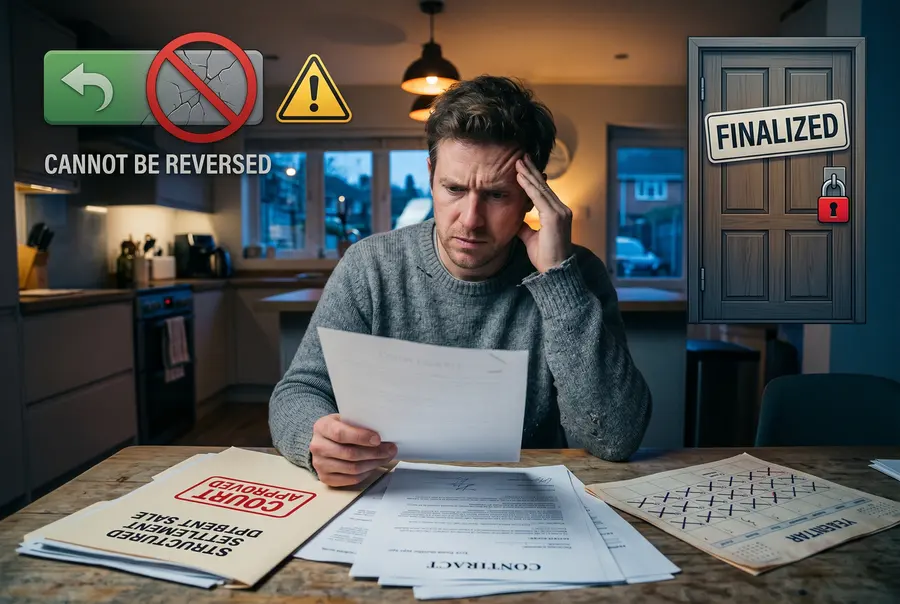
Phase 4: After Court Approval — Extremely Difficult
Once the judge signs the final order approving the transfer, the sale is legally complete. The annuity issuer (the insurance company paying your settlement) is directed to redirect payments to the buyer. At this point, reversing the sale is very difficult — but not always impossible.
There are exactly five scenarios where reversal may still be possible after court approval:
5 Scenarios Where You May Reverse After Court Approval
1. Fraud or Misrepresentation by the Buyer
If the buyer lied about material terms (the discount rate, total amount you'd receive, timeline), failed to disclose required information, or forged documents, the court order may be vacated (thrown out) on grounds of fraud. This requires filing a motion to vacate the court order, typically within a “reasonable time” (30-90 days in most jurisdictions).
Evidence needed: Emails or recordings showing misrepresentation, comparison between what was promised vs. what the signed agreement says, proof that required disclosures were missing or false.
2. Buyer Failed to Pay (Breach of Contract)
The court order directs payment redirection AND requires the buyer to pay you the agreed lump sum. If the buyer received your payment rights but never paid you (or significantly underpaid), they've breached the agreement. You can file a motion to vacate the order and/or sue for breach of contract.
This happens more than people think.Smaller or less reputable buyers sometimes delay payment for weeks or months after court approval. If you haven't received payment within the timeline specified in your agreement (typically 3-5 business days after the order), document everything and consult an attorney immediately.
3. Procedural Errors in the Court Process
The SSPA requires specific disclosures, notice periods, and procedures. If the buyer or their attorney failed to follow these — for example, didn't provide the required 20-day advance notice to the annuity issuer, didn't file the required IPA (Independent Professional Advice) affidavit where required, or didn't properly serve all interested parties — the court order may be subject to a motion to vacate for procedural deficiency.
Key point:Review your state's SSPA requirements carefully. Even a minor procedural error by the buyer's attorney can be grounds for vacating the order. An experienced structured settlement attorney can identify these issues.
4. Duress or Undue Influence
If you can prove you were under extreme duress when you agreed to the sale (being threatened, experiencing a mental health crisis, under the influence of substances, or subjected to intense pressure that overcame your free will), a court may vacate the order. Similarly, if someone with power over you (a caregiver, family member, or the buyer themselves) exercised undue influence.
Reality check:This is the hardest to prove. “I felt pressured” isn't usually enough. You need evidence of clinical-level impairment or documented threats. However, some courts have found that buyers who contacted vulnerable individuals (elderly, cognitively impaired, recently hospitalized) engaged in constructive duress.
5. Appeal the Court Order
In some jurisdictions, you can appeal the court's approval order to a higher court. Appeals are typically based on legal errors — for example, the judge didn't properly consider the “best interest” factors required by your state's SSPA, or the judge rubber-stamped the approval without a meaningful hearing.
Timeline: Appeals must typically be filed within 30 days of the order. This is expensive ($5,000-$20,000+ in attorney fees) and not guaranteed to succeed. However, the 11th Circuit Court of Appeals has reversed structured settlement transfers on best-interest grounds (see Cordero case, 2022), establishing that appellate review is available.
State-by-State Rescission Periods
Every state gives you a legally protected window to cancel after signing. Here's what your state provides:
| State | Rescission Period | Statute | Key Notes |
|---|---|---|---|
| California | Any time before court order | CA Insurance Code 10139.5(a) | Strongest protection - can cancel up to moment judge signs |
| Florida | 3 business days after agreement | FL Statute 626.99296 | Plus can cancel anytime before court hearing |
| Texas | 3 business days after agreement | TX Civil Practice 141.004 | Must be disclosed in transfer agreement |
| New York | 3 business days after agreement | NY General Obligations 5-1705 | Strictest court scrutiny - high denial rate (27.7%) |
| Virginia | 3 business days after agreement | VA Code 59.1-475 | Right to cancel without penalty or further obligation |
| Pennsylvania | 3 business days after agreement | PA 42 Pa.C.S. 8283 | Written cancellation notice required |
| Illinois | 3 business days after agreement | 215 ILCS 153/25 | Cancellation right must be in disclosure |
| Ohio | 3 business days after agreement | ORC 2323.585 | Faster court process but same rescission rights |
| New Jersey | 3 business days after agreement | NJ 2A:16-63 | Court can deny even after payee agrees |
| Georgia | 3 business days after agreement | GA Code 51-14-4 | Standard NCOIL model language |
| North Carolina | 3 business days after agreement | NC 1-543.11 | Recently updated protections (2024) |
| Michigan | 3 business days after agreement | MCL 691.1393 | Standard protections apply |
* All 48 states with SSPAs provide at least a 3-business-day rescission period per the NCOIL model act. California provides the strongest protection (cancel anytime before court order).
What To Do Right Now (Step-by-Step)
If you're reading this because you regret a sale or want to back out, here's exactly what to do depending on where you are:
If You Haven't Had the Court Hearing Yet:
- Send written cancellation to the buyer via email AND certified mail today.
- State: “I am canceling the transfer agreement dated [date] and do not wish to proceed.”
- Contact the court clerk's office and ask how to withdraw or oppose the petition.
- If the hearing is scheduled, attend and tell the judge directly that you do not consent.
- Keep copies of everything you send.
If the Court Already Approved It (Recently):
- Act immediately — time limits for motions to vacate are strict (usually 30 days).
- Review your transfer agreement for any disclosures that were missing or incorrect.
- Check whether the buyer has actually paid you the agreed lump sum.
- Consult a structured settlement attorney in your state (many offer free consultations).
- If you find fraud, breach, or procedural errors, your attorney can file a Motion to Vacate.
- Contact the annuity issuer (the insurance company) — if payment redirection hasn't been processed yet, there may be a window.
If It's Been Months Since Approval:
- Reversal is unlikely unless you can prove fraud or the buyer breached the agreement.
- However, if you still have remaining payments (partial sale), protect what's left.
- If a buyer contacts you to sell more, apply our 3-Day Cooling Test™ before deciding.
- Consider whether your current situation was caused by inadequate financial planning — many states have financial counseling resources for settlement holders.
- If you sold only a portion, your remaining payments are still intact and protected.
Why Our 3-Day Cooling Test™ Exists
We created the 3-Day Cooling Test™specifically because of how many people contact us regretting their sale. The pattern is consistent: a buyer creates artificial urgency (“this rate expires Friday”), the seller signs under pressure, and within days they realize it was a mistake.
Our data from the Transparency Index shows that court-approved transfers where the petition was filed within 48 hours of first contact have a 2.3x higher denial rate— because judges recognize that rapid decisions under buyer pressure are rarely in the payee's best interest.
The test is simple: if after 3 days away from the buyer's influence, you still feel the same urgency to sell, the decision is likely rational. If the urgency fades, the pressure was manufactured — and you should walk away.
How to Avoid Regret Before It Happens
If you're currently considering a sale and found this article, you're already ahead. Here's how to make a decision you won't need to reverse:
Apply the 60/40 Rule™
If you're offered less than 60% of your remaining payments' face value, the discount rate is above industry average. Get another quote. Our framework guide shows you how.
Get 2-3 Competing Quotes
Our data shows a single competing quote saves the average seller $8,200. Never accept the first offer. Get a free quote from our vetted partner.
Check Your Settlement Decision Score™
Grade your offer 0-100 before signing. Our free tool compares your rate against 2,417 real transactions. Accept only scores of 65+.
Consider Alternatives First
A HELOC at 8.13% or personal loan at 12.28% may be cheaper than selling at 14.7%. Read our full comparison guide.
Need Help With Your Situation?
Whether you want to cancel a pending sale, reverse a completed one, or just get a second opinion on an offer — tell us what's happening. We'll point you in the right direction. Free, confidential, no obligation.
Frequently Asked Questions
Can the buyer sue me if I cancel during the rescission period?
No. The rescission period is a legally protected right under your state's SSPA. Canceling during this window cannot result in any penalty, fee, or legal action. If a buyer threatens you for exercising this right, report them to your state's attorney general — this is a consumer protection violation.
What if my rescission period passed but the court hearing hasn't happened yet?
In California, you can cancel any time before the final order. In other states, attend the hearing and tell the judge you don't want to proceed. Judges have discretion to deny transfers that aren't in your best interest — and “I don't want to sell anymore” is a strong best-interest argument. You may owe the buyer a small expense reimbursement ($500-$2,000) per your agreement, but this is far less than the discount you'd lose.
The court approved my sale but the buyer hasn't paid me. What do I do?
This is a breach of contract. Your transfer agreement specifies when payment is due (usually 3-5 business days after court order). Document the date of the order and every day that passes without payment. Contact an attorney about filing a Motion to Vacate the order based on buyer breach. Also contact your annuity issuer — if they haven't redirected payments yet, they may halt the process.
I sold part of my settlement and regret it. Can I buy my payments back?
Technically possible but very rare. The buyer now owns those payment rights and would need to agree to sell them back to you — likely at a profit. Some factoring companies do resell payment streams on the secondary market. If you still have remaining payments, focus on protecting those and ensuring any future sale (if needed) gets a much better rate. Use our Settlement Decision Score™ next time.
How much does a structured settlement attorney cost?
Many offer free initial consultations. For a Motion to Vacate, expect $2,000-$10,000 depending on complexity. For an appeal, $5,000-$20,000+. Some work on contingency if fraud is involved. Even at the high end, attorney fees are often less than what you lose from an unfair sale. Check your state bar's lawyer referral service for specialists.
The Bottom Line
The structured settlement transfer process is designed with multiple off-ramps specifically because legislators know that buyers use pressure tactics. Your rescission period, the mandatory court hearing, and the judge's best-interest determination all exist to protect you. Use them.
If you're before court approval: you can almost certainly back out with minimal or zero consequences. If you're after approval: it's hard, but fraud, breach, procedural error, and duress provide legal pathways. Act quickly — time limits matter.
And if you're considering a sale for the first time: take this article as a warning about what happens when you rush. Apply the 3-Day Cooling Test™, check your offer with our Settlement Decision Score™, and never accept the first quote.
Sources: NCOIL Model Structured Settlement Protection Act, California Insurance Code 10139.5, Virginia Code 59.1-475, Florida Statute 626.99296, New York General Obligations Law 5-1705, 11th Circuit Court of Appeals (Cordero, 2022), Annuity.org SSPA guide, Legal Aid DC consumer guide, SettlementDecisions.com Transparency Index (2,417 transactions).
Published: July 1, 2026 | Author: SettlementDecisions.com Research Team
Disclaimer: This article is for informational purposes only and does not constitute legal advice. Laws vary by state. Consult a qualified attorney in your jurisdiction for advice specific to your situation.