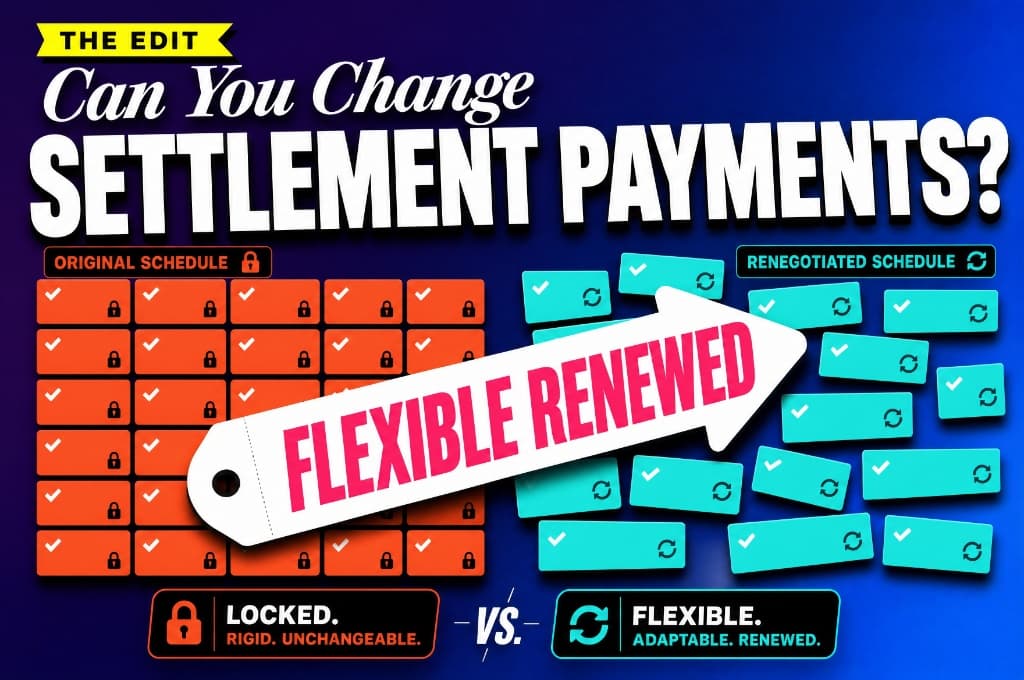
Can You Change a Structured Settlement Payment Schedule?
Structured settlements are designed to create predictable payments, but financial needs rarely stay predictable forever. This guide explains why an established schedule is generally fixed, which servicing details may still be updated, and how a court-approved transfer differs from changing the annuity itself.
Updated September 13, 2026Approximately 15-minute readEducational information
Established payment dates and amounts are generally fixed, although administrative updates and court-approved transfers are different processes.
Quick answer
After a structured settlement is finalized and funded, the recipient generally cannot ask the annuity issuer to accelerate, delay, increase or decrease the contracted payments. Administrative details such as an address, payment destination or permitted beneficiary designation may be changeable. If cash is needed sooner, a recipient may be able to sell specifically identified payment rights through a separate court-approved transfer, but that does not rewrite the original annuity schedule.
Why the payment schedule is generally fixed
A structured settlement is negotiated before the annuity is issued. The parties decide how much will be paid, when payments will begin, how frequently they will arrive, whether future lump sums will be included and whether any portion depends on a person remaining alive. The defendant or its insurer may then transfer the periodic-payment obligation to a qualified assignment company, which purchases an annuity to fund the promised stream.
The resulting schedule is not comparable to a savings-account withdrawal plan that the account holder can edit online. The recipient ordinarily does not own an account balance that can be withdrawn on demand. Instead, the recipient holds contractual rights to receive specified future payments under the settlement documents.
Federal tax law helps explain the rigidity. Section 130 of the Internal Revenue Code describes qualified assignments involving periodic payments that are fixed and determinable as to amount and time. It also provides that the payments cannot be accelerated, deferred, increased or decreased by the recipient. These requirements support the structure's intended tax treatment and long-term predictability.
The practical result is straightforward: an issuer normally cannot transform a payment due five years from now into a check today merely because the recipient's circumstances changed. It also generally cannot double the monthly amount for two years and then reduce it later. The dates and amounts are tied to the governing obligation.
A servicing change is not a schedule change
Changing the bank account that receives a deposit, updating a mailing address or submitting an eligible beneficiary form may be permitted. Those actions change administration, not the amount and timing of the structured settlement payments.
What “fixed and determinable” means
A payment is fixed and determinable when the governing arrangement establishes the payment amount and timing without leaving the recipient free to choose when to take the money. A schedule might provide $2,000 every month for twenty years, $50,000 on a particular future date, lifetime payments beginning at age sixty-five, or a combination of periodic and lump-sum payments.
“Fixed” does not necessarily mean that every payment has the same dollar amount. A structured settlement can contain scheduled increases established at the beginning. For example, a monthly payment might rise by a stated percentage each year, or future lump sums may grow at predetermined intervals. Those changes are part of the original formula; they are not later elections by the recipient.
Life-contingent payments may also be determinable even though nobody knows how long they will continue. The amount and scheduled timing can be established while the duration depends on the measuring individual's life. Guaranteed payments, by contrast, continue for the specified period even if the original recipient dies, subject to the beneficiary and estate provisions in the governing documents.
What usually cannot be changed
The precise answer depends on the settlement agreement, qualified assignment, annuity contract and applicable court orders. However, recipients generally cannot make the following changes through an ordinary customer-service request:
Move a future lump sum to an earlier year because a major expense arose.
Increase monthly payments and shorten the total payment period.
Decrease current payments in exchange for a larger retirement payment.
Convert the entire remaining stream into the annuity's stated account value.
Pause payments temporarily and restart them later.
Add an inflation adjustment that was not included in the original schedule.
Convert a life-contingent payment into a guaranteed payment after the contract is issued.
Change the legal recipient merely by submitting informal written instructions.
The inability to make these changes can feel restrictive during a financial emergency. It is also one of the features that protects the payment stream from rapid depletion, impulsive withdrawals and some forms of outside pressure. The structure trades liquidity for predictability.
What administrative details may be changed
A fixed schedule does not mean that every detail remains frozen. Insurers maintain servicing procedures for routine administrative updates. The available options differ by issuer and contract, so use forms from the official insurer or authorized servicer.
Mailing address and contact information
Recipients can generally report a new mailing address, phone number or other contact information. An address change does not alter the payment obligation, but failing to report it can cause returned mail, delayed checks or missed verification requests.
Direct-deposit instructions
Many issuers permit recipients to enroll in electronic funds transfer or change the bank account receiving existing payments. The issuer may require a signed form, voided check or other verification. The amount and contractual effective date remain unchanged even though the destination changes.
Beneficiary information when permitted
Some guaranteed payment arrangements allow a beneficiary designation to be added or changed, subject to the settlement documents and issuer review. Other arrangements restrict beneficiary changes. A beneficiary update does not convert life-contingent payments into guaranteed payments and does not create benefits that the contract never provided.
Name, guardianship or ownership documentation
Marriage, divorce, adoption, a court-appointed guardian, estate administration or a legal name change may require updated records. These changes can affect who is authorized to communicate with the issuer or receive payments, but they do not automatically redesign the payment schedule.
Interactive schedule explorer
What are you trying to change?
Explore the difference between an administrative update, a prohibited schedule rewrite and a possible transfer of selected payment rights. Results are educational and are not an offer or valuation.
Not a purchase estimate
The illustration does not calculate present value, a discount rate or a buyer's offer. It only visualizes the difference between retaining and potentially transferring payment segments.
CONTRACTUAL SCHEDULE
Payment dates are generally fixed after funding
Moving payment dates earlier or later is ordinarily not an administrative option. A court-approved partial transfer may change who receives selected payments, not when the annuity issues them.
Six-year payment illustration
Purple: original schedule. Cyan: illustrative retained payments.
OriginalRetained
Recommended review
1Obtain the current issuer payment schedule.
2Identify the smallest payment segment that could meet the need.
3Compare the value retained with the cash offered now.
4Do not treat a transfer as a free acceleration of payments.
Can the issuer make an exception for financial hardship?
A medical emergency, threatened foreclosure, job loss or other hardship may create an urgent need for cash, but hardship does not normally give the annuity issuer authority to rewrite the contract. The issuer remains responsible for administering the payments specified in the structured settlement documents.
It is worth contacting the issuer when the question concerns a late payment, bank-account update, lost check, beneficiary claim or administrative error. It is generally not useful to ask the servicing department to advance a future payment simply because the money is needed earlier. Customer service cannot approve a transaction the governing documents and applicable law do not authorize.
A recipient facing hardship may instead evaluate other resources, budgeting changes, assistance programs, conventional financing for which the recipient qualifies, or a potential sale of selected payment rights. Each option has different costs and consequences. Selling should not be treated as an automatic response to every short-term expense.
Selling payment rights is not the same as changing the schedule
A structured settlement factoring transaction involves transferring the right to receive specified future payments to a purchasing company in exchange for a discounted lump sum. The annuity generally continues to make payments on the dates established by the original schedule. After the transfer becomes effective, the issuer redirects the purchased payments to the buyer.
Section 5891 of the Internal Revenue Code establishes federal tax consequences for structured settlement factoring transactions and an exception involving a qualified order. State Structured Settlement Protection Acts generally require disclosures and advance court approval. The judge considers the applicable statutory standard, commonly including whether the proposed transfer is in the recipient's best interest.
Court approval does not mean that the buyer pays the full face value of the future payments. The buyer provides money now and waits to receive the assigned payments later. The difference reflects the discount rate, time, transaction risk, legal process and other pricing considerations.
Partial sale
A partial sale transfers only selected payment rights. A recipient might sell a defined number of monthly payments, a portion of each payment, one future lump sum or payments covering a limited date range. Payments outside the court-approved transfer remain with the recipient.
Partial sales can preserve long-term income while providing a smaller amount of immediate cash. The details must be precise. A recipient should understand exactly which payments are being sold, which are retained and when retained payments resume.
Full sale
A full sale transfers all remaining transferable payment rights identified in the transaction. It may provide more cash immediately, but it also eliminates the future income included in the sale. Recipients should evaluate housing, medical, retirement and dependent needs before considering this option.
Selling a future lump sum
Some schedules include one or more large future payments. A recipient may seek to transfer a particular lump sum while retaining monthly income. This still requires valuation and the applicable legal process. It does not compel the issuer to pay the lump sum early.
Example: schedule change versus partial transfer
Suppose a recipient is scheduled to receive $2,000 per month for fifteen years plus a $50,000 lump sum in five years. The recipient needs money for a home repair today.
A true schedule change would ask the issuer to move the $50,000 payment from year five to today or increase the monthly payment now and reduce it later. That request would generally conflict with the established obligation.
A partial transfer would instead involve a buyer offering a discounted amount today for the right to receive the $50,000 payment in five years. If approved, the annuity would still issue the scheduled payment in year five, but it would be directed to the buyer. The recipient would retain the monthly payments if they were excluded from the transfer.
These outcomes may feel similar because the recipient receives cash now. Legally and financially, they are different. One would rewrite the payment promise; the other sells a defined payment right.
Can a divorce court change the schedule?
Divorce can determine whether payments are separate or marital property and whether they count as income for support purposes. It does not necessarily give a family court power to rewrite the annuity contract. A court may use offsets, support orders or other remedies instead of instructing the insurer to redesign the payment stream.
If payment rights are proposed for sale to fund a property settlement or other divorce-related need, the transfer must still comply with applicable structured settlement transfer law. Family-court orders and transfer-court requirements should be reviewed together by qualified counsel.
Can bankruptcy change the payment schedule?
Bankruptcy raises questions about exemptions, estate property, creditor claims and the debtor's authority to transfer assets. It does not ordinarily create a simple customer-service right to accelerate or postpone structured settlement payments. A recipient in bankruptcy should obtain advice from a bankruptcy attorney before attempting to sell or redirect payment rights.
Failing to disclose a payment stream or proposed transaction can create serious problems. The bankruptcy petition, applicable exemptions, trustee authority and transfer proceedings may interact. Do not rely solely on a buyer or issuer to determine your bankruptcy obligations.
Can inherited payments be rescheduled?
A beneficiary who inherits guaranteed structured settlement payments generally receives the rights provided by the original documents. Inheritance does not usually create a right to redesign the schedule. The beneficiary may need to establish ownership through a death certificate, claim form, probate records, trust documents or other evidence.
Once ownership is confirmed, the beneficiary may be able to evaluate a court-approved transfer if permitted by the payment rights and applicable law. Life-contingent payments may have ended at the measuring life's death, so the payment type must be verified before discussing sale options.
Can payments for a minor be changed?
Settlements involving minors often receive court oversight when they are created. The payment schedule may be designed around education, adulthood, housing or long-term care. A parent or guardian does not automatically own the child's payment rights or have authority to accelerate them.
Any proposed transfer may require careful review of guardianship, ownership, state law and the child's best interests. Some transactions may be unavailable or subject to heightened scrutiny. A parent should not sign a transaction based solely on the promise of immediate cash.
Review your actual schedule
Compare cash now with payments retained
If you are considering a partial or full transfer, request a confidential review of the payment dates and amounts you may want to keep or sell.
Get Free Competing Offers Save $3K$12K
Compare pre-screened professionals in 60 seconds. No obligation.
Step 1/4
What type of settlement or claim do you have?
Select the category that best matches your situation
10,847 settlement holders used this tool
SSL Secured No Obligation 26+ Settlement Buyers Data Never Sold
Questions to answer before considering a transfer
The right decision depends on more than the amount of cash offered. Start by mapping the current schedule and the purpose each payment serves. A future lump sum intended for accessible housing or medical care should not be treated as surplus merely because the need is several years away.
Which exact payments are guaranteed, and which are life-contingent?
Are any payments already assigned under a prior transfer order?
How much dependable monthly income will remain after the proposed sale?
What is the total face value of the payments being transferred?
What net amount will be received after every disclosed deduction?
What effective discount rate is reflected in the transaction?
Could selling fewer payments meet the same immediate need?
How will the decision affect dependents, housing and medical costs?
Documents needed to understand the schedule
Do not rely on memory or a buyer's summary. Gather the original settlement agreement, qualified assignment document, annuity contract, current benefits letter, payment history and any prior transfer agreement or qualified court order. These documents should identify the legal issuer, payment dates, amounts, guarantees and contingencies.
If the issuer has changed names or servicing companies, use recent correspondence to identify the current service channel. A familiar brand may differ from the legal insurance entity printed on the contract. Preserve both names when requesting records.
How to contact the issuer without asking the wrong question
The insurer can help with administrative servicing and explain what its records show. It generally does not provide advice about whether selling payments is financially appropriate. Ask focused questions:
Can you provide a current payment schedule or benefit letter?
Which payments are guaranteed and which are life-contingent?
What legal entity issued the annuity?
Are any payments currently redirected under a transfer order?
Which forms update my address or direct-deposit instructions?
Does the contract permit a beneficiary change for guaranteed payments?
Do not ask a service representative to estimate the sale value of your payment rights unless the company expressly offers that service. Present value depends on timing, market conditions, contingencies and the buyer's pricing.
Plan flexible payments before a settlement is finalized
The best time to design flexibility is during settlement negotiation, before the schedule becomes binding. A claimant working with legal and financial professionals can consider monthly income, future lump sums, scheduled increases, education expenses, housing needs, medical costs, retirement income and an immediate cash reserve.
A structure does not have to contain only equal monthly payments. It may combine immediate cash with periodic payments and future lump sums. The claimant should stress-test the schedule against inflation, emergencies and major life stages. Once the settlement is executed and funded, choices that were available during negotiation may no longer be available.
A structured settlement issuer generally administers the payment dates and amounts established by the governing documents. It normally cannot redesign the schedule merely because the recipient requests different dates.
Can I ask for a future lump sum to be paid early?
The recipient generally cannot accelerate a future structured settlement payment through an ordinary servicing request. A court-approved transfer of specified payment rights may provide cash now, but that is a sale at a discount rather than an early payment by the issuer.
Can I increase my monthly structured settlement payment?
The issuer generally cannot increase the contracted payment amount. A recipient may evaluate selling selected future payments, but that provides a discounted lump sum and reduces the future payments retained.
Can I change from a paper check to direct deposit?
Many issuers allow administrative changes such as electronic deposit enrollment, bank-account updates or address changes. These servicing updates normally do not change the amount or contractual due date.
Does hardship let me rewrite my payment schedule?
Financial hardship does not ordinarily authorize the issuer to rewrite the annuity schedule. Hardship may be relevant if a recipient seeks court approval to transfer specified payment rights, but approval is not automatic.
Does selling payments change the annuity contract?
A transfer generally assigns the right to receive payments identified in a court order. It does not usually rewrite the annuity's underlying payment schedule. The issuer redirects the transferred payments according to the qualified order.
This article provides general educational information and is not legal, tax, financial or insurance advice. Structured settlement documents and state transfer laws differ. Consult qualified professionals before transferring payment rights or relying on a particular legal outcome.