Structured settlement record-recovery guide
How to Find and Replace Lost Structured Settlement Documents
Recover the issuer identity, payment schedule, annuity records, settlement agreement, assignment and beneficiary information without relying on an unverified third party.
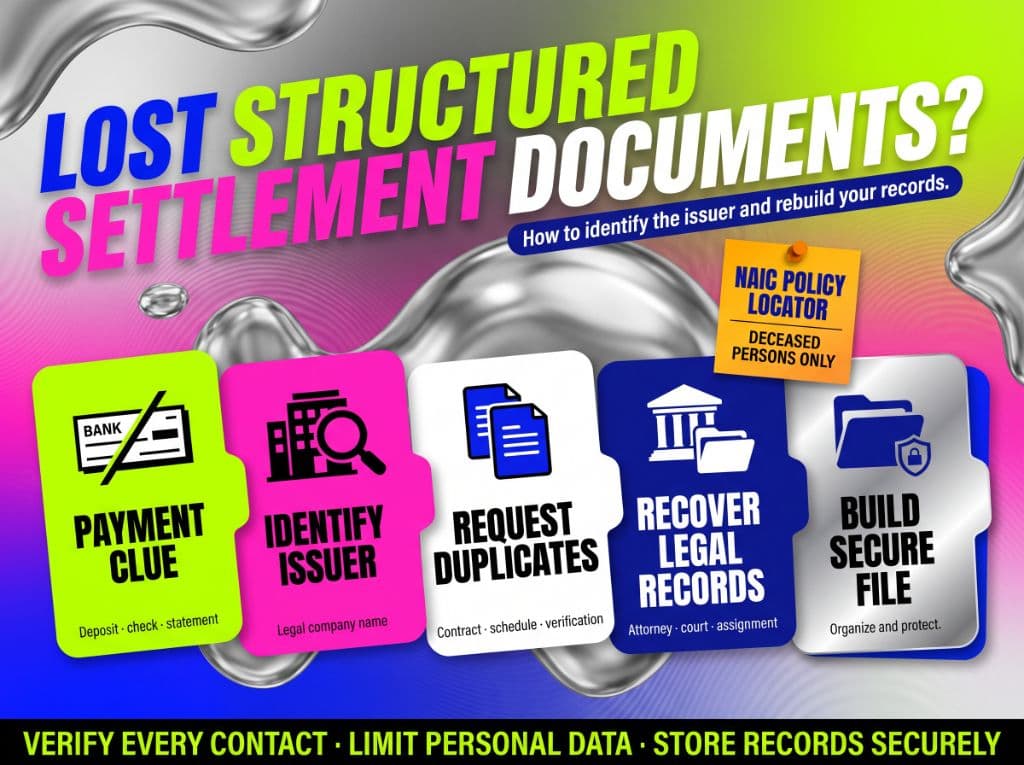
Direct answer: begin with payment evidence and identify the current legal annuity issuer or authorized servicer. Request available duplicates there, then contact the original attorney, structured settlement professional or court for records the insurer does not maintain.
Interactive document-recovery workflow
Structured Settlement Document Recovery Map
Select whose records you are trying to recover. The correct search path differs for a living payee and a deceased person.
Start with payment evidence
Use recent deposits, check stubs, annual statements, tax documents or correspondence to identify company names and payment references.
- Bank deposit description
- Check image or stub
- Annual payment statement
- Issuer correspondence
Identify the legal issuer
Separate the legal annuity issuer from a parent brand, assignment company, servicer or payment processor.
- Exact company name
- Contract number
- Former company names
- Current servicer
Contact the verified service center
Request payment verification and available duplicate contract or schedule records through an independently verified channel.
- Identity verification
- Current address
- Approximate payment amount
- Secure delivery method
Recover legal records
Contact the settlement attorney, structured settlement professional, court clerk or other document custodian when insurer records do not include the complete settlement file.
- Case name
- Court and county
- Approximate settlement date
- Attorney or law-firm name
Living payee starting point
For your own active payments, begin with the deposit trail, current issuer or servicer, former issuer names and the attorneys or professionals involved in the original settlement.
Recovery file
0 of 8 documents located
Avoid paid “recovery” scams
Do not pay an unknown caller or website merely to reveal your insurer. Verify companies through official insurer records, the NAIC, a state insurance department or the court where the case was handled.
Start by identifying what is actually missing
“Structured settlement paperwork” can refer to several documents created by different organizations. No single company necessarily possesses the complete file. The annuity issuer maintains contract and payment records, while the attorneys or court may retain the settlement agreement, release, pleadings and approval order.
Write down what you need before contacting anyone. A lender may need only a current income verification letter and payment schedule. An estate attorney may need the contract, beneficiary designation and guaranteed-payment terms. A court matter may require certified copies rather than ordinary duplicates.
The core document set
Settlement agreement and release
Records the negotiated settlement obligation and release of claims.
Qualified assignment
Shows the transfer of the periodic-payment obligation to the assignment company.
Annuity contract or certificate
Identifies the issuing insurer, owner and funded payment benefits.
Payment schedule
Lists payment dates, amounts, guarantees and life-contingent terms.
Beneficiary designation
Identifies the successor recipient currently recorded for eligible benefits.
Court order
May approve a minor's settlement, transfer or another court-supervised action.
Company-change notices
Trace former issuers, legal successors and current servicers.
Payment verification
Confirms current payment facts for lenders, landlords or agencies.
Use the payment trail to identify the company
If payments are still arriving, inspect the bank deposit description, check image, check stub and recent correspondence. Record every company name and reference number exactly as shown. Do not assume the largest brand name is the legal annuity issuer.
The payment may display an issuer, parent brand, assignment company, servicing affiliate or payment processor. Compare these names with NAIC Consumer Insurance Search records and state insurance department information.
If the original issuer merged or changed names, preserve both the predecessor and successor names. Historical court and attorney files may use only the former name.
What to request from the insurer or servicer
Ask the verified customer-service department which records it can reproduce. Depending on the company and your authority, available records may include an annuity certificate, payment schedule, income verification letter, beneficiary form, payment history or company-change endorsement.
Be prepared to establish your identity. An authorized representative may need a power of attorney, guardianship document, trustee certification or estate appointment. A beneficiary may not have access to all records while the payee remains alive.
Request secure electronic delivery or mail to the verified address. Do not send a complete Social Security number, bank credentials or medical records through ordinary email unless the company has specifically provided an approved secure method.
What to request from the original attorneys
The claimant's attorney may have retained the settlement agreement, release, pleadings, closing statement, court order, qualified assignment and annuity illustrations. The defense attorney or liability insurer may also have portions of the settlement file.
Law-firm retention periods vary. A firm may have closed, merged or transferred old files. Search state bar records for successor contact information when the original attorney cannot be located. Explain the case name, approximate date, court and client relationship.
Recovering court records
Contact the clerk for the court where the action or approval proceeding occurred. Courts commonly require a case number, party name, filing year and request form. Copy and certification fees may apply.
Not every settlement agreement is filed publicly. Records involving minors, medical information, protected persons or sealed settlements may be restricted. The clerk can explain access procedures but cannot provide legal advice or guarantee that every document was retained.
Using the NAIC Life Insurance Policy Locator
The NAIC Life Insurance Policy Locator is a free tool that can help locate participating life insurance policies and annuity contracts belonging to a deceased person. The requester submits information from the death certificate through a secure process. If a participating company identifies a match and the requester is the beneficiary or otherwise entitled, the company contacts the requester directly.
The locator does not maintain policy or beneficiary information and does not locate annuity contracts for living people. A living payee should instead use payment evidence, issuer records, attorneys, regulators and court information.
Important distinction
Use NAIC Consumer Insurance Search to research insurance-company identities. Use the Life Insurance Policy Locator only for a deceased person's potentially missing policy or annuity. They are different tools.
If a factoring transaction changed the schedule
A recovered original schedule may not show which payments remain payable to you after a sale of payment rights. Locate the final transfer order, transfer agreement and post-transfer issuer or servicer statement.
Do not rely on the original gross schedule when applying for a mortgage, reporting benefits or preparing an estate file. Reconcile each transferred payment against the current payment records.
Create a permanent recovery file
Store one encrypted digital copy and one secure physical copy of the recovered file. Include a one-page identity sheet listing the original issuer, current legal successor, servicer, contract number, payee, measuring life and last verification date.
Keep beneficiary confirmations, merger notices and court orders with the core documents. Tell a trusted person where the records are stored without unnecessarily distributing sensitive information.
Frequently asked questions
How do I find my structured settlement without paperwork?+
Start with bank deposits, checks, tax records and old correspondence. Use those clues to identify and contact the verified issuer or current servicer.
Can the insurer provide the settlement agreement?+
Possibly, but not necessarily. The insurer may maintain annuity and payment records while the attorneys or court retain the settlement and litigation documents.
Can NAIC find my annuity while I am alive?+
The NAIC Life Insurance Policy Locator is for potentially missing policies and annuity contracts of deceased individuals. It does not locate contracts for living people.
How do I obtain a court order?+
Contact the clerk of the court where the case was handled. Access, retention, sealing, identification and fee rules vary.
What if the company name on my deposit is unfamiliar?+
It may be a successor, affiliate, servicer or payment processor. Compare the name with the contract, official notices, NAIC records and state regulator information.
Can a beneficiary request the records?+
The company may require proof of death, identity and beneficiary or estate authority. Access before the payee's death can be more limited.
Should I pay a company to find the issuer?+
Usually begin with free official sources and existing payment records. Independently verify any company requesting money or sensitive information.
Official recovery resources
Bottom line
Lost structured settlement documents can often be reconstructed, but the records may be distributed among the issuer, servicer, assignment company, attorneys and court. Begin with the payment trail, verify the current company, request available duplicates and create a secure permanent file.
Get Free Competing Offers Save $3K$12K
Compare pre-screened professionals in 60 seconds. No obligation.
What type of settlement or claim do you have?
Select the category that best matches your situation
This guide provides general educational information, not legal, insurance, tax or estate advice. Record access, retention and authorization requirements vary by company, court and state.