
Contract review guide
How to Read a Structured Settlement Transfer Disclosure
Learn what the figures mean before comparing a proposed cash advance with the future payment rights being transferred.
Updated September 23, 2026 · Educational information, not legal or financial advice
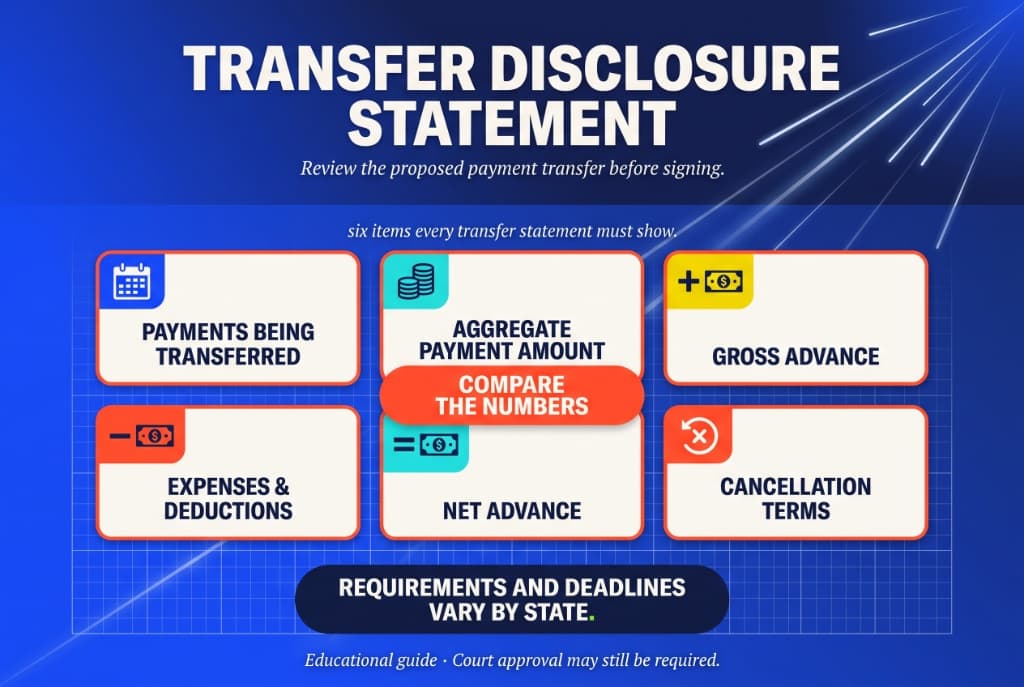
A structured settlement transfer disclosure statement is designed to place important terms of a proposed sale in one readable document. Depending on applicable state law, it may identify the payments being transferred, their aggregate amount, a statutory present-value calculation, the proposed advance, expenses, effective pricing and cancellation rights.
The disclosure is not the same thing as court approval, and it should not be read as a guarantee that a transfer will close. It is a comparison document: it helps the payee see what future payments would be transferred and what the payee would receive now.
Interactive document review
Disclosure Statement Checker
Mark the items you can locate. This checklist is educational and does not replace the requirements of your state law or professional advice.
Start with the payment rights
Verify every payment amount and due date against the annuity payment schedule, benefit letter, prior transfer orders and any current issuer or servicer statement. A disclosure should make it possible to identify exactly which payments are being sold.
This matters especially in a partial sale. Payments outside the proposed transfer should remain identifiable as payments the payee expects to retain, subject to the governing documents and any prior court orders.
Aggregate amount versus present value
| Term | What it generally describes | Question to ask |
|---|---|---|
| Aggregate amount | Total scheduled amount of the transferred payments | Does it match the listed payment amounts and dates? |
| Discounted present value | A current-value calculation made under the method required by applicable law | Which rate and valuation date were used? |
| Gross advance | Proposed consideration before disclosed deductions | Which expenses will reduce this amount? |
| Net advance | Amount after disclosed transfer expenses and deductions | Is this the amount expected at funding? |
Gross advance and net advance are not interchangeable
A large gross figure can be misleading if deductions are not considered. Compare offers using the net amount, the same payment stream and the same valuation date. Ask for clarification if an expense appears estimated, conditional or capable of changing.
Comparison rule
Two offers are not comparable unless they purchase the same payments on the same dates. A higher advance may simply require transferring more payments.
Review the effective pricing
Some state statutes require an effective annual interest-rate disclosure or similarly defined pricing information. This helps translate the relationship between the net amount received and the amount and timing of the payments being transferred.
Do not compare only the headline lump sum. Review the net advance, transferred payment schedule, expenses and effective rate together. If the terminology is unclear, request a written explanation before signing.
For an educational estimate before requesting an actual offer, use the structured settlement cash payout calculator.
Check expenses and deductions line by line
A disclosure may list transfer expenses and estimated legal or filing costs according to the applicable statute. Ask whether each amount is paid by the purchaser, deducted from the advance, or subject to later adjustment.
- Confirm whether every deduction is itemized.
- Ask which amounts are estimates.
- Request the final net amount in writing.
- Keep every version of the quote and disclosure.
- Do not send original documents unless required and secure.
Find the cancellation instructions before signing
The disclosure or transfer agreement may state a cancellation deadline and delivery procedure. Read the exact rule rather than relying on a salesperson's summary. State deadlines and requirements differ.
If cancellation is being considered, preserve proof of delivery and obtain jurisdiction-specific advice promptly. Do not assume that a phone call alone satisfies a written-notice requirement.
The disclosure does not replace court review
Federal tax law generally ties favorable treatment for a structured settlement factoring transaction to advance approval through a qualified order. The order must include findings concerning applicable law and the payee's best interest, including the welfare and support of dependents.
Applicable state law controls the transfer procedure and may add disclosure, notice, advice and hearing requirements. A complete disclosure does not guarantee that the court will approve the transaction.
Questions to ask before comparing offers
- Are all offers purchasing exactly the same payments?
- What amount will I receive after every deduction?
- Which expenses are estimated rather than final?
- What effective pricing measure is disclosed?
- When does the quote expire or become subject to repricing?
- What is the cancellation procedure and deadline?
- Which payments will I continue receiving?
- What happens if the court does not approve the transfer?
Frequently asked questions
Is a disclosure statement the same as a transfer agreement?
Not necessarily. A disclosure is commonly a separate document summarizing specified transaction terms. The transfer agreement is the contract governing the proposed transfer.
Is the federal present-value number my cash payout?
Not necessarily. The statutory current-value calculation and the proposed advance serve different purposes and may use different pricing assumptions.
Should I compare gross advances or net advances?
The net advance is generally more useful, but only when the offers purchase the same payment rights and use comparable timing.
Does every state require identical wording?
No. State structured settlement protection statutes vary. Review the law and documents applicable to the particular transaction.
Does signing guarantee that I will receive the advance?
No. The proposed transfer generally remains subject to applicable legal requirements and advance court or administrative approval.
Primary sources
Bottom line
Compare the exact payment rights being transferred with the net amount received, expenses, effective pricing and cancellation terms. Never compare headline advances without confirming that each offer purchases the same payment stream.
Request a private payment reviewFree quote check
See what your payments are really worth
Compare written offers side by side, with the discount rate and every fee shown. Free, private and no obligation.
- No cost to you
- You choose whether to sell
- Rates and fees in writing