
Case file

Access Funding and the CFPB: What the Structured Settlement Case Teaches Every Seller

The CFPB sued structured settlement buyer Access Funding in 2016 over lead-paint victims, a paid 'independent' adviser and binding-sounding advances. The allegations, the 2021 settlements, Maryland's high court ruling, and how to protect yourself.

Med F., Settlement AnalystMed F. Settlement Analyst Updated 8 min read
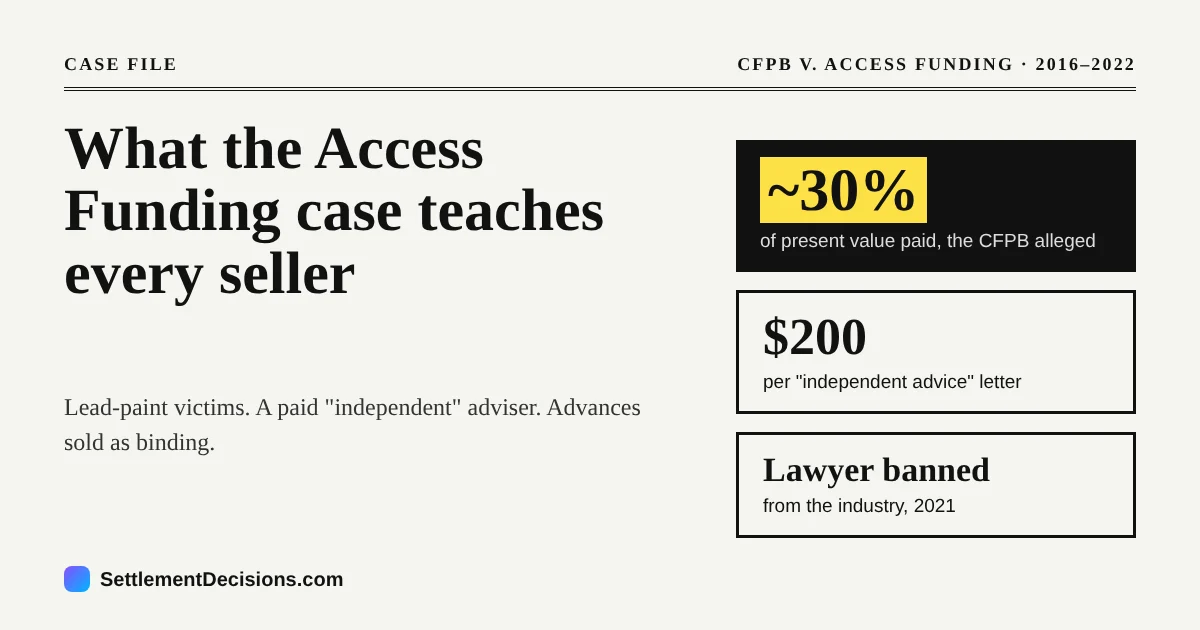
Access Funding case file thumbnail: CFPB lawsuit filed November 2016, lump sums around 30% of present value, adviser paid $200 per letter

Key takeaway

In 2016 the CFPB sued Access Funding, alleging it bought lead-paint victims' settlement payments for about 30% of their value, steered them to an adviser it paid, and told them advances bound them to sell. The case settled in 2021 and 2022. The lessons: your adviser must be truly independent, and an advance doesn't force a sale.

Quick answer: The Consumer Financial Protection Bureau sued Access Funding, a Maryland structured settlement buyer, in November 2016. It alleged the company targeted lead-paint poisoning victims, paid a lawyer $200 per 'independent advice' letter, and falsely said cash advances obligated people to sell. The defendants settled in 2021 and 2022 without admitting the allegations, and the lawyer was banned from the industry.
In this guide (4 sections)
  1. What the CFPB alleged
  2. How it ended
  3. Maryland's high court weighed in
  4. What this means if you're selling now

What the CFPB alleged

On November 21, 2016, the CFPB sued Access Funding, LLC, related companies, three of its principals and a Maryland lawyer in federal court in Maryland (CFPB press release). The Bureau alleged that:

  • It targeted lead-paint poisoning victims, many with significant cognitive impairments, who had structured settlements from lead-paint lawsuits.
  • Lump sums were typically about 30% of the present value of the payments bought.
  • The "independent" adviser wasn't independent. Maryland law requires sellers to get independent professional advice. The CFPB alleged Access steered people to one lawyer, paid him directly ($200 per letter), and that he gave virtually no advice.
  • Advances were used as leverage. Access allegedly gave cash advances to people waiting for court approval and told them they were obligated to finish the sale. The CFPB said they weren't.

Access Funding was based in Chevy Chase, Maryland. It sought court approval for about 200 transfers in Maryland from 2013 to 2015, at least 158 of which were approved. These were allegations, not findings.

How it ended

The case ran for five years, including a pause while the Supreme Court decided a challenge to the CFPB's structure (case page).

DateWhoOutcome
Nov. 18, 2021The lawyer$40,000 disgorgement, $10,000 penalty, permanent ban from structured settlement work
Dec. 17, 2021Access Funding, Access Holding and two principals$40,000 disgorgement, $10,000 penalty, conduct bans
May 18, 2022A third principal$5,000 penalty

The orders bar the settling defendants from referring people to a specific adviser, from misrepresenting their relationship with advisers, and from taking unreasonable advantage of people's misunderstanding of a cash advance.

Maryland's high court weighed in

Victims also sued privately. In Linton v. Consumer Protection Division (Md. Mar. 3, 2020), Maryland's top court reviewed a class settlement covering about 100 lead-paint victims that would have paid them a small share of their losses and tried to make the government drop its own cases. The court held that private parties can't use a settlement to block the state from seeking restitution, and sent the case back (opinion).

What this means if you're selling now

1. Choose your own adviser. If a buyer hands you an adviser's name, find a different one. The adviser should work for you, not be paid by the buyer. See independent professional advice.

2. An advance doesn't lock you in. Read the advance terms. In most deals you can walk away and repay the advance. Never let it stop you from getting other offers. See advances before court approval.

3. Know your present value. If an offer is close to 30% of what your payments are worth today, it's far outside approved deals. Use the present value calculator, then compare with our court deal benchmark, where approved New York deals ran from about 7% to 16% a year.

4. Watch out if someone's capacity is limited. If you're helping a family member with a brain injury or cognitive impairment, be at the hearing. Judges can and do deny sales that don't serve the payee. See denied sales.

5. Report problems. You can file a complaint with the CFPB or your state attorney general.

Talk to a qualified financial advisor who doesn't profit from the sale before you sign.

Sources we checked

Figures were checked on November 19, 2026. Limits and rules change, so confirm the current numbers with the source or a qualified professional.

Prefer to talk it through?

Get a free quote on your settlement, by phone

  • Free and no obligation
  • Know your rate before you sign
  • Questions about court approval

Calls are free. Nothing is sold or signed on a call; any sale of settlement payments needs a judge's approval. Talk to a qualified financial advisor before you decide.

Free quote check

Want offers you can check?

Tell us about your payments and we'll help you compare written offers side by side, with the rate on each one spelled out.

  • No cost to you
  • You choose whether to sell
  • Rates and fees in writing

Tell us where to send your quotes

Takes under a minute. We'll only use your details for this request.

Your details are sent securely. No cost, no obligation.

Keep reading

Related guides and tools

FAQ

Frequently asked questions

What did the CFPB accuse Access Funding of?
Targeting lead-paint poisoning victims, paying lump sums of about 30% of the payments' present value, steering sellers to an adviser it paid, and falsely saying cash advances obligated them to sell.
How did the Access Funding case end?
The lawyer settled in November 2021 and was banned from the industry. Access Funding, Access Holding and two principals settled in December 2021 for $40,000 in disgorgement and a $10,000 penalty plus conduct bans. A third principal paid a $5,000 penalty in 2022.
Does a cash advance from a buyer mean I have to sell?
The CFPB alleged Access falsely told people advances obligated them to sell. Read your advance terms; you can usually walk away and repay the advance.
Who should give me independent advice?
An attorney, CPA or financial advisor you choose who isn't paid by or affiliated with the buyer.
Where can I report a structured settlement buyer?
File a complaint with the Consumer Financial Protection Bureau or your state attorney general.

This guide is for education only. It is not legal, tax, investment or financial advice, and it does not promise any offer, rate or return. Rules differ by state and by your settlement documents. Before you sell payments or change a financial plan, talk to a qualified financial advisor and, where it applies, a tax professional or attorney who is independent of any buyer.

Free quote · no obligation(484) 286-5757Call now