
Company file

Woodbridge Structured Funding: What Happened, and What It Means If You're Selling Payments

Woodbridge Structured Funding bought structured settlement payments before the Woodbridge Ponzi scheme collapsed. The SEC case, the 2017 bankruptcy, Robert Shapiro's sentence, and what sellers should do now.

Med F., Settlement AnalystMed F. Settlement Analyst Updated 7 min read
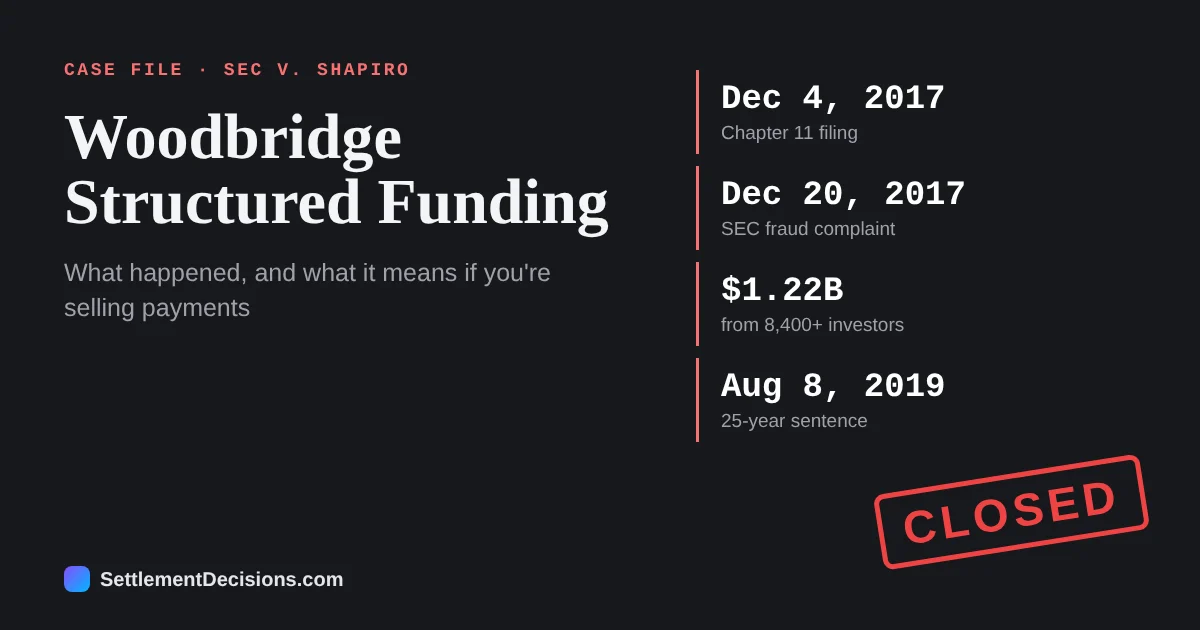
Woodbridge Structured Funding case file thumbnail: SEC complaint December 2017, $1.22 billion from 8,400 investors, Chapter 11 filing and a 25-year sentence

Key takeaway

Woodbridge Structured Funding, a buyer of structured settlement payments, was owned by Robert Shapiro and named as a defendant in the SEC's December 2017 fraud case against Woodbridge. The group filed for bankruptcy, Shapiro got 25 years, and the company no longer operates. Payments you kept are still paid by your insurer.

Quick answer: Woodbridge Structured Funding is closed. It bought structured settlement and annuity payments, and the SEC named it as a defendant in its December 2017 case over a Ponzi scheme that raised more than $1.22 billion from over 8,400 investors through real estate notes. Woodbridge filed for bankruptcy in December 2017. Your remaining payments come from your insurer, not from Woodbridge.
In this guide (5 sections)
  1. What Woodbridge Structured Funding was
  2. What happened
  3. If you sold payments to Woodbridge years ago
  4. If someone using the Woodbridge name contacts you now
  5. Choosing a buyer today

What Woodbridge Structured Funding was

Woodbridge Structured Funding, LLC ("WSF") bought structured settlement, annuity and lottery payments for lump sums. According to the SEC's complaint:

  • WSF was a Delaware company formed in 2009, owned and controlled by Robert H. Shapiro.
  • From about 2012 to 2015, it was the operating company for Shapiro's businesses and held their main bank account.
  • It was headquartered in Boca Raton, Florida. The Woodbridge group later moved to Sherman Oaks, California.
  • Before 2016, the Woodbridge business operated under the WSF name.

The settlement-buying business is why people still search for it. Some sellers dealt with WSF years ago; others see the name in old comparison lists.

What happened

DateEventSource
Early Dec. 2017Woodbridge stops paying investorsStructured Settlements 4Real blog
Dec. 4, 2017Woodbridge entities file for Chapter 11 bankruptcy in DelawareSame
Dec. 20, 2017SEC sues Shapiro, WSF and related companies for fraudSEC complaint
Aug. 8, 2019Shapiro sentenced to 25 years in federal prisonU.S. Attorney, S.D. Fla.

The SEC alleged that Woodbridge raised more than $1.22 billion from over 8,400 investors, including at least 2,600 who used retirement savings totaling nearly $400 million. Investors bought short-term notes promising 5% to 8% a year, supposedly backed by loans to third-party property owners. The SEC said those "borrowers" were Shapiro-controlled companies with no income, so older investors were paid with new investors' money. The Justice Department put the scheme at about $1.3 billion.

The fraud was in the real estate notes, not in settlement payments. The SEC charged WSF because it was the operating company, held investor money and acted as an unregistered broker-dealer, according to the complaint.

If you sold payments to Woodbridge years ago

  • The payments you kept are still yours. Your insurer (the annuity issuer) pays them, not the buyer. A buyer going bankrupt doesn't touch payments you didn't sell.
  • The payments you sold were redirected by a court order to the buyer or whoever it later sold them to. You don't owe anything back on a completed, court-approved sale.
  • If payments look wrong, call the insurer on your annual statement and ask for a list of who receives each payment. See late or missing payments.

If someone using the Woodbridge name contacts you now

Woodbridge Structured Funding no longer buys payments. If a caller or letter uses the name:

  1. Don't sign anything or accept an advance.
  2. Ask for the company's exact legal name and address in writing, then check your state's registration list. See registered buyers by state.
  3. Report suspected impersonation to your state attorney general. See structured settlement scams.

Choosing a buyer today

The Woodbridge story is a reminder to check who you're dealing with:

  • Check registration where your state requires it (Georgia, Minnesota, Nevada, Louisiana).
  • Get three written offers for the same payments and compare net cash and the effective rate with the discount rate calculator.
  • Benchmark against real court orders. Approved New York deals in our court deal benchmark ran from about 7% to 16% a year.
  • Never "invest" with a buyer. Selling your payments is a sale, not an investment. Anyone pitching you notes or high-yield products alongside a settlement sale is a warning sign.

Talk to a qualified financial advisor who doesn't profit from the sale before you decide.

Sources we checked

Figures were checked on November 19, 2026. Limits and rules change, so confirm the current numbers with the source or a qualified professional.

Prefer to talk it through?

Get a free quote on your settlement, by phone

  • Free and no obligation
  • Know your rate before you sign
  • Questions about court approval

Calls are free. Nothing is sold or signed on a call; any sale of settlement payments needs a judge's approval. Talk to a qualified financial advisor before you decide.

Free quote check

Looking for a buyer you can check?

Tell us about your payments and we'll help you compare written offers from buyers you can verify, side by side.

  • No cost to you
  • You choose whether to sell
  • Rates and fees in writing

Tell us where to send your quotes

Takes under a minute. We'll only use your details for this request.

Your details are sent securely. No cost, no obligation.

Keep reading

Related guides and tools

FAQ

Frequently asked questions

Is Woodbridge Structured Funding still in business?
No. Woodbridge filed for Chapter 11 bankruptcy on December 4, 2017, and Woodbridge Structured Funding no longer buys payments.
Was Woodbridge Structured Funding part of the Woodbridge Ponzi scheme?
The SEC named Woodbridge Structured Funding, LLC as a defendant in its December 2017 complaint. It was owned by Robert Shapiro and served as the operating company for his businesses from about 2012 to 2015. The fraud involved real estate notes sold to investors.
What happened to Robert Shapiro?
He was sentenced to 25 years in federal prison on August 8, 2019, according to the U.S. Attorney's Office for the Southern District of Florida.
I sold payments to Woodbridge. Are my other payments safe?
Yes. Payments you kept are paid by your insurer, not by the buyer. A buyer's bankruptcy doesn't affect payments you didn't sell.
Who are the alternatives to Woodbridge?
Compare several registered buyers, such as those on Georgia's and Minnesota's lists, and get at least three written offers for the same payments.

This guide is for education only. It is not legal, tax, investment or financial advice, and it does not promise any offer, rate or return. Rules differ by state and by your settlement documents. Before you sell payments or change a financial plan, talk to a qualified financial advisor and, where it applies, a tax professional or attorney who is independent of any buyer.

Free quote · no obligation(484) 286-5757Call now