

Where these investments come from
Every structured settlement investment starts with a person who settled an injury or workers' compensation case and later sold future payments for a lump sum. That sale needs a judge's approval under the state's structured settlement protection act. Without a qualified court order, the buyer owes a 40% federal excise tax under 26 U.S.C. § 5891.
The factoring company that bought the payments then funds itself in one of two ways:
| Route | Who buys | What you own |
|---|---|---|
| Secondary market annuity | Individuals, often through an insurance or annuity broker | The right to a specific stream of payments from an insurer |
| Asset-backed notes | Institutional investors | Bonds backed by a pool of many payment streams |
Example of the institutional route: in March 2025, Morningstar DBRS rated $100 million of fixed-rate notes issued by JG Wentworth LIV, LLC at A (sf). J.G. Wentworth originates and services the payment streams behind them, and there's a backup servicer in case it can't.
Some self-directed IRA custodians also let an IRA hold structured settlement payments. The payments then go into the IRA, not to you personally.
What the SEC and FINRA warn about
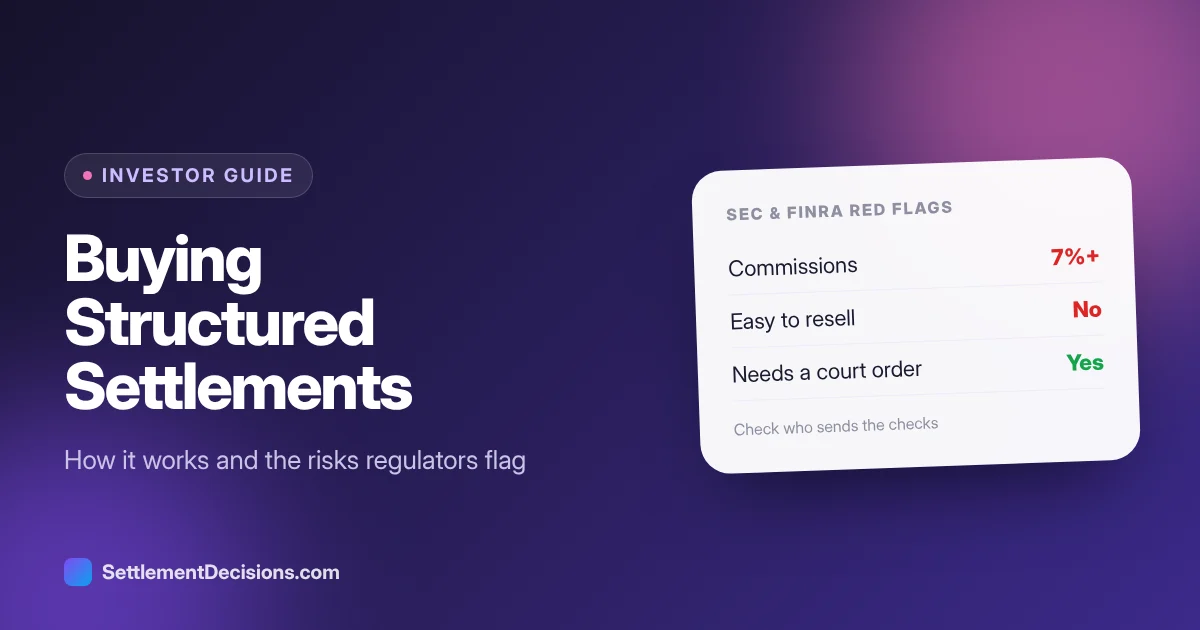
In a joint investor alert, "Pension or Settlement Income Streams" (May 9, 2013), FINRA and the SEC's investor education office list these risks for buyers:
| Risk | What the alert says |
|---|---|
| Cost | Commissions can be 7% or higher. |
| Regulation | The products may not be securities and are likely not registered with the SEC, so information is hard to find and disputes are hard to resolve. |
| Liquidity | You may not be able to sell, or only at a loss. |
| Legal challenges | Your right to the payments could be challenged. |
| Payment handling | In some setups, the original holder forwards the checks, and might not. |
| Payer risk | If the insurer or pension fund gets into financial trouble, payments may stop. |
The alert's red flags: pitches that use "guaranteed" and "safe," returns well above CDs or money market accounts, and names like "secondary-market annuities" sold by financial salespeople. It also suggests asking:
- Is the seller registered? Check FINRA BrokerCheck, the SEC's adviser search, and your state securities and insurance regulators.
- How is the salesperson paid, and how does that cut your return?
- Who exactly pays you, how strong is that insurer, and who sends the checks?
- What are the tax consequences?
Six checks before you buy
- Get the court order. Make sure it names the payments you're buying, is final, and directs the insurer to pay the new owner. A sale without proper approval is the "legal challenge" the alert warns about.
- Get the insurer's acknowledgment. Ask for written confirmation from the insurer or assignment company that it will send payments to you or your custodian. Avoid setups where the original payee forwards checks.
- Know whether the payments depend on someone's life. If payments stop when the original payee dies, you carry that risk. Many buyers stick to guaranteed (period-certain) payments. See life-contingent payments.
- Check the insurer's strength. Look at A.M. Best and other ratings, and know your state guaranty association's limits. See what if the insurer goes bankrupt.
- Get every cost in writing. Commissions, servicing and custodian fees all come out of your return. Work out the yield after all costs, not before.
- Ask a tax professional. The tax-free treatment under 26 U.S.C. § 104(a)(2) applies to damages received for personal physical injuries. As a buyer you didn't receive damages, so expect your gain to be treated differently.
The other side of the trade
Your yield comes from the discount the seller accepted. Courts look hard at that discount. In 2023 a Brooklyn judge refused a sale of $36,000 in payments for $15,192.37, a 40.75% discount rate the judge called "grossly excessive," and sent the decision to the New York Attorney General (Sapphire Valley Group v Prudential Assigned Settlement Services). Payment streams from fair, well-documented, court-approved sales are the sound ones to own.
If you're the person with the structured settlement and wondering what your payments are worth to buyers like these, start with our court deal benchmark and discount rate calculator.
Nothing here is a recommendation to buy. Past or advertised yields don't predict what you'll earn. Talk to a qualified financial advisor and a tax professional before you invest.