

Which Prudential company pays you?
Prudential's structured settlement page says its structured settlement products are "insurance contracts issued by The Prudential Insurance Company of America (PICA), Newark, NJ."
If your case used a qualified assignment, a second company owes you the payments: Prudential Assigned Settlement Services Corporation. New York court decisions on Prudential payees name both. The assignment company is the legal "obligor" and PICA is the annuity issuer.
Your settlement agreement and annuity contract give the exact names and your contract number. Have them ready for every call and form. For what each role means, see owner, payee and beneficiary explained.
How to contact Prudential about your payments
From Prudential's structured settlement page:
| What you need | How |
|---|---|
| Questions about an existing structured settlement | 877-778-8118 |
| Switch to direct deposit | Direct deposit form: print, fill in, mail to the address on the form |
| New mailing address | Address change form |
| New beneficiary | Beneficiary change form |
Prudential's site also lists 800-521-5774, but that line is for brokers, not payees.
Getting proof of your payments
Lenders, landlords and buyers want a letter that lists your remaining payments. Ask for one on the payee line. Update your address first if you've moved, so the letter reaches you. Our guide to income verification letters covers what lenders look for.
How safe are Prudential payments?
Prudential's page lists these financial strength ratings for PICA as of February 6, 2026:
| Rating agency | Rating |
|---|---|
| A.M. Best | A+ (second highest of 13) |
| Fitch | AA- |
| Moody's | Aa3 |
| S&P | AA- |
Ratings are opinions, not guarantees, but they sit near the top of each scale. For what happens if any insurer fails, see what if the insurance company goes bankrupt.
Prudential sells two structured settlement annuities: a traditional fixed one and Income Advantage, which links growth during a deferral period to the S&P 500. If yours is Income Advantage, ask the payee line how your future payment amounts are set before you price a sale. A buyer has to know exactly what it is buying.
Can you sell Prudential structured settlement payments?
Yes, but only with a judge's approval. Prudential pays the schedule in your contract; it doesn't pay early or buy payments back. To get a lump sum, you sell some or all future payments to a buyer. The buyer asks a court to approve the transfer under your state's protection act, and Prudential is notified as an interested party.
Without a qualified court order the buyer would owe a 40% federal excise tax under 26 U.S.C. § 5891, so legitimate buyers always go to court.
Two recent Prudential court decisions
Both are published New York decisions. Both were denied.
| Decision | Buyer | Payments sold | Price offered | Share of face value | Result |
|---|---|---|---|---|---|
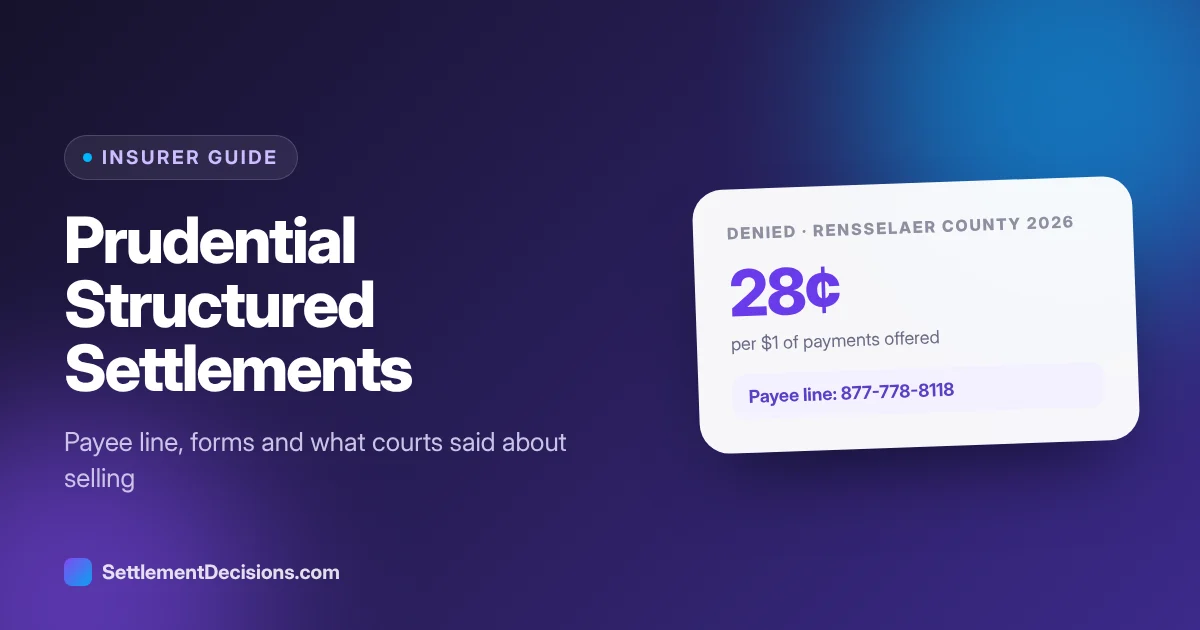
| Rensselaer County, May 27, 2026 | J.G. Wentworth | $2,253.12 a month rising 3% a year to 2058, plus two $15,000 lump sums: $1,445,031.84 in total | $404,000 | about 28% | Denied |
| Kings County, Apr. 14, 2023 | Sapphire Valley Group | 24 monthly payments of $1,500 in 2024 and 2025: $36,000 | $15,192.37 | about 42% | Denied with prejudice |
The 2026 case. The seller was 26, earned $145,000 a year as a steelworker, and wanted the money for a multi-family rental property. It was his fourth petition; the first three were also denied. The court valued the payments at $689,705.85 using the federal rate of 4.60%, against the $404,000 offered. His own financial advisor didn't support the plan. The judge found the deal neither "fair and reasonable" nor in his best interest.
The 2023 case. The buyer's disclosure statement showed a 40.75% discount rate, which the judge called "grossly excessive." The same seller had sold $556,000 of payments for $200,377.83 (about 36%) a year earlier, and the petition didn't properly disclose that. The judge sent the decision to the New York Attorney General.
What these teach:
- Courts compare the price with what the payments are worth. In 2026 the gap was about $286,000 at the federal rate.
- "Best interest" is a real test. A good income and a plan weren't enough when the plan was risky and the price was low.
- Repeat sales get harder. Judges look at earlier sales, and buyers must disclose them.
Compare any offer with approved deals using our court deal benchmark.
If you're thinking about selling
- Ask Prudential for a letter listing your remaining payments. Buyers price from it, and you can check their math.
- Sell the smallest piece that solves the problem. See partial sales.
- Get at least three written offers for the same payments. Compare the net cash and the effective annual rate. Our discount rate calculator finds the rate in any offer.
- Check the buyer's registration where your state requires it: registered buyers by state.
- Get advice from someone with nothing to gain. Many states require independent professional advice, and judges ask about it.
Talk to a qualified financial advisor before you sign anything.