
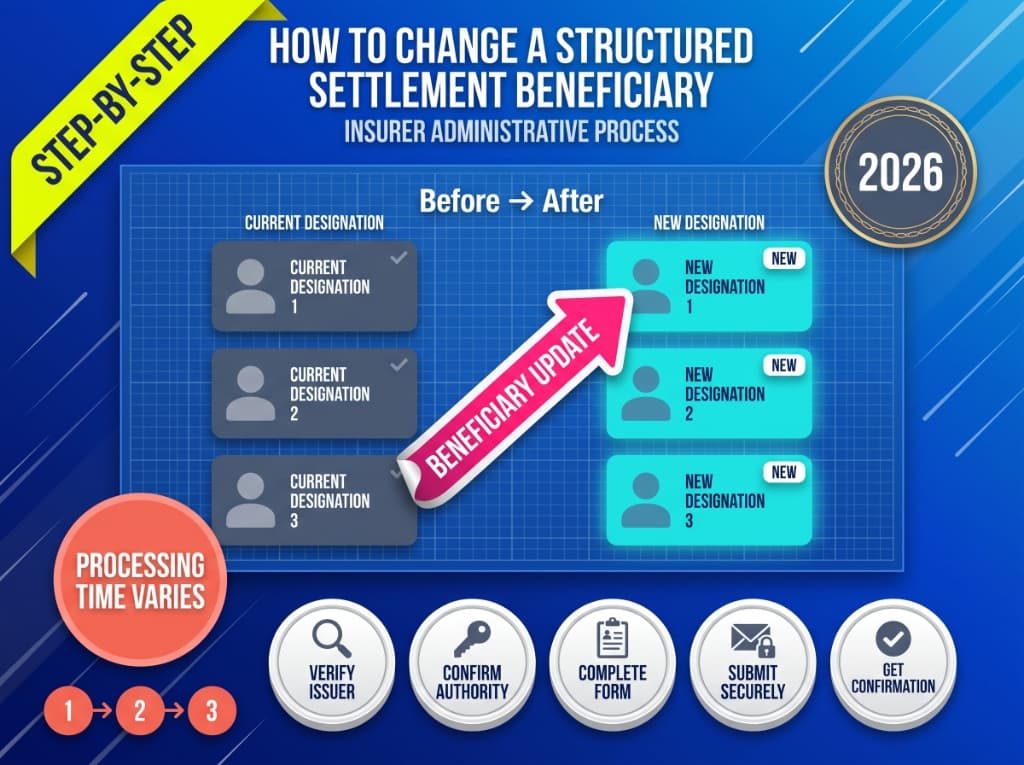
First determine whether a beneficiary change is permitted
Many structured settlement recipients can request a beneficiary update, but no universal rule gives every payee unrestricted authority to change every designation. A structured settlement can involve an assignment company that owns the annuity, an insurer that issues it, a payee who receives payments and a beneficiary who may receive eligible remaining benefits after a covered death.
The payee often does not own the annuity contract. That is different from owning a conventional life insurance policy or personally purchased annuity. The settlement agreement, qualified assignment and annuity records determine which party has authority to make a change.
Corebridge, for example, publishes a structured settlement beneficiary form and notes that the owner will be contacted for authorization after a completed form is received. New York Life, Pacific Life and Prudential also provide structured settlement service resources or beneficiary forms. Their procedures are not necessarily interchangeable.
Before filling out a form, ask the issuer these questions:
- Does this payment stream permit a beneficiary change?
- Who is currently recorded as the beneficiary?
- Who must sign or authorize the change?
- Does the request require notarization or witness signatures?
- Can primary and contingent beneficiaries be named?
- Are percentage allocations permitted?
- What documents are required for a trust, minor or estate?
- How will acceptance of the change be confirmed?
Changing a beneficiary does not create death benefits
A beneficiary designation controls who may receive benefits that survive the relevant death under the governing documents. It does not create a benefit where none exists.
Guaranteed payments generally continue for their specified term regardless of whether the measuring life survives. Pure life-contingent payments generally stop when that person dies. A hybrid arrangement may provide payments for life with a guaranteed minimum period.
Suppose a payment stream provides $2,000 per month for life with ten years guaranteed. If the payee dies in year six, approximately four years of guaranteed payments may remain for the valid beneficiary. If the payee dies after the tenth year, the guaranteed period has expired and the life-contingent payments generally stop.
Naming a new beneficiary does not restart that guarantee, extend its length or convert life-only payments into guaranteed payments. Ask the issuer to identify the remaining guaranteed benefits before making estate-planning assumptions.
The beneficiary answers “who may receive eligible remaining payments.” The payment schedule answers “whether any payments remain.”
Step 1: Identify the correct insurer and payment stream
Use a recent payment notice, direct-deposit description, annuity certificate, tax document or official correspondence to identify the legal insurer and current servicing company. Brand names can change after mergers, acquisitions or servicing transfers, so an old company name may not match the current website.
A recipient can have more than one structured settlement annuity. Separate streams may have different issuers, owners, beneficiaries and guarantees. A form submitted for one contract may not update the others.
Do not rely on a phone number from an unsolicited text, email or advertisement. Navigate independently to the insurer’s official website or use a verified number printed on recent correspondence. Never send a Social Security number, contract record or identity document to an unverified recipient.
Step 2: Confirm who can authorize the request
The person receiving the payments may be allowed to request the beneficiary change, but the annuity owner may retain formal authority over the contract. The insurer’s process can require the assignment company to approve or acknowledge the request.
Additional authority questions arise when the payee is a minor, has a court-appointed guardian, acts through an agent under a power of attorney or is subject to a protective order. The signer may need to provide court papers or another document proving authority.
A power of attorney does not automatically authorize every beneficiary change. Such a change can be treated as a significant estate-planning act, and the document or governing state law may need to grant specific authority. The issuer should review the instrument before the agent assumes that a signature will be accepted.
Step 3: Obtain the issuer’s structured settlement form
Use the form intended for structured settlements. An insurance company can maintain separate forms for life insurance, retirement plans, employee benefits, personally owned annuities and structured settlement annuities. Submitting the wrong form creates delay and can leave the previous designation in place.
New York Life’s Structured Settlement Service Central specifically lists a change-of-beneficiary request. Pacific Life directs structured settlement clients through its dedicated client-forms channel. Prudential includes beneficiary-change resources within its structured settlement service materials.
Download a fresh copy from the official source instead of reusing a form saved years ago. Addresses, fax numbers, legal disclosures and signature requirements can change.
Step 4: Complete the designation precisely
Beneficiary forms often distinguish between primary and contingent beneficiaries. A primary beneficiary is first in line for eligible benefits. A contingent beneficiary generally receives them only if no eligible primary beneficiary survives or qualifies under the form.
Use full legal names and provide the information requested by the insurer. Avoid informal descriptions such as “my children” unless the form expressly permits a class designation and you understand how it will be administered.
When naming multiple beneficiaries, verify that percentage shares total exactly 100%. Decide whether the arrangement should distribute a deceased beneficiary’s share among surviving named beneficiaries or through that beneficiary’s descendants. Do not add Latin estate terms such as “per stirpes” unless the issuer accepts them and their legal effect has been reviewed.
| Designation | Information commonly needed | Issue to verify |
|---|---|---|
| Individual adult | Legal name, relationship, birth date and contact details | Identity and percentage allocation |
| Multiple individuals | Information for every beneficiary and assigned shares | Shares total 100% and contingent instructions are clear |
| Minor | Child’s information and potential guardian or custodian details | How payment will be legally administered before adulthood |
| Trust | Exact trust name, date, trustee and requested trust documents | Trust exists and designation matches estate plan |
| Estate | Designation wording required by issuer | Probate, creditor and administration consequences |
| Charity | Legal organization name, address and tax identification details | Correct entity and successor instructions |
Special considerations when naming a minor
Naming a minor directly can create administrative complications if the payee dies before the child reaches legal adulthood. An insurer may not be permitted to send unrestricted payments directly to a child. A guardian, conservator, custodial account, restricted account or trust may be required.
A parent is not automatically authorized to take unrestricted control of money legally belonging to the child. Court appointment can be required, particularly for substantial payments.
Before naming a minor, discuss the payment schedule with an estate-planning attorney. Relevant questions include the amount and duration of potential payments, the child’s age, special needs, eligibility for public benefits and whether a trust or custodial designation is appropriate.
Special considerations when naming a trust
A trust can provide management instructions, continuity and protections that a direct individual designation does not. However, the trust must be valid and the designation must identify it correctly.
The insurer may request the trust’s full legal title, execution date, trustee name, successor-trustee information, tax identification details or selected certification pages. Avoid abbreviations that could refer to more than one instrument.
Naming “my trust” without a clear legal identifier can cause disputes or delays. Coordinate the insurer’s wording with the attorney who prepared the trust. If the trust is amended or restated, determine whether the beneficiary designation should also be updated.
Should you name your estate?
Naming an estate can be appropriate in some plans, but it can route eligible payments through probate. That can introduce administration, delay, creditor questions and distribution under a will or intestacy law.
A named individual or trust may provide a more direct contractual path, but no choice is universally best. Estate liquidity needs, tax considerations, creditor exposure, family circumstances and the payment schedule should be evaluated together.
Do not assume that leaving the beneficiary line blank produces the same result as intentionally naming the estate. The contract may have a default succession provision.
Marriage, divorce and family changes
Review beneficiary records after marriage, divorce, birth, adoption, death of a beneficiary or a major estate-plan revision. The National Association of Insurance Commissioners encourages consumers to keep beneficiary information current after significant life events.
Divorce requires special caution. Some states have laws that may revoke certain former-spouse designations, while court orders or settlement agreements can preserve obligations. Contract terms and federal rules can also affect other types of benefits.
Do not rely on the divorce decree alone unless qualified counsel and the issuer confirm its effect. Submit any permitted change and obtain written acceptance.
Step 5: Submit the request securely
Follow the form’s instructions exactly. Depending on the insurer, the approved channel may be secure online upload, mail or fax. Emailing sensitive documents to an address found through an advertisement can expose identity and contract information.
Before submission, confirm that all required fields are complete, percentage shares total 100%, signatures are dated and any witness or notarization requirement is satisfied. Include only supporting documents requested for the designation.
Keep a complete copy and evidence of delivery. If mailing original documents is required, use a trackable method and retain copies.
Step 6: Obtain written confirmation of acceptance
Delivery is not acceptance. A form can be received but rejected because of missing information, incorrect authority, inconsistent percentages, an outdated version or absent trust documents.
Ask the issuer or servicer to confirm in writing that the new designation was accepted and recorded. Check the spelling, shares, primary and contingent status, and effective date shown in the confirmation.
Store the confirmation with the settlement agreement, annuity records, will, trust and other estate-planning materials. Tell a trusted person where the records are located without unnecessarily distributing sensitive contract information.
Common reasons a beneficiary request is delayed or rejected
- The wrong company or department received the form.
- A generic annuity form was used instead of the structured settlement form.
- The person signing lacked authority.
- The annuity owner’s authorization was missing.
- Beneficiary shares did not total 100%.
- A beneficiary’s legal name or identifying information was incomplete.
- Required trust, guardianship or power-of-attorney documents were omitted.
- Joint payees did not provide all required signatures.
- The form lacked required witnesses or notarization.
- The requested change conflicted with the settlement or court order.
Beneficiary change versus ownership or payment transfer
A beneficiary change is not a sale of payment rights. It generally identifies who may receive eligible payments after death. A factoring transaction transfers specified payment rights for current cash and is governed by separate disclosure and court-approval requirements.
A beneficiary also does not ordinarily gain present control while the payee is alive. The payee continues receiving the payments unless the governing documents or a qualified transfer order provide otherwise.
Likewise, changing a bank account for direct deposit is a servicing update, not a beneficiary change. Keep the requests separate so the insurer knows exactly what should be updated.