
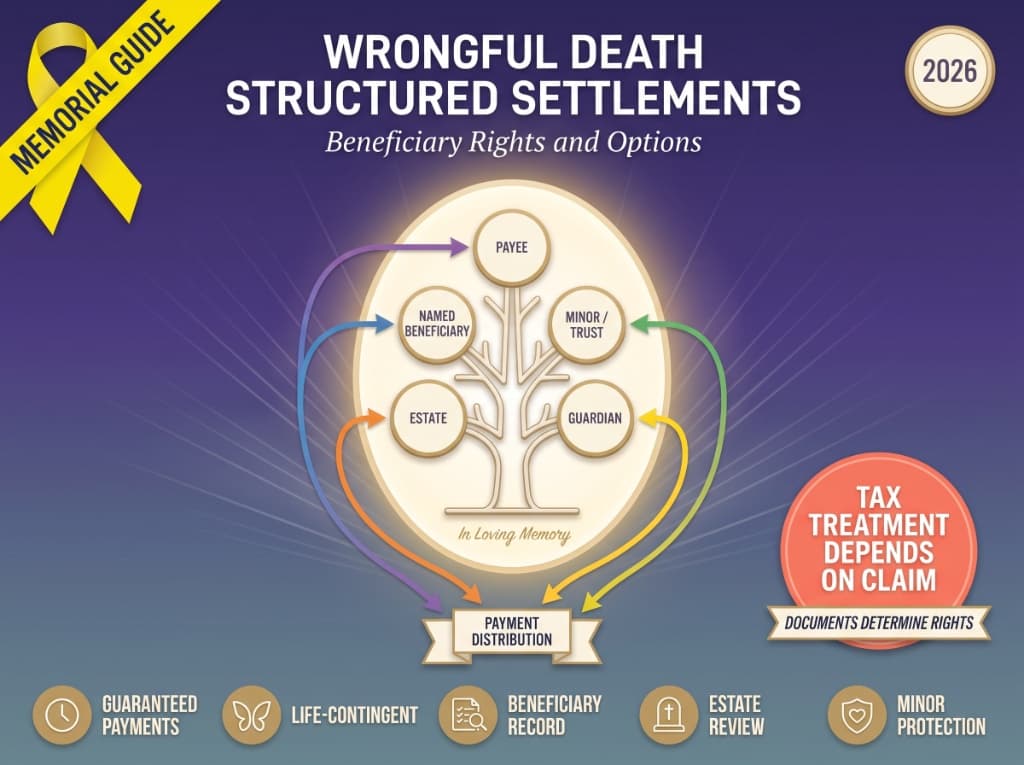
What a wrongful death structured settlement actually does
A wrongful death claim seeks compensation for losses arising from a person’s death. Depending on state law and the facts of the case, eligible claimants may include a surviving spouse, children, parents, an estate representative or other dependents. The recoverable damages and persons authorized to bring the claim differ by jurisdiction.
When the case resolves, the parties may divide the recovery between immediate cash and future periodic payments. A defendant or liability insurer can assign the periodic-payment obligation to an assignment company, which purchases an annuity to fund the agreed schedule.
Each survivor’s allocation can be different. A surviving spouse might receive monthly income for living expenses, while children receive future lump sums for education and additional payments beginning at specified ages. The settlement should identify who owns each payment right rather than treating the family’s recovery as one informal pool.
The annuity company does not decide who should recover wrongful death damages. That allocation is established through the settlement, court proceedings where required and the documents submitted when the annuity is funded.
The three documents that usually control payment rights
Family assumptions do not override written settlement terms. When a disagreement or payment question arises, begin with the controlling documents.
Settlement agreement
Describes the claim resolution, allocation, payees and promised payment obligations.
Qualified assignment
Identifies the obligation transferred to the assignment company and the related payment schedule.
Annuity and beneficiary records
Show the funding contract, measuring life, guarantees and current beneficiary designation.
These documents should be reviewed together. An annuity certificate may summarize payments but not reproduce every settlement condition. A beneficiary form may identify who receives guaranteed payments after death but does not give that person ownership while the original payee is alive.
Guaranteed payments versus life-contingent payments
The most important survivor-rights question is whether the remaining payments are guaranteed or contingent on a person remaining alive. The labels used in the contract matter more than the family’s understanding of what the settlement was intended to accomplish.
| Payment design | While payee is alive | After payee dies | Beneficiary issue |
|---|---|---|---|
| Guaranteed fixed term | Payments continue for the stated term | Unpaid guaranteed remainder generally continues | Valid beneficiary or estate may receive it |
| Life-only | Payments continue while measuring life survives | Payments generally stop | No guaranteed remainder to inherit |
| Life with period certain | Lifetime income, subject to contract | Guaranteed-period remainder may continue | Rights depend on death date and remaining guarantee |
| Guaranteed future lump sum | Paid on scheduled date if still unpaid | May remain payable after death | Designation and ownership must be confirmed |
| Life-contingent lump sum | Payable only if measuring life survives to date | Usually not payable after earlier death | Beneficiary cannot remove survival condition |
Guaranteed fixed-term payments
A guaranteed term requires payments for a defined period regardless of whether the original payee survives for the entire period. If a twenty-year guaranteed stream has seven years remaining when the payee dies, those seven years may continue to the designated beneficiary, subject to the documents and claim process.
“Guaranteed” does not necessarily mean payable immediately as one lump sum. It normally means the remaining payments continue on their original dates. Any commutation provision or lump-sum death benefit must appear in the governing arrangement.
Life-only payments
Pure life-contingent payments protect against the financial risk of a payee living longer than expected. In exchange, the obligation generally ends when the measuring life dies. Naming a beneficiary does not convert a life-only stream into guaranteed payments.
This can surprise relatives who remember a long projected payment schedule but do not realize that the illustration assumed continued survival. Confirm whether the document says “for life,” “life contingent,” “period certain,” “guaranteed” or a combination.
Life with a guaranteed period
A hybrid arrangement pays for life but guarantees a minimum period. If the payee survives beyond the guaranteed period, lifetime payments can continue. If the payee dies during the guaranteed period, the remaining guaranteed payments may continue to the beneficiary.
Example: payments are made for life with twenty years guaranteed. If the payee dies in year twelve, approximately eight years of the guaranteed term remain. If the payee dies in year twenty-five, the guarantee has expired and the life-contingent payments generally end.
Named beneficiary versus the payee’s estate
A named beneficiary can create a more direct claims path for eligible guaranteed payments. The beneficiary normally submits the insurer’s claim documents and a certified death certificate. Additional identity, tax or relationship documentation may be requested.
If no valid beneficiary survives, if the designation is missing or if the documents direct payment to the estate, the remaining rights may enter probate. The personal representative may need letters testamentary, letters of administration or another court document proving authority.
Probate can affect timing, creditor issues and distribution under a will or intestacy law. It does not automatically change a life-contingent payment into a guaranteed asset. The estate receives only rights that survived under the contract and settlement.
Being the closest relative does not automatically make someone the contractual beneficiary. Being named as beneficiary does not automatically create payments that were never guaranteed.
Can a beneficiary designation be changed?
Some structured settlement arrangements permit a beneficiary change; others restrict who can request it or require consent from the annuity owner. The recipient should use the structured settlement servicing form issued by the correct insurer, not a generic life-insurance form found through an advertisement.
New York Life publishes a structured settlement beneficiary-change request through its Service Central page. Corebridge publishes a structured settlement beneficiary form and explains that the owner may be contacted for authorization. These examples demonstrate why the correct procedure depends on the issuer and ownership structure.
Divorce, remarriage, birth, adoption and death of a previous beneficiary are reasons to review the designation. Whether those events automatically revoke or change a designation is a state-law and contract question. Do not assume that a will overrides the insurer’s accepted beneficiary record.
Rights of children and protected beneficiaries
Wrongful death recoveries frequently include children. A child’s allocation belongs to the child even when a parent or guardian manages paperwork. Courts may require a minor settlement hearing, restricted account, guardianship, trust or structured payment arrangement.
Payments can be designed around expected needs: monthly support, tuition payments, lump sums at selected ages or lifetime care for a disabled beneficiary. The design should consider whether the child can manage a large payment at the scheduled age and whether means-tested benefits could be affected.
A parent generally cannot sell, redirect or use the child’s payment rights as though they were the parent’s property. Transactions involving a minor or legally protected adult require specialized review and may be restricted even when the family believes the transaction would help.
Tax treatment of wrongful death structured settlements
Internal Revenue Code Section 104 excludes certain damages received on account of personal physical injury or physical sickness from gross income, whether paid as lump sums or periodic payments. The IRS emphasizes that the facts and circumstances control and asks what the settlement payment was intended to replace.
Wrongful death compensatory damages connected to physical injury or death may qualify for exclusion. However, interest awarded separately, punitive damages and amounts allocated to other claims can receive different treatment. Section 104 contains a narrow rule involving punitive damages in particular wrongful death actions where applicable state law provided only punitive damages.
The settlement agreement’s characterization matters, but labels alone cannot transform the nature of a payment. Survivors should preserve the complaint, settlement agreement, allocation, court order, tax forms and correspondence supporting the payment’s origin.
A beneficiary should not assume that every inherited annuity payment has the same tax treatment as every other inherited asset. Obtain advice based on the underlying claim and documents rather than a general rule about inheritance.
How to claim remaining payments after a death
Contact the annuity issuer or authorized structured settlement servicer through an official website, recent correspondence or the phone number printed on the payment record. Avoid sending documents to a company that contacts the family unexpectedly.
- Identify the legal annuity issuer and any current servicing company.
- Ask whether the payment stream contains a remaining guarantee.
- Confirm the beneficiary currently recorded for the relevant stream.
- Request the issuer’s official beneficiary claim instructions.
- Obtain certified death certificates in the quantity actually required.
- Submit identity, address and payment instructions securely.
- Keep copies and record the date, department and reference number.
- Ask whether payments accrue during review and how missed scheduled payments will be handled.
Do not publish contract numbers, Social Security numbers, death certificates or bank information in public forums. A legitimate issuer can explain its secure submission process.
Can inherited wrongful death payments be sold?
A beneficiary who has legally succeeded to guaranteed structured settlement payment rights may be able to transfer some or all of those rights. But receiving payments and having transferable ownership are separate questions.
The review should establish that the original payee died, the beneficiary designation is valid, the payments survived the death, no probate dispute exists and the proposed seller has authority over the rights. A buyer may request the settlement agreement, annuity records, death certificate, beneficiary confirmation and estate documents.
Structured Settlement Protection Acts generally require advance disclosures and judicial approval of a transfer. For example, Virginia’s statute provides a court process for approving transfers and defines relevant parties and payment rights. Exact procedures, notice periods and best-interest findings vary by state.
A court-approved transfer does not normally rewrite the annuity’s payment dates. It redirects the transferred payments to the buyer on their original schedule in exchange for a discounted lump sum paid to the seller.
Common disputes and how to prevent them
Multiple people claim to be the beneficiary
Competing forms, divorce documents, wills and family statements can create conflict. The insurer may suspend distribution while reviewing the records or may seek a judicial determination. Keep confirmation of any beneficiary change accepted by the issuer.
The family expected payments to continue, but they stopped
The stream may have been life-contingent or the guaranteed period may have expired. Request a written explanation identifying the provision controlling termination. Compare it with the settlement and annuity documents.
The beneficiary is a minor
The insurer may require proof of guardianship, a restricted account or court instructions. The adult caring for the child does not automatically receive unrestricted ownership.
The issuer or assignment company changed names
Corporate mergers and servicing changes can make old paperwork confusing. Start with the exact legal name and contract number shown in the original records, then verify the successor through official insurer communications or a state insurance regulator.
The estate has debts
Payments directed to an estate may be subject to probate administration and creditor rules. Payments passing through a valid beneficiary designation can follow a different route, but exemptions and creditor protections depend on applicable law.
A document checklist for survivors
A survivor does not need every document before making the first call, but assembling them early can reduce delays and reveal whether the question concerns a beneficiary claim, probate administration, payment servicing or a proposed transfer.