
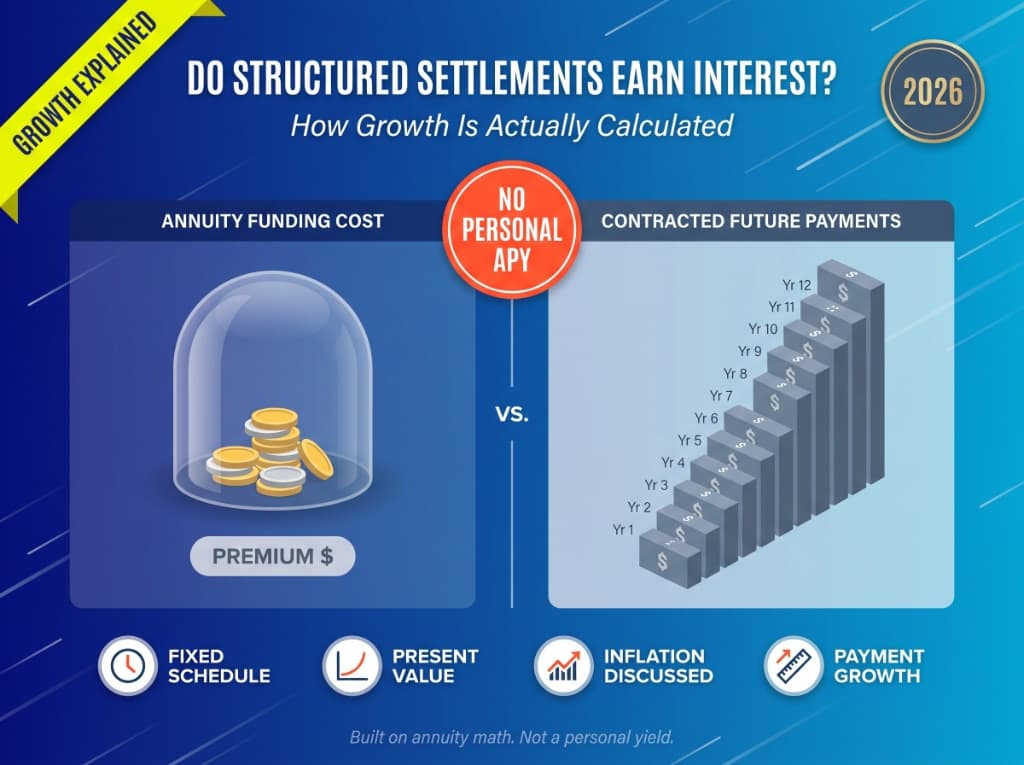
The essential distinction: account interest versus annuity pricing
The word “interest” can describe several different financial ideas. In a bank account, interest is generally credited to an identifiable balance. The account owner can usually view the balance, see the annual percentage yield, deposit additional money and withdraw funds subject to the account rules. A conventional investment account may also report gains, losses, dividends and capital appreciation.
A structured settlement usually works differently. The settlement agreement identifies a payment obligation. That obligation might require $2,000 every month for twenty years, $100,000 on a future birthday, lifetime monthly payments, or a combination of recurring payments and future lump sums. An assignment company may assume the obligation and purchase an annuity from a life insurance company to fund it.
The recipient generally does not receive ownership of the premium used to purchase that annuity. The recipient instead has the right to receive the promised payments. Consequently, there may be no recipient-controlled principal balance and no line on a statement showing “interest earned this month.”
This distinction answers the question more accurately than simply saying that structured settlements do or do not earn interest. The annuity issuer considers investment yields and other assumptions when pricing the contract, but the recipient ordinarily receives a contractual stream rather than a variable account return.
Why total future payments may exceed the annuity’s purchase price
Suppose a settlement is designed to pay $3,000 per month for twenty years. The arithmetic total is $720,000. That does not necessarily mean $720,000 was deposited into a personal account on the first day. An insurer may be able to accept a lower premium today in exchange for promising the scheduled payments over time.
Money available today can be invested before later payments become due. Insurers maintain diversified portfolios and use actuarial, expense, timing and investment assumptions to price long-term obligations. Guaranteed payments, life-contingent payments and deferred lump sums can have different costs even when their stated future totals appear similar.
The difference between the annuity’s purchase price and its scheduled future payout is economically important, but it should not automatically be presented as interest belonging to the recipient. The recipient’s enforceable benefit is normally the payment schedule, not the insurer’s internal investment return.
Misleading description
“You have a $720,000 account earning a guaranteed personal interest rate.”
More accurate description
“Your documents promise $3,000 per month for twenty years, producing $720,000 in scheduled nominal payments.”
Four numbers that people mistakenly call “the interest rate”
Discussions about structured settlement value often combine four separate measurements. Keeping them separate prevents confusion and makes comparisons more useful.
1. The annuity pricing rate
An annuity issuer uses current financial conditions and its own pricing assumptions when determining the premium required to fund a payment schedule. Long-term bond yields can influence pricing, but the resulting quote is not necessarily a personal annual percentage yield disclosed to the recipient.
Two insurers can quote different premiums for the same payment stream because of differences in portfolio strategy, expenses, capacity, mortality assumptions and product design. A broker arranging the original structure may compare multiple annuity quotes before the settlement becomes final.
2. The internal rate of return
An analyst can calculate an implied internal rate of return when the annuity’s purchase price and every future payment are known. This is a mathematical rate that connects the present cost with the future cash flows. It is useful for evaluating settlement design, but it still does not create an account from which the recipient can withdraw accumulated interest.
Internal-rate calculations can become more complicated when payments are life-contingent. A guaranteed payment due on a specified date is different from a payment that is made only while a person remains alive. Quoting one simple rate without explaining the assumptions can be misleading.
3. A contractual payment increase
Some structures include payments that increase by a stated percentage. A schedule might begin at $2,000 per month and rise by 2% every year. Other arrangements use level payments plus scheduled lump sums for college, housing, medical equipment or retirement.
These increases were designed and priced when the settlement was established. They are not interest credits that the recipient can turn on, stop or change later. Internal Revenue Code Section 130 describes qualifying periodic payments as fixed and determinable as to amount and time and provides that the recipient cannot accelerate, defer, increase or decrease them.
4. A factoring discount rate
A discount rate appears when a company offers present cash in exchange for future structured settlement payment rights. This rate works in the opposite direction from account interest: it discounts future dollars to an estimated value today. A higher factoring rate generally means a lower current offer for the same payment stream.
The factoring rate is not the rate supposedly being earned inside the annuity. Comparing the two as though they were the same number can lead to poor decisions. Anyone evaluating a transfer should examine the net amount paid, all transferred payments, fees, timing and the effective annual discount rate disclosed for the transaction.
Fixed payments, increasing payments and future lump sums
A settlement’s design determines how its nominal dollars arrive. The right design depends on the needs anticipated when the case is resolved, not on a universal formula.
| Payment design | Example | What changes | Main tradeoff |
|---|---|---|---|
| Level payments | $2,500 monthly for 20 years | Nothing in nominal dollars | Purchasing power may decline with inflation |
| Increasing payments | $2,000 monthly with a 2% annual step-up | Contracted payment amount | Lower initial income may fund later increases |
| Deferred payments | $4,000 monthly beginning in 10 years | Start date | No income during the deferral period |
| Future lump sums | $50,000 at ages 25, 30 and 35 | Amount arrives on selected dates | Less recurring income between lump sums |
| Life-contingent income | $3,000 monthly for life | Total depends on longevity | May require guarantees or protections for heirs |
Increasing payments can partially address inflation, but the scheduled increase and actual inflation may differ. If a payment rises 2% while living costs rise 4%, real purchasing power still declines. Conversely, fixed payments can remain useful when they are paired with future lump sums or other assets intended for specific expenses.
Inflation: why more total dollars may still buy less
Nominal value counts the dollars shown in the payment schedule. Real value estimates what those dollars can buy after accounting for inflation. The distinction matters because a payment that remains unchanged for decades can lose purchasing power even though the insurer pays every dollar promised.
At 3% annual inflation, prices roughly double over a long enough period. A fixed $3,000 monthly payment twenty years from now would still be $3,000 on the check or deposit, but it might purchase substantially less housing, food, transportation and medical care than $3,000 purchases today.
This does not mean a fixed structure failed. It means the structure transferred investment and longevity risks in exchange for predictability. The appropriate evaluation asks whether the schedule was designed around realistic future needs, other income sources and expected cost increases.
A guaranteed payment amount and guaranteed purchasing power are not the same thing. The contract can fix the dollars, but it cannot fix future prices throughout the economy.
Present value: what future payments are worth today
Present value answers a different question: what amount today is financially comparable to a series of payments received later? The calculation discounts each future payment based on how long the recipient must wait and the selected annual discount rate.
A simplified formula for one future payment is:
Simplified present-value formula
Present value = Future payment ÷ (1 + rate)years
For a stream of monthly payments, each payment is discounted separately or an annuity formula is used. The selected rate has a major effect. A higher rate produces a lower present value because it assumes money available today has greater earning potential or that the future cash flow requires a larger adjustment.
Present value is an estimate, not a new balance inside the annuity. The insurer’s contractual obligation remains the scheduled payments. Likewise, a factoring company’s cash offer can be below a simplified present-value estimate because the transaction may include expenses, profit, timing, underwriting risk and life-contingency considerations.
Does the recipient receive annual interest statements?
A recipient of a qualified physical-injury structured settlement generally does not receive a bank-style statement dividing each payment into principal and interest. The tax analysis begins with the nature of the underlying claim and what the damages were intended to replace.
The Internal Revenue Service explains that damages received on account of qualifying personal physical injuries or physical sickness may be excluded from gross income under Section 104, whether received as lump sums or periodic payments. The IRS also emphasizes that not every settlement is tax-exempt. Punitive damages, nonphysical claims and other categories can be treated differently.
This is another reason the savings-account analogy is incomplete. A savings institution might report taxable interest annually. A qualifying structured settlement can instead provide periodic damages whose tax character is determined by the underlying claim and settlement documents.
If a recipient invests payments after receiving them, earnings on that separate investment can have their own tax consequences. The original settlement payment and later income generated by investing it are not automatically treated the same way.
Can market interest-rate changes alter existing payments?
Interest rates can affect the pricing of new structured settlement annuities. When market yields rise or fall, the premium required to fund a new payment schedule may change. That can influence how much future income can be purchased with a settlement allocation during negotiations.
Once a fixed structured settlement is completed, later market-rate changes generally do not reprice the recipient’s promised schedule. If rates rise next year, the insurer does not ordinarily increase an existing fixed payment. If rates fall, it does not ordinarily reduce the promised payment either.
This stability is part of the bargain. The recipient gives up direct control over the invested premium and the possibility of personally capturing higher market returns. In exchange, the responsible parties and annuity issuer maintain the contractual payment obligation subject to the governing documents and the issuer’s claims-paying ability.
Who owns the annuity and its investment earnings?
In a typical qualified assignment, an assignment company assumes the obligation to make periodic payments and purchases a qualified funding asset. The assignment company is commonly the owner of the annuity, while the injured person is the payee or beneficiary of the structured settlement payments.
The precise roles must be confirmed from the settlement agreement, qualified assignment, annuity contract and beneficiary records. Casual language such as “my annuity account” may be convenient, but it can obscure the legal distinction between owning the annuity contract and having rights to receive its scheduled payments.
That distinction affects what the recipient can change. A payee may be able to update an address, change a bank account used for direct deposit or submit a permitted beneficiary designation. The payee ordinarily cannot direct the insurer’s portfolio, add money to the annuity, select new investments or withdraw an internal cash value.
How to analyze your own payment schedule
Begin with documents rather than online assumptions. Locate the settlement agreement, release, qualified assignment document, annuity information and current payment schedule. Identify the legal entities involved and determine whether each payment is guaranteed or life-contingent.
- List every payment amount, date and frequency shown in the current schedule.
- Separate guaranteed payments from payments contingent on someone remaining alive.
- Identify any annual increases, deferred periods and future lump sums.
- Calculate the nominal total without calling the difference “interest.”
- Model inflation-adjusted purchasing power using more than one reasonable inflation assumption.
- Calculate present value using multiple discount rates rather than selecting the rate that produces the preferred answer.
- Confirm tax treatment with a qualified tax professional who can review the underlying claim and settlement language.
If the original annuity purchase price is unavailable, you cannot reliably calculate an implied return from the payment schedule alone. A future-payment total does not reveal what the annuity cost or which assumptions the issuer used.
Interest myths that can produce expensive decisions
Myth: the difference between the settlement amount and payouts is withdrawable interest
The future total may exceed the premium used to fund the obligation, but the recipient normally cannot request the difference as a separate withdrawal. The governing documents control the amount and timing of payments.
Myth: a buyer only takes the interest and leaves the principal
A structured settlement transfer involves specifically identified payment rights. The buyer pays a discounted lump sum and receives the transferred payments if the transaction is approved. Describing the transferred portion as “interest only” can hide the actual future dollars being assigned.
Myth: increasing payments always beat inflation
A contractual increase helps only to the extent it keeps pace with actual cost changes. Inflation varies by year and by expense. Medical, housing and education costs can move differently from a broad consumer-price measure.
Myth: a higher future total automatically means a better plan
Timing matters. A distant payment may have a large nominal amount but limited value for a current medical, housing or accessibility need. A strong plan aligns payment timing with expected needs while considering guarantees, inflation, taxes and available alternatives.
What happens if you sell some future payments?
Selling payment rights does not cause the annuity issuer to pay its internal earnings early. A factoring company offers a separate lump sum today in exchange for receiving specified future payments. State structured settlement protection laws generally require disclosures, notice and judicial review, and federal law addresses qualified orders for factoring transactions.
A partial transfer can preserve payments not included in the court order. For example, someone might transfer five years of monthly payments while retaining later payments, or transfer a future lump sum while keeping monthly income. The retained and transferred portions must be described precisely.
Compare the buyer’s net lump sum with the exact nominal payments being transferred, the effective discount rate and the financial purpose of the transaction. Do not compare the offer with an imaginary account balance or assume that only “interest” is being sold.