

What the Home Equity Cashout is
JG Wentworth is best known for buying structured settlement and lottery payments. It now also sells a Home Equity Cashout. Its product page says this lets you "receive a lump sum of cash now — in exchange for a share of your home's future value."
The cashouts are originated by JGW Residential, LLC (NMLS ID 2669687). The FAQ says it is "not a mortgage or loan," but it does create a lien on your home, and "in some jurisdictions, this agreement may be considered a reverse mortgage or credit obligation."
The Consumer Financial Protection Bureau calls this kind of product a home equity contract, also sold as a home equity "investment" or "agreement." Its January 15, 2025 report names Unison, Point, Hometap and Unlock as the four largest providers. JG Wentworth is a newer entrant.
The terms, from JG Wentworth's own pages
| Term | What JG Wentworth says | Where |
|---|---|---|
| Amount | "Generally" 10–20% of your home's current value, up to $400,000; "typical Cashout is $25,000 or more" | FAQ |
| Share you give up | "Typically" about 2x the percentage you receive | FAQ |
| Payoff | The lesser of final home value × JGW's share, or a maximum payoff set by the cap | FAQ |
| Cap | "Generally 19.99% in most states" a year | FAQ |
| Term | Up to 10 years; no prepayment penalty | Product page |
| Monthly payments | None; you keep your existing mortgage | Product page |
| Fees | Origination fee of 4.9% plus appraisal, title, credit and escrow costs, deducted at closing | Landing page |
| Equity needed | "Usually at least 25%" | FAQ |
| Home value | Over $150,000, in "an approved market area" | FAQ |
| Property | Primary residence or second home; investment properties not eligible | FAQ |
| Timeline | 10–45 days to underwrite (average 30), funds within 5 days of closing | FAQ |
The pages don't always agree. The FAQ and one landing page set the minimum credit score at 500; the product page says 600. One page puts the origination fee at 4.99%, another at 4.9%. The product page lists nine states (Florida, Michigan, New Jersey, New York, Ohio, Pennsylvania, California, Georgia and Illinois); the FAQ lists seven, without Georgia and Illinois. Minimums shown range from $15,000 to $50,000. Treat the closing disclosure and the agreement, not the marketing pages, as the real terms.
What you could owe: a worked example
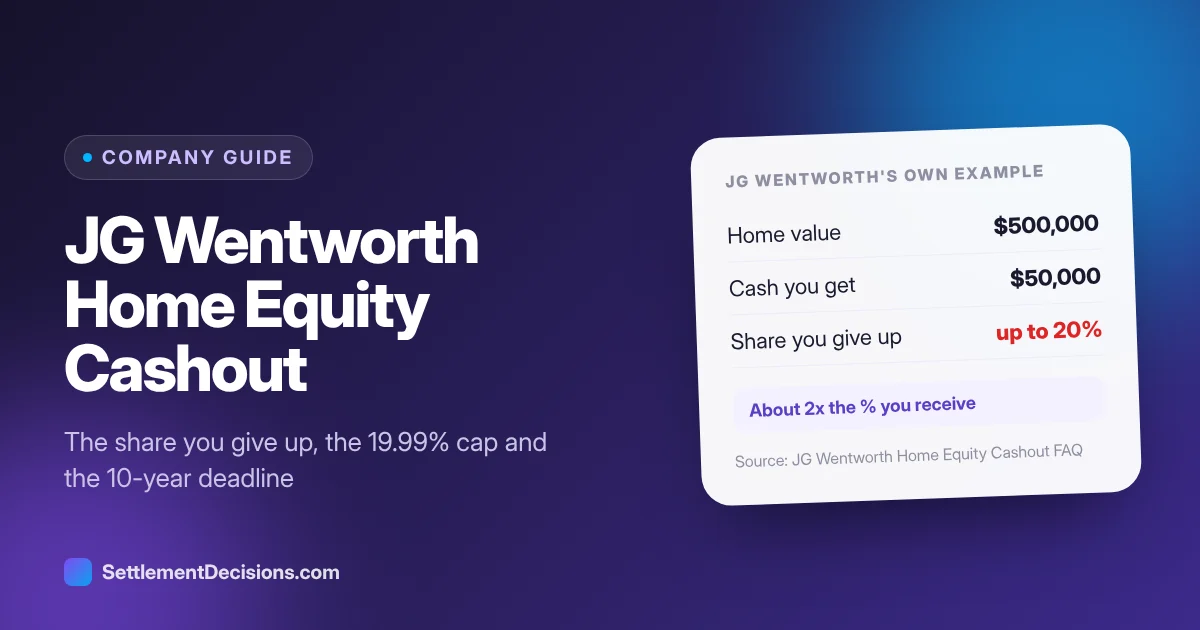
The FAQ's own example: a $500,000 home and a $50,000 cashout (10% of value) means JG Wentworth would receive "up to 20%" of your home's value at payoff.
We applied the FAQ's formula to that example. Assumptions: the 19.99% cap compounds once a year, the starting value is the full $500,000, and the 4.9% fee ($2,450) comes out of the $50,000, so you receive $47,550 before third-party closing costs. Your agreement sets the real numbers.
| Home value change per year | Payoff after 3 years | After 5 years | After 10 years |
|---|---|---|---|
| Falls 2% a year | $86,378 (cap) | $90,392 | $81,707 |
| Stays flat | $86,378 (cap) | $100,000 | $100,000 |
| Rises 3% a year | $86,378 (cap) | $115,927 | $134,392 |
| Rises 6% a year | $86,378 (cap) | $124,364 (cap) | $179,085 |
Three things stand out:
- Early payoffs hit the cap. In year 3 the 20% share is worth more than the cap in every case, so you'd owe the capped amount: about 22% a year on the $47,550 you actually received.
- A flat or falling market still costs a lot. If the home never gains a dollar, you'd still owe $100,000 after 5 or 10 years, because 20% of $500,000 is $100,000.
- Strong growth raises the bill. At 6% a year for 10 years you'd owe $179,085. The CFPB report shows the same $179,085 figure for its own $50,000, 20%-stake example.
The CFPB found that settlement amounts on these contracts often grow at 19.5–22% a year in the early years, and that several companies cap their rates around 18–20%, compounded monthly. JG Wentworth's FAQ doesn't say how its cap compounds. Ask.
The risks to know before signing
- A lien on your home. You can't take out new loans or add liens on the property without JG Wentworth's written consent. That can block a refinance or a home equity loan later.
- Default rights. The product page says that after an uncured default JG Wentworth may become a co-owner, call the payoff due right away, and "sell or foreclose on the property."
- The 10-year deadline. If you haven't paid off by year 10, the FAQ says JG Wentworth can become a co-owner and direct the sale of your home. Plan where the money will come from, whether a sale, a refinance or savings, before you sign.
- Valuation fights. On a cash payoff, JG Wentworth uses an appraisal as of the payoff date. The CFPB says appraisal disputes are a common complaint, along with "surprise at the size of the repayment amounts."
- Repair and remodel adjustments. The FAQ describes a "home repair adjustment" if the home isn't maintained, and a remodeling credit only for improvements that add at least $25,000.
- Death. The estate has 30 days to choose how to settle and 180 days to finish.
On the plus side, JG Wentworth says you can make partial payoffs at any time with 45 days' notice, which lowers its share. The CFPB says many providers in this market don't allow partial payments.
Home equity cashout or selling settlement payments?
If you own a home and receive structured settlement payments, you may be weighing two JG Wentworth products. They work very differently:
| Home Equity Cashout | Selling settlement payments | |
|---|---|---|
| What you give up | A share of your home's future value | Some or all future payments |
| Court approval | Not required | Required under state protection acts |
| Monthly payments | None | None, but those payments stop coming to you |
| Cost depends on | Your home's value and how long you wait | The discount rate in the offer |
| Risk to your home | Lien; foreclosure possible after default | None |
A judge reviews a settlement sale for fairness. Nobody reviews a home equity contract that way. Whichever you consider, find the effective yearly cost. Our discount rate calculator does that for a settlement offer, and the court deal benchmark shows what approved deals paid. For cash without selling or a lien, see structured settlement loans and other options.
If you're considering one
- Get the closing disclosure and the full agreement before you commit. Check the share percentage, the cap, how it compounds and the starting home value.
- Ask whether the starting value is discounted. The CFPB describes providers that set it below the appraisal, which raises your cost. JG Wentworth's pages don't say.
- Work out the payoff at year 3, 5 and 10 with flat, falling and rising home values, as in the table above.
- Compare it with a HELOC or home equity loan if you qualify. Those have monthly payments but often cost less over time.
- Plan your exit. Know how you'd pay it off by year 10 without being forced to sell.
- Check the company. Review JG Wentworth's BBB rating and complaints and its NMLS record.
Talk to a qualified financial advisor or HUD-approved housing counselor before you sign anything that puts a lien on your home.