
Seller guide

Selling a Structured Settlement to Pay Off Your Mortgage: The Math, the Judge, and Better Options

Should you sell structured settlement payments to pay off your mortgage? The rate comparison that decides it, a worked example at today's mortgage rates, what a New York judge said, and when it can make sense.

Med F., Settlement AnalystMed F. Settlement Analyst Updated 8 min read
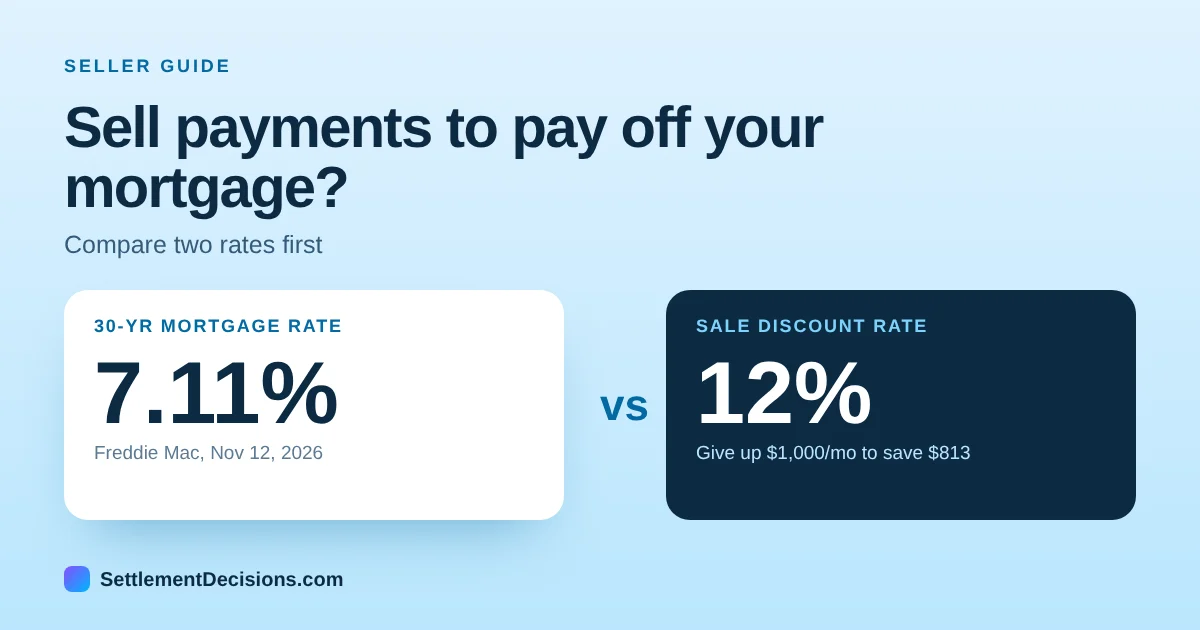
Thumbnail comparing a 7.11% mortgage rate with a 12% settlement discount rate: give up $1,000 a month to save $813

Key takeaway

Selling payments to pay off a mortgage usually loses money, because buyers' discount rates (about 7% to 16% in approved deals) tend to exceed mortgage rates (7.11% in November 2026). It can make sense to stop a foreclosure or when a partial sale clears arrears. Compare the rates first, and expect the judge to.

Quick answer: It only pays off if the discount rate on your sale is lower than your mortgage rate, and it rarely is. In our example, selling $1,000 a month for 10 years at 12% raises about $69,700, which clears a mortgage costing $813 a month at 7.11%. You'd be $187 a month worse off. Stopping a foreclosure is the main exception.
In this guide (6 sections)
  1. The one comparison that decides it
  2. A worked example
  3. What judges say
  4. When it can make sense
  5. Better options to try first
  6. If you decide to sell

The one comparison that decides it

When you sell structured settlement payments, the buyer charges a discount rate, effectively the interest rate on the cash you get. When you pay off a mortgage, you save the mortgage rate.

  • Discount rate higher than your mortgage rate: you pay more for the cash than the mortgage costs you. You lose money every month.
  • Discount rate lower than your mortgage rate: paying it off can come out ahead, before counting fees.

For context, Freddie Mac's weekly average 30-year fixed rate was 7.11% on November 12, 2026 (Freddie Mac PMMS). Approved sales in our court deal benchmark ran from about 7% to 16% a year, with a median near 9%. Many older mortgages carry much lower rates than today's average.

A worked example

Say you have $1,000 a month for 10 more years and a mortgage with 10 years left at 7.11%. Here's what selling all 120 payments would raise at three discount rates, and the mortgage it would pay off:

Discount rate on the saleCash you'd getMonthly mortgage payment that cash replacesMonthly result
9%$78,942$921$79 a month worse off
12%$69,701$813$187 a month worse off
15%$61,983$723$277 a month worse off

Our calculation: present value of 120 monthly $1,000 payments at each rate, and the 10-year payment on that balance at 7.11%. Fees, taxes and insurance not included.

In each case you give up $1,000 a month to stop paying less than that. Run your own numbers with the discount rate calculator.

What judges say

Every sale needs a judge to find it's in your best interest. Judges compare the deal with what a mortgage costs.

In Matter of J.G. Wentworth Originations LLC (Aiken) (N.Y. Sup. Ct., Erie County, July 9, 2019), a payee wanted to sell $43,535 of future payments for $22,064 to pay off his late grandmother's home, which faced foreclosure. The judge denied it. The deal carried a 12.52% rate, and the court took notice that a 30-year mortgage then averaged about 3.94%. The payee had also recently received $30,000 in lump sums and had no concrete plan (decision).

Even a real foreclosure doesn't guarantee approval. A clear plan and a fair rate matter.

When it can make sense

  • To stop a foreclosure when you've exhausted a loan modification, forbearance and refinancing. Losing the home usually costs more than a high discount rate. See selling to stop a foreclosure.
  • To clear arrears, not the whole loan. A small partial sale that catches you up keeps most of your income.
  • When the rate gap is small or reversed, such as a high-rate loan and a competitive offer for a top-rated insurer's payments.

Better options to try first

  1. Use the payments as income to refinance. Lenders can count structured settlement income. See using settlement income to qualify for a mortgage.
  2. Call your servicer about a modification or forbearance, and talk to a HUD-approved housing counselor, which is free.
  3. Pay extra each month from your payments instead of selling them. You get the same payoff over time without the discount.
  4. Compare a loan with a sale. See loan vs. selling.

If you decide to sell

  • Get a payoff letter from your servicer and sell only what's needed.
  • Get at least three written offers for the same payments.
  • Bring the payoff letter, the offers and your budget to the hearing. See what the judge asks.

Talk to a qualified financial advisor who doesn't profit from the sale before you decide.

Sources we checked

Figures were checked on November 19, 2026. Limits and rules change, so confirm the current numbers with the source or a qualified professional.

Prefer to talk it through?

Get a free quote on your settlement, by phone

  • Free and no obligation
  • Know your rate before you sign
  • Questions about court approval

Calls are free. Nothing is sold or signed on a call; any sale of settlement payments needs a judge's approval. Talk to a qualified financial advisor before you decide.

Free quote check

See what your payments are worth first

Tell us about your payments and mortgage, and we'll help you compare written offers so you can see the real rate before you decide.

  • No cost to you
  • You choose whether to sell
  • Rates and fees in writing

Tell us where to send your quotes

Takes under a minute. We'll only use your details for this request.

Your details are sent securely. No cost, no obligation.

Keep reading

Related guides and tools

FAQ

Frequently asked questions

Should I sell my structured settlement to pay off my mortgage?
Usually not. It only comes out ahead if the discount rate on the sale is lower than your mortgage rate. Approved sales run about 7% to 16% a year, and the average 30-year mortgage was 7.11% in November 2026.
Will a judge approve selling payments to pay off a house?
Only if it's in your best interest. A New York judge denied one in 2019 because the 12.52% rate far exceeded mortgage rates and the payee had no concrete plan.
Can I sell part of my payments to catch up on my mortgage?
Yes. A partial sale that covers only the arrears keeps most of your future income and is easier to justify in court.
Can structured settlement payments help me refinance instead?
Often, yes. Lenders can count structured settlement payments as income if they continue long enough.
When does selling to pay a mortgage make sense?
Mainly to stop a foreclosure after other options fail, or when the sale's discount rate is close to or below your mortgage rate.

This guide is for education only. It is not legal, tax, investment or financial advice, and it does not promise any offer, rate or return. Rules differ by state and by your settlement documents. Before you sell payments or change a financial plan, talk to a qualified financial advisor and, where it applies, a tax professional or attorney who is independent of any buyer.

Free quote · no obligation(484) 286-5757Call now