

What is a life settlement?
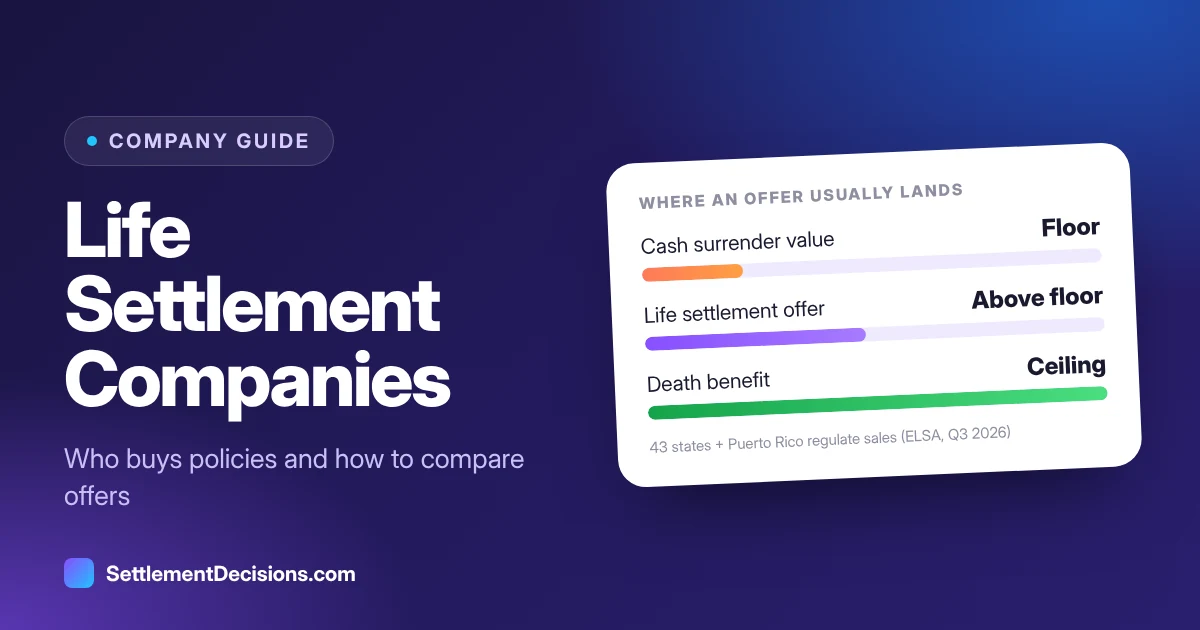
A life settlement is the sale of an existing life insurance policy to a third party for a lump sum. The buyer pays you more than the policy's cash surrender value, takes over the premium payments, becomes the beneficiary and collects the death benefit when you die.
It's usually an option for people who:
- are about 65 or older, or younger with serious health conditions,
- own a policy they no longer need, for example because a mortgage is paid off, children are grown or a business has been sold, and
- find the premiums hard to keep paying.
The alternative for most of these people is to let the policy lapse or surrender it for its cash value. A life settlement can produce more money than either. It's different from selling a structured settlement, where you sell future payments from a lawsuit. If that's what you have, start with our structured settlement selling guide.
| Option | What you get | What you give up |
|---|---|---|
| Keep paying premiums | Death benefit for your heirs | Ongoing premium costs |
| Let it lapse | Nothing | The policy and everything paid in |
| Surrender to the insurer | Cash surrender value | The death benefit |
| Life settlement | A lump sum, usually above surrender value | The death benefit, which goes to the buyer |
| Accelerated death benefit (if your policy has one) | Part of the death benefit early, if seriously ill | A reduced death benefit |
The main life settlement companies
These are some of the best-known providers active in 2026. We've stuck to facts we could verify from company filings, company websites and trade press. Company claims are labeled as such.
Coventry
Coventry is based in Fort Washington, Pennsylvania, and markets to consumers as Coventry Direct. It describes itself as a pioneer of the life settlement market and says it has led the market for more than 25 years. According to a company announcement, it has delivered more than $6 billion to policyowners and ranked first in 2024 for both policies purchased and total face value. Those are the company's own figures.
Abacus Global Management (Nasdaq: ABL)
Abacus is a publicly traded alternative asset manager and life settlement market maker headquartered in Orlando, Florida. It was founded in 2004 and changed its name from Abacus Life, Inc. to Abacus Global Management, Inc. in February 2025, according to its company profile. Being public means it files reports with the SEC, including its shelf registration and prospectus, which describe its business and risks in detail.
Magna Life Settlements
Magna Life Settlements says it has been buying policies since 2004. Its website states it is licensed as a viatical settlement provider in 20 states and as a life settlement provider in 18, and may buy policies in 8 more states that don't regulate the market. Magna is owned by Obra Capital, Inc. (formerly Vida Capital), which acquired it in 2010.
Lighthouse Life
Lighthouse Life is a life settlement firm based in Conshohocken, Pennsylvania, that buys and resells existing policies. In July 2024 it acquired the websites and other assets of Harbor Life Settlements, an Austin, Texas, lead-generation firm. If you got an estimate through a Harbor Life Settlements site, that's why Lighthouse may be the company that contacts you.
Rule of thumb: Some well-known "life settlement" websites are brokers or lead generators, not buyers. That's fine, but you should know who is actually bidding on your policy and who is being paid a commission.
How state licensing works
Life settlements are regulated by the states, mostly through two model laws: the NCOIL Life Settlements Model Act and the NAIC Viatical Settlements Model Act. According to the European Life Settlement Association's Q3 2026 fact sheet:
- 43 states and Puerto Rico have adopted one or both model acts.
- Alabama, Missouri, South Carolina, South Dakota, Wyoming and the District of Columbia have no specific regime. Policies can still be bought and sold there, subject to other insurance and securities rules.
- Michigan and New Mexico regulate only viatical settlements (sales by terminally or chronically ill people), not the wider market.
- 14 providers are licensed in 30 or more states, 19 in 20 or more, and 30 hold at least one licence.
- Providers held 685 licences in 2026, down 25, or 3.5%, from 2025.
In regulated states, providers must be licensed by the state insurance department, and brokers who represent sellers usually need a license too. Many states also require a rescission period after closing, during which you can cancel by returning the money, and require disclosures about the broker's compensation.
Before you sign, look up the provider on your state insurance department's licensee search. If your state is one of the few with no regime, ask the buyer which state's rules it follows and get advice from a lawyer.
Brokers vs. providers
There are two ways to sell:
- Directly to a provider. You deal with one buyer. It's simpler, but you only see one bid.
- Through a life settlement broker. A broker represents you, sends your policy to several providers and negotiates. Brokers are paid a commission out of the transaction, and many states require that commission to be disclosed to you.
A broker's value is competition. If you go direct, collect bids from several providers yourself so you know what the market will pay.
What affects your offer
Providers price a policy based on:
- Life expectancy, estimated by independent underwriters from your medical records. Shorter life expectancy generally means a higher offer.
- Death benefit and policy type. Universal life and convertible term policies are common in this market.
- Premiums the buyer will have to keep paying.
- The buyer's required return, which works much like the discount rate in a structured settlement sale.
We don't publish typical payout percentages because offers vary widely with health and policy terms. Instead, compare every bid with your policy's cash surrender value and with what it would cost to keep the policy.
Taxes on a life settlement
Taxes can take a real bite, so plan for them:
- Rev. Rul. 2009-13 explains how proceeds are taxed. In general, the amount up to your basis is tax-free, the gain up to the cash surrender value is ordinary income, and anything above that is generally a capital gain. Rev. Rul. 2020-5 updated that ruling after the 2017 Tax Cuts and Jobs Act, which changed the basis rules so that you no longer reduce your basis by the cost of insurance.
- Terminally or chronically ill sellers may be able to exclude proceeds under 26 U.S.C. § 101(g) when selling to a licensed viatical settlement provider.
- Public benefits. A lump sum can affect Medicaid or other means-tested benefits.
Ask a tax professional to run the numbers on your specific policy before you accept an offer.
How to sell a policy, step by step
- Get an in-force illustration from your insurer showing the cash value, death benefit and future premiums.
- Check alternatives with the insurer: accelerated death benefits, a reduced paid-up policy or a policy loan.
- Choose your route: a licensed broker, or bids from several licensed providers.
- Authorize medical records for life-expectancy underwriting.
- Compare offers on net cash after commissions, against the surrender value.
- Review the closing documents with an adviser. Note the rescission period.
- Get paid, usually through an escrow agent once the insurer records the change of ownership.
Red flags to watch for
- Pressure to decide fast. A legitimate provider expects you to compare bids and consult advisers.
- No license in your state. In a regulated state, the provider and any broker should appear on the insurance department's licensee list.
- Unclear broker pay. Many states require brokers to disclose their compensation. Ask for it in writing.
- Upfront fees. Brokers are normally paid out of the transaction at closing, not by you in advance.
- Offers to buy a brand-new policy. Arrangements in which someone takes out a policy mainly to sell it, sometimes called stranger-originated life insurance, are restricted in many states. Be wary of anyone proposing one.
- Requests to change the beneficiary early. Ownership and beneficiary changes should happen at closing, through escrow.
Bottom line
A life settlement can turn an unwanted policy into meaningful cash, and established providers such as Coventry, Abacus and Magna compete for policies. Check that the buyer and any broker are licensed in your state, get more than one bid, compare offers with your surrender value, and plan for taxes. Talk to a qualified financial advisor and a tax professional before you sign, and make sure the people who were counting on that death benefit are part of the decision.