

What "non-qualified" means
"Qualified" refers to a qualified assignment under 26 U.S.C. § 130. In a qualified assignment, the defendant hands its duty to pay you to an assignment company, which buys an annuity to fund the payments.
Section 130 only allows this for payments "on account of personal injury or sickness (in a case involving physical injury or physical sickness)" or workers' compensation. It also requires that the payments be excludable from the recipient's income under section 104(a)(1) or (2).
So if your claim isn't a physical injury or workers' comp claim, a qualified assignment isn't available. A structure set up for that kind of claim is called non-qualified. Common examples are settlements of:
- employment and wrongful termination claims
- discrimination and harassment claims without physical injury
- contract and business disputes
- punitive damages and interest, which aren't excluded under section 104(a)(2)
Insurers have built products for these cases. MetLife, for example, launched a non-qualified funding agreement in 2026; see our explainer on the MetLife NQA-FA.
Qualified vs. non-qualified at a glance
| Qualified structured settlement | Non-qualified structured settlement | |
|---|---|---|
| Typical claims | Physical injury or sickness, workers' comp | Employment, discrimination, contract, punitive damages |
| Assignment allowed under § 130? | Yes | No (the claim fails § 130(c)) |
| Payments tax-free under § 104? | Yes | Generally no; taxed as received |
| Covered by the 40% factoring tax rule (§ 5891)? | Yes | No, by its definition |
| Covered by NY, NH and Ohio protection acts? | Yes | Likely not (see next sections) |
Section 130(c)(2)(B) also says qualified payments "cannot be accelerated, deferred, increased, or decreased by the recipient." Non-qualified agreements set their own terms, so the contract decides what you can change.
How the payments are taxed
Because a non-qualified structure pays a claim that isn't excluded under section 104, the payments are generally taxable income in the year you receive them. That's the main reason people choose one: spreading a large taxable award over several years can keep each year's income lower than one lump sum would.
The exact treatment depends on what each dollar compensates. Back wages in an employment case can be treated differently from emotional distress damages or interest. A CPA should review your settlement agreement. Our structured settlement taxation guide covers the tax-free side for comparison.
Can you sell non-qualified payments?
Sometimes, but the rules that protect sellers of ordinary structured settlements may not apply.
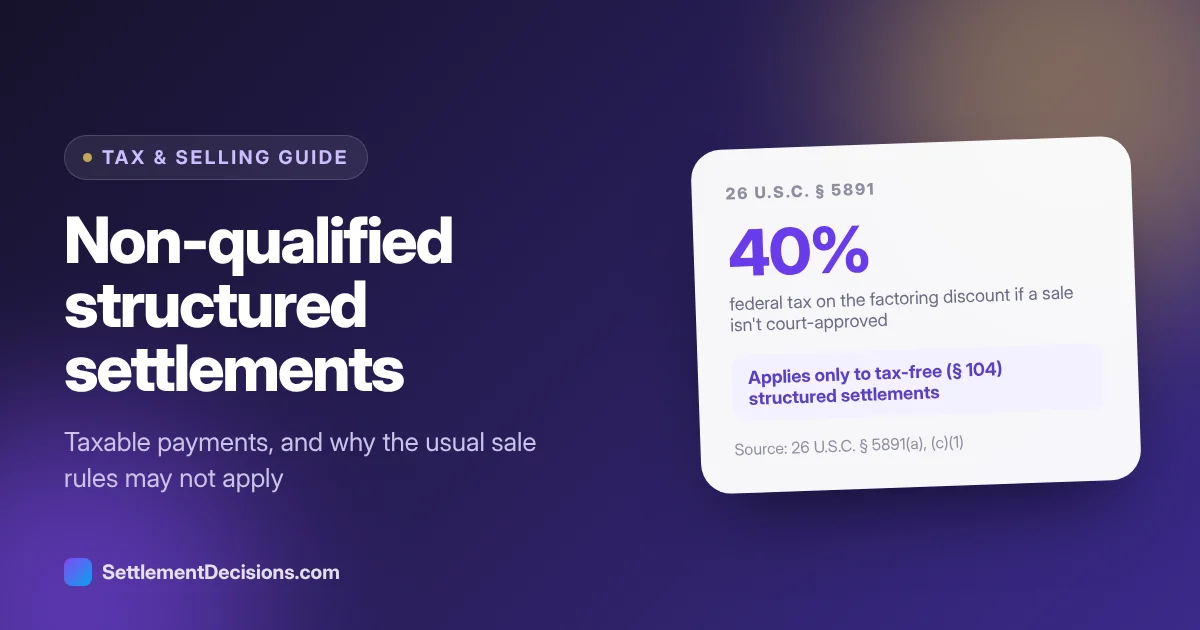
The federal rule. 26 U.S.C. § 5891 charges a buyer "a tax equal to 40 percent of the factoring discount" unless a state court approves the sale in advance and finds it is in the seller's best interest. That tax is why buyers of ordinary structured settlements always go to court. But § 5891(c)(1) defines a "structured settlement" as one paying damages excludable under section 104(a)(2) or workers' comp excludable under 104(a)(1), payable under section 130. A taxable, non-qualified structure falls outside that definition, so the buyer has no federal tax reason to seek a court order.
State protection acts. The statutes we checked limit who counts as a "payee":
| State | Statute | Who counts as a "payee" |
|---|---|---|
| New York | Gen. Oblig. Law § 5-1701(h) | "an individual who is receiving tax free payments under a structured settlement" |
| New Hampshire | RSA 408-G:1, IX | "an individual who is receiving tax free payments under a structured settlement" |
| Ohio | Rev. Code § 2323.58(I) | someone receiving payments "excludable from the individual's gross income under federal income taxation laws" |
All three also define a structured settlement as periodic payment of "damages for personal injuries or sickness" in resolution of a tort claim. An employment or contract settlement paid in taxable installments doesn't fit those words. On their face, these statutes' disclosure rules, cooling-off periods and best-interest hearings may not cover you.
What that means in practice. Fewer rules can mean less protection, not an easier sale:
- No required disclosure. Protection acts force buyers to show the discount rate and fees in writing. Without one, insist on the same disclosure anyway.
- No judge checking the price. Courts deny sales that pay too little. Our court deal benchmark shows real approved rates, and why courts say no explains the tests judges use.
- The contract still controls. Your settlement agreement or annuity may bar assignment or require the payer's consent. See anti-assignment clauses.
- Other state laws can still reach the deal. State statutes differ. In 2021 Delaware's Court of Chancery reviewed and denied a DRB Capital petition to buy part of an annuity payment from a class-action settlement, finding it wasn't in the payee's best interest.
Taxes on a sale. Because the payments were taxable to begin with, cash from selling them is likely to have tax consequences too. How much, and when, depends on your facts. Get a tax professional's answer before you sign, not after.
What to do before you sign anything
- Find out which kind you have. Your settlement agreement says whether there was a qualified assignment under § 130. If it names an assignment company and says "qualified assignment," it's qualified. If it says "non-qualified" or the claim wasn't a physical injury, it likely isn't.
- Read the assignment and anti-assignment terms. Note who owes the payments and whether consent is needed for a transfer.
- Ask your CPA two questions: how the payments are taxed now, and how cash from a sale would be taxed.
- Get at least three written offers for the same payments. Compare net cash and the effective annual rate with our discount rate calculator.
- Ask the buyer whether it will seek a court order and under which statute. A buyer willing to go before a judge is accepting more scrutiny.
- Talk to a qualified financial advisor with nothing to gain from the sale.
If your payments come from a physical-injury case, the usual rules apply; start with how to sell a structured settlement.