

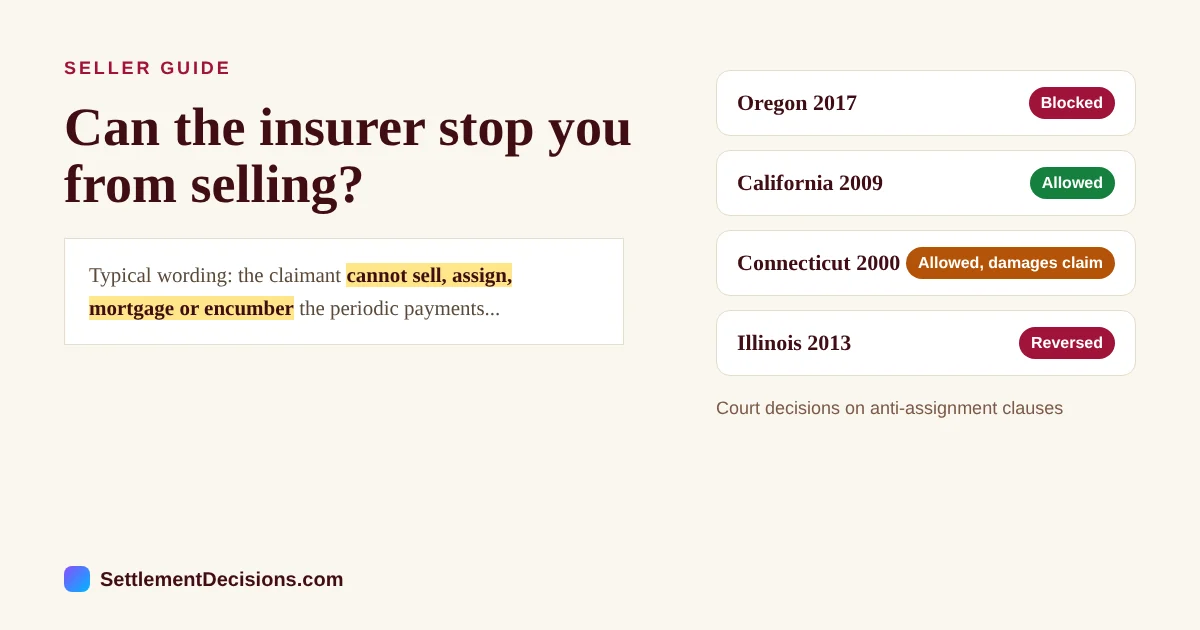
What an anti-assignment clause is
Almost every structured settlement agreement and annuity contract has a sentence like: "Payments cannot be accelerated, deferred, increased or decreased by the claimant, nor can the claimant sell, mortgage, encumber or anticipate them." That's an anti-assignment clause. It protects the tax-free status of the settlement and the insurer's simple payment schedule.
Selling your payments is an assignment. So the question is whether the insurer (the "obligor" or annuity issuer) can use that clause to stop a court-approved sale.
The short answer: usually not, but it can
Federal law encourages court approval: under 26 U.S.C. § 5891, a buyer pays a 40% excise tax on a sale unless a state court approves it in a "qualified order." Every state has a protection act setting out that approval. In most cases the insurer is notified, doesn't object, and simply redirects the payments once the judge signs the order.
When an insurer does object, courts have split:
| Case | Court and year | Outcome |
|---|---|---|
| Johnson v. J.G. Wentworth Originations | Oregon Court of Appeals, March 1, 2017 | Sale blocked. The agreement chose California law and barred assignment. MetLife objected, so the clause was enforced and the trial court's approval reversed (opinion) |
| 321 Henderson Receivables v. Sioteco | California Court of Appeal, 2009 | Sale allowed. The obligor chose not to enforce the clause, so it didn't bar a court-approved transfer (as described in the Oregon decision) |
| Rumbin v. Utica Mutual | Connecticut Supreme Court, 2000 | Transfer stood, but the insurer kept a claim for damages. The protection act didn't cancel the clause; the clause limited the right to assign, not the power (case brief) |
| Settlement Funding v. Brenston | Illinois Appellate Court, Aug. 26, 2013 | Approval reversed. The settlement agreement and annuity had anti-assignment clauses, and the court found the trial court lacked authority to approve the petition (summary) |
The pattern: an insurer that objects, plus clear contract language, plus the right state's law can stop a sale. An insurer that stays silent usually can't be pushed into enforcing it later.
Why insurers sometimes object
- Protecting the payee. Some insurers object to sales they see as unfair, especially for minors, repeat sellers or deals with very high discount rates.
- Contract and tax concerns. Insurers want payments to stay tax-free and the paperwork simple.
- Their own programs. Some insurers prefer to offer hardship alternatives instead. See Berkshire Hathaway's hardship program.
How to check your own situation
- Find your settlement agreement and annuity contract. Look for "assign," "encumber" or "anticipate." See finding lost settlement documents.
- Check for a choice-of-law clause ("governed by the laws of..."). In the Oregon case, California law decided the outcome even though the seller lived in Oregon.
- Ask each buyer directly: "Has my insurer objected to transfers before? What happens to my deposit or advance if it objects?" Get the answer in writing.
- Don't take an advance you'd struggle to repay if the insurer objects and the sale fails.
- Read the hearing notice. The insurer gets the same notice you do. If it files an objection, ask the court for time to get independent advice.
If the insurer objects
- You haven't lost yet. The judge decides; some objections are withdrawn or overruled.
- Ask about a partial sale or a smaller deal the insurer may accept. See partial sales.
- Ask the insurer about hardship options.
- Get your own lawyer. The buyer's lawyer represents the buyer. See do I need a lawyer?.
Talk to a qualified financial advisor who doesn't profit from the sale, and a lawyer you choose, before you sign.