
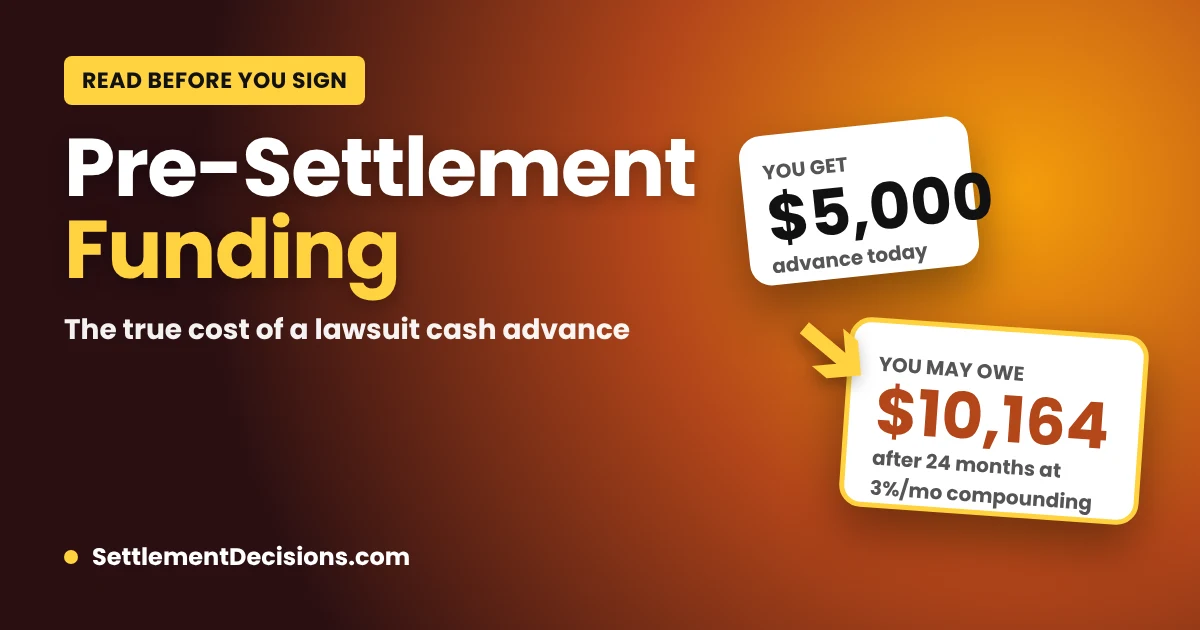
Key Takeaway: Pre-settlement funding is a cash advance against your expected lawsuit recovery that you repay only if you win or settle. It can keep you afloat while your case moves, but the charges grow every month the case stays open. A $5,000 advance at 3% a month, compounded, grows to about $10,164 in two years. Borrow the smallest amount you can, insist on simple (not compound) charges with a cap, and have your attorney review the contract.
Quick answer: Pre-settlement funding (often called a "lawsuit loan," though it usually isn't legally a loan) is money a funding company advances to a plaintiff with a pending claim, usually personal injury. The company is repaid from your settlement or judgment. If you lose, you generally owe nothing. Because the funder takes that risk, the cost is high, and it grows the longer the case takes.
In This Guide
- How pre-settlement funding works
- Who qualifies
- What it really costs: worked examples
- Simple vs. compound charges: the clause that matters most
- State laws and regulation
- How funders look at different case types
- Is pre-settlement funding taxable?
- Questions to ask your attorney
- Pros and cons
- How to compare funding offers
- Alternatives to try first
- After your case settles: structured settlement or lump sum
- FAQ
How Pre-Settlement Funding Works
Lawsuits are slow. Personal injury cases can take many months, and cases that go to trial can take years. Meanwhile, an injured person may be out of work, behind on rent, and facing medical bills. Insurance companies know this, and a plaintiff under financial pressure is more likely to accept a low early offer.
Pre-settlement funding was built for that gap. The typical process:
- You apply with a funding company, usually online or by phone. There's typically no credit check or job requirement, because repayment depends on your case, not your income.
- The funder contacts your attorney to review the case: liability, insurance coverage, damages, and expected timeline.
- The funder makes an offer, usually a fraction of what it expects your case to be worth, so there's room left for your attorney's fees, liens, and your own recovery.
- You, your attorney, and the funder sign the contract. Your attorney typically acknowledges the agreement and agrees to pay the funder from the settlement proceeds.
- You get the cash, often within days of approval.
- When the case resolves, your attorney pays the funder from the settlement before releasing your share. If you lose, you generally repay nothing, because the advance is non-recourse.
Why it's usually "not a loan"
Because repayment depends on the outcome of the case, many courts and states treat pre-settlement funding as an investment or purchase of part of your recovery, not a loan. That distinction is why, in states without specific laws, ordinary usury caps may not apply. It's also why the cost can be much higher than a credit card. Industry groups describe non-recourse terms as standard practice, but your contract is what controls, so confirm the advance is truly non-recourse in writing.
Who Qualifies for Pre-Settlement Funding?
Funders look at the case, not your credit score. You're generally a candidate if:
- You have a pending legal claim, most commonly personal injury (car and truck accidents, slip and fall, medical malpractice, product liability), and sometimes employment, civil rights, or wrongful death cases.
- You have an attorney working on contingency. Most funders won't work with self-represented plaintiffs.
- Liability looks clear and there's a solvent defendant or insurance policy to pay.
- The expected recovery is large enough to cover attorney fees, liens, the advance, and still leave you a meaningful amount.
Cases that are hard to fund: unclear fault, no insurance, very low damages, or claims already headed to an uncertain trial.
What Pre-Settlement Funding Really Costs: Worked Examples
Funders quote costs in different ways: a monthly rate, a flat fee, or a "rate" that resets every six months. The only number that matters is how much you'll owe on the day your case settles.
Example: a $5,000 advance
| Months until your case settles | Owed at 3%/month simple | Owed at 3%/month compound | Owed at 2.5%/month compound |
|---|---|---|---|
| 6 months | $5,900 | $5,970 | — |
| 12 months | $6,800 | $7,129 | $6,724 |
| 18 months | $7,700 | $8,512 | — |
| 24 months | $8,600 | $10,164 | $9,044 |
| 36 months | $10,400 | $14,491 | $12,163 |
Illustrative math only, not a quote. Some contracts add processing, application, or delivery fees on top of the rate.
Look at the 24-month row. With compounding at 3% a month, the amount owed more than doubles. On a case that drags to three years, a $5,000 advance can cost nearly $9,500 in charges.
How that hits your settlement
Say your case settles for $60,000 after 24 months, your attorney's contingency fee is one-third ($20,000), and you have $8,000 in medical liens.
- Before funding: $60,000 − $20,000 − $8,000 = $32,000 to you.
- With a $5,000 advance at 3% compounded: subtract $10,164 → $21,836 to you, plus the $5,000 you already received = $26,836 total.
That advance cost you $5,164. It may still be worth it if it kept you from accepting a $25,000 lowball offer 18 months earlier. But you should know the price before you sign.
Simple vs. Compound Charges: The Clause That Matters Most
Two contracts can both advertise "3% per month" and produce very different bills:
- Simple charges are calculated only on the original amount. $5,000 × 3% = $150 every month, forever.
- Compound charges are calculated on the original amount plus charges already added. The monthly charge grows each month.
Ask every funder these five questions, and get the answers in writing:
- Are charges simple or compounding? How often do they compound?
- Is there a cap, a maximum amount I'll ever owe regardless of how long the case takes?
- What are all the one-time fees (application, processing, underwriting, wire)?
- Is there a payoff schedule showing exactly what I'll owe at 6, 12, 18, 24 and 36 months?
- Is the advance fully non-recourse: if I lose, do I owe anything at all?
A funder that won't give you a month-by-month payoff schedule is a funder to skip.
State Laws and Regulation
Pre-settlement funding (often called consumer legal funding in statutes) is regulated state by state, and the rules have changed quickly in the last few years. A few examples:
- Early statutes: Maine (2007), Ohio (2008), Nebraska (2010), and Oklahoma (2013) were among the first states to pass consumer legal funding laws.
- Indiana caps charges at 36% a year and updated its law again in 2024.
- Vermont regulates the industry but has no statutory rate cap.
- Tennessee, Nevada, Utah, and Illinois (2022) have also adopted frameworks.
- Missouri (2023) requires funders to be licensed through its Division of Finance and limits contracts to 48 months.
- California enacted a new law, AB 931, effective January 1, 2026.
- New York passed legislation signed in December 2025 and strengthened it in early 2026, moving oversight to the Department of Financial Services.
- Maryland has no dedicated framework, so funding falls under ordinary lending and usury law.
Separately, a 2025 wave of laws targeted litigation funding more broadly, especially foreign-funded and commercial deals. Georgia now requires funders to register with its Department of Banking and Finance starting January 1, 2026. Montana caps a funder's share of the recovery at 25% in covered agreements. Kansas, Oklahoma, Colorado, and Arizona passed disclosure or foreign-funding restrictions.
What this means for you: Your state may cap charges, require specific disclosures, give you a right to cancel, or require the funder to be licensed. Ask your attorney what your state requires, and check whether the funder is licensed or registered where you live. Laws change, so confirm the current rules before you sign.
How Funders Look at Different Case Types
Funders price risk, and some cases are simply easier to fund than others. This is a general picture, not a promise from any provider:
| Case type | How funders typically view it | Why |
|---|---|---|
| Car or truck accident with clear fault | Most commonly funded | Liability is often clear and an insurance policy usually exists |
| Workplace injury involving a third party | Often fundable | A third-party claim can sit alongside workers' comp |
| Slip and fall | Case-by-case | Liability can be disputed |
| Medical malpractice | Fundable but slower | Strong damages, but these cases often take years |
| Product liability / mass tort | Fundable, often smaller advances | Long timelines and uncertain individual payouts |
| Employment or civil rights | Selective | Outcomes and damages vary widely |
| Workers' comp only | Limited availability | Some states restrict assignment of benefits |
The longer your case is likely to take, the more an advance will cost you. That's the single most important fact to weigh against the cash you'd receive.
Is Pre-Settlement Funding Taxable?
An advance against your expected recovery is generally not treated as income when you receive it, because it's repaid from a recovery you're expected to receive later. What matters more is how the underlying settlement is taxed. Under Internal Revenue Code §104(a)(2), damages received for personal physical injuries or physical sickness are generally excluded from income. Punitive damages, interest, and lost wages in some types of cases can be taxable. Ask your attorney or a tax professional how your specific settlement will be treated before you plan around it, and see our tax guide for the basics.
Questions to Ask Your Attorney Before You Apply
Your lawyer knows your case better than any funder. Before you sign anything, ask:
- What's a realistic timeline, best case and worst case?
- What's a realistic settlement range, after fees and liens?
- How much of my recovery could the advance consume at the worst-case timeline?
- Are there medical providers who would treat me on a lien instead?
- Have you worked with this funder before? How did the payoff go?
- Could the advance affect settlement strategy? For example, would it pressure me to settle sooner, or let us hold out for a fair offer?
Many attorneys are cautious about funding for good reason: they've seen advances eat a large share of a client's check. If your lawyer advises against it, ask why before you go ahead.
If you already took funding and the case is dragging
Ask the funder for a current payoff statement and check it against your contract. Ask your attorney whether the funder will agree to a reduced payoff at settlement; some funders negotiate when the recovery is smaller than expected, especially when the alternative is a long dispute. Avoid taking a second advance just to cover the first unless there's truly no other option.
Pros and Cons of Pre-Settlement Funding
| Pros | Cons |
|---|---|
| Cash in days for rent, bills, or living costs | Expensive, especially with compounding |
| No credit check or income requirement | Cost grows the longer the case takes |
| Usually non-recourse: nothing owed if you lose | Reduces your final recovery |
| Can help you avoid accepting a lowball offer | Patchy regulation in some states |
| Doesn't add monthly payments while the case runs | Multiple advances stack up fast |
How to Compare Pre-Settlement Funding Offers
- Get at least three offers. Pricing varies widely between funders for the same case.
- Compare the payoff at your realistic timeline, not at six months. Ask your attorney how long the case is likely to take, then double it to be safe.
- Prefer simple charges with a hard cap. A cap protects you if the defendant drags out the case.
- Ask for the smallest amount you need. You can often request a second advance later, but you can't un-borrow.
- Read the fee schedule. Fees deducted up front reduce the cash you actually get.
- Have your attorney review the contract. Your lawyer will be the one paying the funder, so they have every reason to read it carefully.
- Check licensing and complaints. Search your state attorney general and financial regulator.
Watch for the same warning signs we flag in our guide to avoiding settlement scams: pressure to sign fast, upfront fees you pay out of pocket, and refusal to put terms in writing.
Alternatives to Try First
Pre-settlement funding should usually be a last resort. Before applying, ask about:
- Medical providers working on a lien or letter of protection, so treatment continues without upfront payment while the case is pending.
- Payment deferrals from your mortgage lender, landlord, auto lender, or credit card companies. Many have hardship programs.
- Short-term disability, workers' comp, or unemployment benefits if you qualify.
- Personal loans or credit union loans if your credit allows. Even a high-rate personal loan can cost less than compounding funding over two years.
- Help from family, with a written repayment plan.
- Community assistance programs for rent and utilities.
- Asking your attorney whether an early partial settlement for the undisputed portion of damages is possible.
After Your Case Settles: Structured Settlement or Lump Sum?
Once you win or settle, you may be offered a structured settlement: payments over time funded by an annuity, instead of one check. For physical injury cases, those payments are generally tax-free, and they can protect you from running through the money too fast. Learn the basics in how structured settlements work, and see our guide on structured settlement vs. lump sum.
If you already have a structured settlement and need cash later, that's a different product with stronger protections: every state requires a judge to approve the sale. You can estimate what your payments are worth with our settlement calculator.
Frequently Asked Questions
What is pre-settlement funding?
It's a cash advance from a funding company against the money you expect to recover from a pending lawsuit. The funder is repaid from your settlement or judgment, and if you lose, you generally owe nothing.
Is pre-settlement funding a loan?
Usually not in the legal sense. Because repayment depends on winning, many states treat it as a non-recourse purchase of part of your recovery rather than a loan, which is why ordinary usury limits may not apply unless your state has a specific law.
How much does pre-settlement funding cost?
It depends on the rate, whether charges compound, any fees, and how long the case takes. A $5,000 advance at 3% a month costs $3,600 in charges over 24 months if simple, and $5,164 if compounded monthly.
What happens if I lose my case?
With a true non-recourse contract, you owe nothing. Confirm this in writing before signing, and check for exceptions such as fraud or firing your attorney.
Do I need a lawyer to get pre-settlement funding?
Almost always. Funders review your case with your attorney, and your attorney usually agrees to pay the funder from the settlement proceeds.
How fast can I get pre-settlement funding?
Often within a few days of approval, once the funder has reviewed the case with your attorney.
Does pre-settlement funding affect my credit?
Typically funders don't use your credit score to approve you. Ask the funder whether they run any credit check or report to bureaus.
Which states regulate pre-settlement funding?
Many states have consumer legal funding laws, including Maine, Ohio, Nebraska, Oklahoma, Indiana (which caps charges at 36% a year), Vermont, Tennessee, Nevada, Utah, Illinois, Missouri, California, and New York. Rules differ, so check your state's current law.
Can I get more than one advance?
Often, yes, but each advance adds its own charges. Multiple advances can consume a large share of a modest settlement.
The Bottom Line
Pre-settlement funding can be a lifeline when you need to cover basic costs and avoid accepting a lowball settlement out of desperation. It can also quietly take thousands out of your recovery. Borrow the smallest amount you need, choose simple charges with a cap, get a full payoff schedule, and let your attorney review the contract before you sign.
Your next step: Ask your attorney for a realistic timeline for your case, then request written payoff schedules from at least three funders for that timeline.
Sources
- State consumer legal funding statutes, Indiana 36% cap, Missouri licensing and 48-month limit, California AB 931, New York legislation, Maryland framework, Attorney at Law Magazine
- 2025 litigation finance laws in Georgia, Kansas, Oklahoma, Colorado, Arizona and Montana, Legal Finance Expert
- Indiana legislative history, The Indiana Lawyer
Last reviewed October 23, 2026. This guide is general information, not legal, tax or financial advice. SettlementDecisions.com does not provide pre-settlement funding and may receive a referral fee if you choose to work with a provider through our platform.