

How casino jackpot annuities work
Most slot wins are paid on the spot. The exception is the very large progressive jackpots that are linked across many casinos, such as IGT's Megabucks in Nevada.
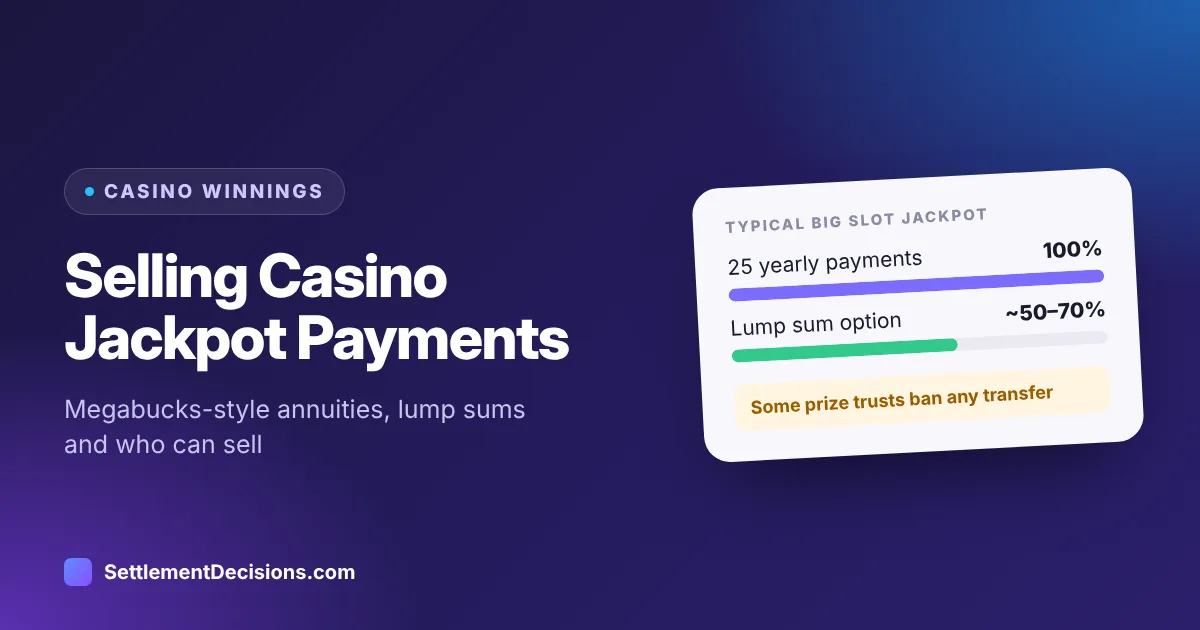
For those jackpots, the advertised number is usually the total of yearly payments, not cash today:
| Feature | What winners usually see |
|---|---|
| Payment period | Megabucks pays over 25 years, according to Las Vegas Advisor |
| Lump-sum option | Offered since 1999 for Megabucks, worth about half to 70% of the advertised amount depending on interest rates |
| Time to choose | Usually 60 to 90 days after the win |
| Who pays | For Megabucks, IGT (the machine maker) handles the jackpot, not the casino where you won |
If you chose the yearly payments, you own a stream of future checks. That is the asset a buyer would purchase.
How Nevada requires casinos to fund periodic jackpots
Nevada Gaming Commission Regulation 5.115 sets the rules for prizes paid over time. It says:
- Periodic payments can't be used for prizes of $100,000 or less.
- The payments must be guaranteed by one of four methods: an irrevocable surety bond or letter of credit, an irrevocable trust at an independent financial institution, a reserve kept by the licensee, or another method the Commission approves.
- The licensee stays responsible for paying the prize, even if a financial institution fails.
This matters for selling, because the funding method decides what you're allowed to do with the payments.
Can you sell casino jackpot payments?
There's no single yes or no. Three things decide it.
1. Your prize agreement. This is the document you signed when you chose the annuity. Look for words like "assign," "transfer," "encumber" or "pledge." If it says the payments can't be assigned, a buyer can't legally take them.
2. The funding method. Under Nevada Regulation 5.115(3)(b), a jackpot funded through the trust method must "expressly prohibit the patron from encumbering, assigning or otherwise transferring" the deferred payments, except to the patron's estate. If your Nevada prize is paid this way, it generally can't be sold.
3. Your state's law. Several states treat prize assignments like lottery assignments and require a court order. For example, a 2004 New Jersey bill (S1324) proposed that slot annuity jackpot payments could be assigned only through a Superior Court order, after the judge found the deal fair and the winner had independent legal and tax advice. Check the current law in the state where you won, not where you live now.
Some structured settlement buyers advertise that they buy casino winnings. That tells you a market exists. It doesn't tell you your prize can be sold. Ask the buyer to confirm in writing, before you sign anything, that your specific prize agreement and state allow the transfer.
If a buyer says "we'll handle the paperwork" but can't name the court or agency that approves the transfer, stop. A transfer that breaks your prize agreement can leave you without the cash and without the payments.
What you'd get if you sell
Buyers price prize payments the same way they price structured settlement payments: they discount each future check back to today's value. Payments 20 years away are worth far less than next year's check.
As a rough guide:
- The casino's own lump-sum option is often worth about 50% to 70% of the advertised jackpot at the time you win.
- Selling later usually means a higher discount rate than the casino's built-in lump sum, because the buyer takes on transfer and legal costs.
- Selling only some of the payments (for example, the next 5 years) often gets a better rate than selling all of them.
Use the payout calculator to turn a quoted discount rate into dollars, and get at least three written quotes. Our guide to comparing offers side by side shows what to line up.
Taxes on casino jackpot payments
This is the biggest difference from an injury settlement.
- Casino winnings are taxable income. Each yearly payment is taxed in the year you receive it. A personal injury structured settlement, by contrast, is usually tax-free under IRC § 104(a)(2).
- Reporting: since January 1, 2026, casinos issue Form W-2G for slot winnings of $2,000 or more (up from $1,200), under the One Big Beautiful Bill Act. The threshold is indexed for inflation from 2027.
- Selling changes the timing. If you sell future payments for a lump sum, expect the lump sum to be taxable in the year you receive it, which can push you into a higher bracket.
Talk to a tax professional before you sell. The tax hit can change whether selling makes sense at all.
How to check if your jackpot payments can be sold
- Find your prize agreement and the annuity or trust documents. Note who sends the checks (IGT, an insurer, a trust bank).
- Search the documents for "assign," "transfer," "encumber" and "pledge."
- Call the payer and ask: "Are my periodic jackpot payments assignable, and what approval is required?"
- Check your state's rules for prize or lottery assignments. The state gaming regulator can usually point you to them.
- Get written quotes that show the payments sold, the discount rate, every fee and the net cash.
- Get independent advice from a lawyer or tax advisor who isn't paid by the buyer.
Lottery, sweepstakes and casino prizes compared
| Prize type | Usually paid by | Typical transfer rule |
|---|---|---|
| State lottery annuity | The state lottery | Court order under state lottery law, in states that allow it. See selling lottery payments |
| Sweepstakes or brand promotion | The sponsor or an insurer it hired | Depends on the prize contract. See selling sweepstakes prize payments |
| Casino jackpot annuity | The game maker or casino, backed by a bond, trust or reserve | Depends on the funding method and state gaming rules. Some trusts forbid any transfer |
| Injury structured settlement | A life insurance company | Court approval under every state's structured settlement protection act |