
Key Takeaway: Yes, you can sell lottery annuity payments for a lump sum in most states that offer annuity prizes, but the sale usually needs a court order, the buyer applies a discount rate that is your real cost, and the money you receive is taxed as ordinary income. Get at least three quotes and check the implied discount rate before you sign anything.
Quick answer: A lottery payment buyer pays you cash today in exchange for some or all of your future annual prize payments. You receive less than the face value of those payments, because the buyer discounts them to present value. Most states allow the sale only through a court-approved assignment, and federal courts have held that the lump sum is taxed as ordinary income, not as a capital gain.
In This Guide
- How selling lottery payments works
- Is it legal in your state?
- What your payments are worth: worked example
- How the sale is taxed
- Full sale vs. partial sale
- Step-by-step: from quote to cash
- How to compare lottery payment buyers
- Red flags and scams
- Alternatives to selling
- FAQ
How Selling Lottery Payments Works
When you win a large lottery prize and choose the annuity option, the lottery pays you in yearly installments instead of one check. The big multistate games are paid over decades: according to Mega Millions, its annuity is made of 30 payments, one immediate payment followed by 29 annual payments that grow by 5% each year. Many state games with smaller "for life" or "per year" prizes pay over 20 or 25 years.
That schedule is safe and predictable. It is also rigid. If you need a large amount of money now to pay off a mortgage, cover medical bills, start a business, or settle a divorce, the yearly check can feel like a locked door.
A lottery payment buyer (sometimes called a factoring company or funding company) opens that door. It works like this:
- You agree to transfer the right to receive some or all of your future installments.
- The buyer pays you a lump sum today.
- Once the transfer is approved, the lottery sends the assigned payments to the buyer instead of you.
The buyer is not doing you a favor. It is buying a reliable, state-backed payment stream at a discount and earning a return on the difference. That difference is set by the discount rate, and it is the single number that decides whether the deal is fair.
Lottery payments vs. structured settlements
Selling lottery payments looks a lot like selling structured settlement payments, and many of the same companies buy both. Three differences matter:
| Lottery annuity | Structured settlement | |
|---|---|---|
| Who pays you | The state lottery | A life insurance company (annuity issuer) |
| Governing law | Your state's lottery statute | Your state's Structured Settlement Protection Act + IRC §5891 |
| Tax on the lump sum | Ordinary income (taxable) | Usually tax-free for physical injury claims |
| Court approval | Required in most states that allow assignment | Required in all states |
The tax difference is the one sellers miss most often. A structured settlement from a physical injury is generally tax-free whether you take payments or a lump sum. Lottery winnings are taxable either way, and selling does not change that.
Is It Legal to Sell Lottery Payments in Your State?
There is no single national rule. Each state lottery decides, through its own statute, whether a winner may assign future installments to someone else and under what conditions. Most states that offer annuity prizes allow voluntary assignment, but almost all of them attach consumer protections.
Texas is a good example of what those protections look like. Under the Texas lottery assignment law, a winner may assign future installments only to a person named in an order from a Travis County district court. Before the court approves it, the winner must sign a sworn affidavit confirming they are an adult, of sound mind, not under duress, were advised about the legal, financial and tax consequences, and received a one-page written disclosure. The winner also gets a right to cancel within three days of signing. Texas does not allow the installments due in the final two years of the schedule to be assigned, and a married winner must provide spousal consent or the court must find it isn't needed.
You will see versions of the same building blocks in other states:
- A court order approving the specific assignment.
- A written disclosure of the payments sold, the lump sum, and the effective discount rate.
- A cancellation window after signing.
- Limits on how much of the schedule can be sold, or which payments.
- Notice to the lottery so it knows where to send the money.
What to do: Before you call any buyer, look up your state lottery's rules on "assignment of prize payments," or ask the lottery's claims office directly. Our State Law Lookup covers the structured settlement side; for lottery prizes, your state lottery commission is the authority. If your state prohibits assignment, any company promising to "buy" your payments is offering something else (often a loan secured by your payments), and you should read the contract as a loan.
What Are Your Lottery Payments Worth? A Worked Example
Buyers value your payments with the same present-value math used for any annuity. Each future payment is discounted back to today's dollars, and payments further in the future are worth less.
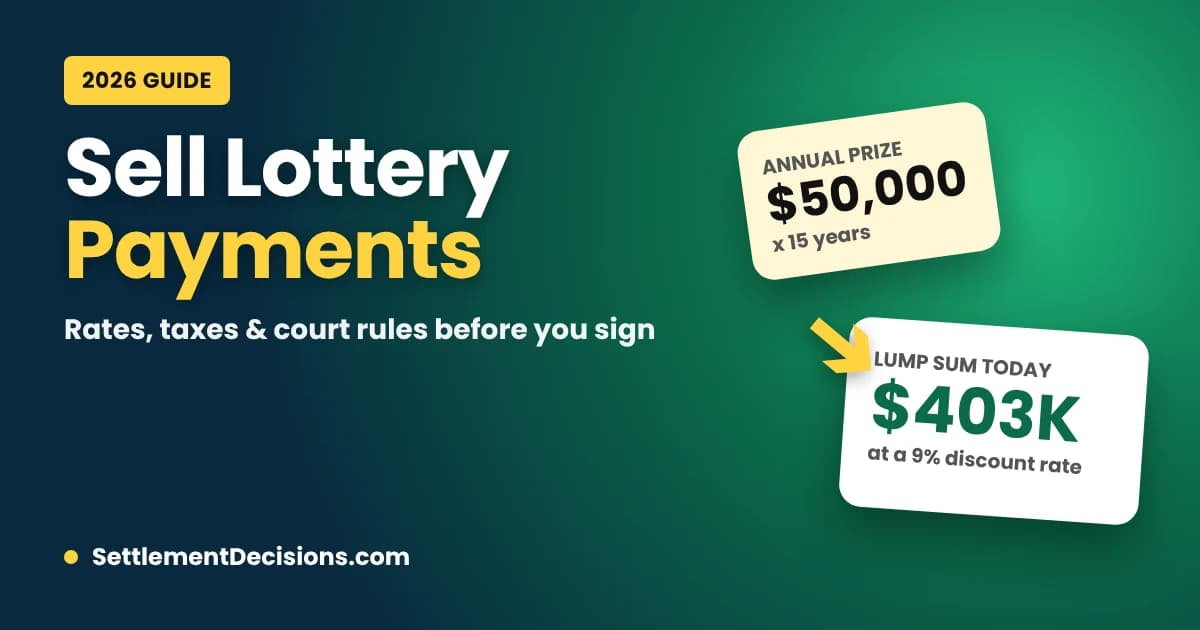
Example: You have 15 annual payments of $50,000 left, with the next one due in one year. The face value is $750,000. Here is roughly what that stream is worth at different discount rates:
| Discount rate | Present value (what a buyer would pay) | % of face value | Cost to you vs. a 7% offer |
|---|---|---|---|
| 7% | $455,396 | 61% | — |
| 9% | $403,034 | 54% | $52,362 |
| 11% | $359,543 | 48% | $95,853 |
| 13% | $323,119 | 43% | $132,277 |
Figures are present values before any fees, calculated at annual compounding. Real quotes may also deduct legal, court and processing costs.
Two things jump out:
- The face value is not the number to anchor on. Even a strong offer here is around 61% of face value because the payments stretch 15 years into the future.
- Every two points of discount rate costs this seller roughly $40,000 to $50,000. That is why comparing quotes matters more than anything else you do.
Lottery payments are backed by the state, which is about as safe a payer as a buyer can find, so you have a strong argument for a rate at the low end of the market. Run your own numbers with our settlement calculator (the math is identical; enter your annual amount and years remaining) or paste a buyer's offer into the Offer Analyzer to see the rate hidden inside it.
Graduated payments (Powerball and Mega Millions)
If your prize is from a multistate jackpot, your payments are not level. They rise 5% a year. That means later payments are larger, but they are also the most heavily discounted. Buyers often prefer to buy the nearer payments. Make sure every quote lists exactly which payment dates and amounts you are selling.
How Selling Lottery Payments Is Taxed
This is where many sellers get hurt, so read this part twice.
The lump sum from selling your lottery payments is ordinary income. In Lattera v. Commissioner (3rd Cir. 2006), a couple sold their remaining lottery payments and reported the proceeds as a capital gain, which is taxed at lower rates. The Third Circuit disagreed. It held that the lump sum is a substitute for income the winners would otherwise have received as ordinary income, so it is taxed as ordinary income. The court noted that it reached the same result as the Ninth Circuit's earlier Maginnis decision and the Tax Court.
What that means in practice:
- Federal tax: The lump sum is added to your income for the year you receive it. A large lump sum can push you into the top federal bracket of 37%, even if your yearly lottery checks kept you in a lower one.
- Withholding is not the same as tax owed. Lotteries withhold 24% federal tax on large prizes. If your actual bracket is higher, you can owe more at filing time. Do not assume what was withheld covers the bill.
- State tax: It depends on where you live. Some states tax lottery winnings (New York's top rate is 10.9%, and Illinois taxes them); others, like California, do not tax state lottery winnings.
- Timing risk: Selling 10 or 15 years of payments in one year bunches all of that income into a single tax return. Spreading the same money over years usually means a lower total tax bill.
Before you sign: Ask a CPA to estimate your after-tax proceeds for the year of the sale. A buyer's "you'll get $403,000" offer could leave you with closer to $250,000 to $280,000 after federal and state income tax, depending on your state and other income. That after-tax number is the one to compare against simply keeping the payments.
We are not tax advisors. Tax treatment depends on your full situation, so confirm with a licensed tax professional before you sell. For the different rules that apply to injury settlements, see our structured settlement tax guide.
Full Sale vs. Partial Sale
You rarely have to sell everything. Most buyers will structure a deal around what you actually need.
Common structures:
- Full sale: All remaining payments for one lump sum. Largest check, highest total cost, biggest tax hit in one year.
- Sell the next few years: For example, the next 5 payments of $50,000. At a 9% discount rate those are worth about $194,483; at 11%, about $184,795. You keep every payment after that.
- Sell part of each payment: For example, $20,000 of each $50,000 check, keeping $30,000 a year for yourself.
- Sell a fixed dollar amount: Ask for a specific lump sum and let the buyer calculate the minimum payments needed.
A partial sale usually gets a better rate on the nearer payments, keeps a reliable income stream in place, and limits how much taxable income lands in one year. If you only need $150,000, do not let anyone talk you into selling $750,000 of payments. Our guide to partial sales walks through the same strategy for settlement holders.
Step-by-Step: How to Sell Lottery Payments
Expect the whole process to take several weeks to a few months, mostly because of the court step.
Step 1: Gather your documents
You will need your lottery claim paperwork, the payment schedule (amounts and dates), a government ID, and any prior assignment orders if you have sold payments before.
Step 2: Decide what you actually need
Write down the dollar amount and the purpose. Courts in many states look at whether the sale makes sense for you, and a clear purpose ("pay off a $140,000 mortgage") helps. It also stops you from overselling.
Step 3: Get at least three written quotes
Ask each buyer for a quote that shows:
- Exact payments being sold (dates and amounts)
- Lump sum you will receive
- Effective annual discount rate
- Every fee, itemized
- Who pays the court and legal costs
Use the free quote comparison to collect offers in one place, or contact buyers directly.
Step 4: Compare and negotiate
Line the offers up by net cash to you and effective discount rate, not by headline promises. Tell the buyers you have competing quotes. Because lottery payments are low-risk, rates tend to tighten when buyers know they are competing.
Step 5: Sign the purchase agreement
Read the cancellation clause and note the deadline. Confirm the payments listed match what you agreed to. Do not sign anything with blank spaces.
Step 6: Court petition and hearing
The buyer typically files the petition and serves the lottery. A judge reviews the agreement, the disclosures, and your affidavit, and may ask you a few questions. Some courts allow phone or video appearances.
Step 7: Funding
After the order is entered and delivered to the lottery, the buyer wires your lump sum. Ask in writing how many business days funding takes after the order.
How to Compare Lottery Payment Buyers
The industry is small, and many companies buy lottery payments, structured settlements, and annuities. Judge them on these points:
| What to check | Good sign | Warning sign |
|---|---|---|
| Discount rate | Stated clearly in writing | "We don't quote rates, just look at the cash" |
| Fees | Itemized, small, disclosed up front | Lump "processing" or "closing" fees revealed late |
| Court process | Explains your state's process and timeline | Says no court approval is needed where your state requires it |
| Pressure | Lets you take time and get other quotes | "Offer expires Friday" |
| Track record | Verifiable complaints history and reviews | No physical address, no history |
| Advances | Clear terms if they offer one before court | Large "advance" that locks you in |
See how established buyers stack up on our company rankings and in our guide to avoiding settlement scams.
Red Flags and Scams to Avoid
Lottery winners are targeted because their names are often public. Watch for:
- Upfront fees. Legitimate buyers are paid from the payments you sell, not by a fee you wire in advance.
- "You won, now pay the taxes first" calls. Real lotteries and real buyers never ask you to send money to unlock a payment.
- Pre-court cash advances with heavy strings. Some buyers offer a small advance before the hearing. Read the terms: if you change your mind, can you repay it easily, or does it obligate you to sell?
- Overselling. If a buyer pushes you to sell more than you asked for, get another quote.
- No written discount rate. If they won't put it in writing, assume it is high.
Alternatives to Selling Your Lottery Payments
Selling is permanent. Before you do it, check whether one of these solves the problem for less:
- A conventional loan or HELOC. If you have strong credit and home equity, a bank loan may cost far less than a buyer's discount rate. Note: some states restrict lenders from taking lottery payments as collateral, so ask how the loan is secured.
- A smaller partial sale. Sell only what covers the need.
- Reworking the budget around the next payment. If your next check arrives in a few months, short-term options might bridge the gap.
- A fee-only financial planner. One hour with a planner who doesn't earn a commission on the sale is cheap compared to the cost of a poor deal.
Our comparison of loans vs. selling applies the same logic to settlement payments.
Frequently Asked Questions
Can you sell lottery annuity payments?
Yes, in most states that offer annuity prizes, but usually only through a court-approved assignment. Some states restrict or prohibit it, and many limit which payments can be sold. Check your state lottery's assignment rules first.
How much will I get if I sell my lottery payments?
It depends on how many payments you sell, how far in the future they are, and the discount rate. As an example, 15 annual payments of $50,000 are worth about $403,000 at a 9% discount rate and about $360,000 at 11%.
Is selling lottery payments taxable?
Yes. Federal courts, including the Third Circuit in Lattera v. Commissioner (2006), have held that the lump sum is ordinary income, not a capital gain. State income tax may also apply depending on where you live.
Do I need a court order to sell lottery payments?
In most states that allow assignment, yes. In Texas, for example, the assignment must be approved by a Travis County district court, and the winner must sign a sworn affidavit and receive a written disclosure.
Can I sell only part of my lottery winnings?
Yes. You can sell a set number of years, a portion of each payment, or enough payments to raise a specific amount. Partial sales keep some income coming and can limit the tax hit in a single year.
How long does it take to sell lottery payments?
Typically several weeks to a few months from signed agreement to cash, because the court must review and approve the assignment and the lottery must be notified.
What is a good discount rate for lottery payments?
Because payments are backed by a state, they are low-risk, and you should push for rates at the low end of what buyers offer for structured settlements. Compare at least three written quotes and use the effective annual rate, not the lump sum alone, to decide.
Can I sell Powerball or Mega Millions annuity payments?
Generally, yes, if the state where you claimed the prize allows assignment. Multistate jackpot annuities rise 5% a year, so make sure the quote lists exactly which payments you are selling.
Can I cancel after I sign?
Many states give you a short cancellation window. Texas, for example, requires that you be told in writing of the right to cancel by the third day after signing. Check your agreement for the exact deadline.
The Bottom Line
Selling lottery payments can be a sensible move when you need a large sum for a specific purpose and you have compared real offers. It becomes an expensive mistake when you sell more than you need, ignore the tax bill, or accept the first discount rate you are given.
Your next step: Run your payment schedule through the settlement calculator to see a fair range, then get competing written quotes before you talk numbers with anyone.
Sources
- Mega Millions annuity structure (30 payments, 5% annual increase), as reported by NBC San Diego
- Lattera v. Commissioner, No. 04-4721 (3rd Cir. Feb. 14, 2006), via FindLaw and the Third Circuit opinion
- Texas lottery prize assignment requirements, H.B. 1799 bill analysis
- Lottery withholding, top federal rate and state tax examples, Wood LLP
Last reviewed October 23, 2026. This guide is general information, not legal, tax or financial advice. SettlementDecisions.com is not a lottery payment buyer and may receive a referral fee if you choose to work with a buyer through our platform.