
Life Contingent Structured Settlement Payments: Who Buys Them and Why Rates Are Higher
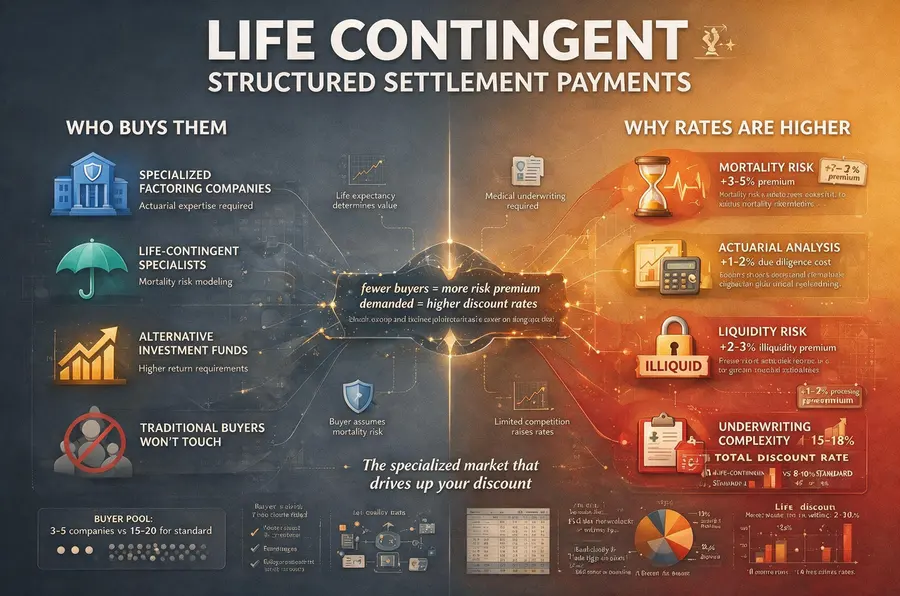
Quick answer. Life contingent structured settlement payments stop if the person whose life measures the annuity dies. Because the buyer may never collect the full stream, these payments carry mortality risk, are quoted at discount rates of roughly 12 to 18 percent against 7 to 12 percent for guaranteed payments, and are declined outright by buyers who cannot underwrite life expectancy.
Disclosure: SettlementDecisions.com is compensated by , LLC for qualified referrals. We are not a buyer of structured settlements and we do not fund transactions. This page is educational and is not financial or legal advice.
What makes a payment life contingent
A payment is life contingent when the annuity pays only while a named person, called the measuring life, is still living. A period certain payment is guaranteed for a fixed schedule and passes to your estate or beneficiary if you die before it ends.
Structured settlement annuities are built from two kinds of payment obligations, and the difference between them is invisible in your monthly deposit. The money arrives the same way, on the same day, from the same insurer. The distinction only surfaces the moment you ask what your payments are worth to somebody else.
Period certain payments run for a defined term. If the schedule says two hundred and forty monthly payments, the insurer owes two hundred and forty payments regardless of what happens to you. Your estate collects the remainder. A buyer purchasing that stream knows precisely what it is acquiring, and the only real risk is the credit quality of the issuing insurance company.
Life contingent payments are tied to a measuring life, usually yours. The obligation ends when that life ends. If the annuity promises payments for twenty years or for life, whichever is shorter, the insurer stops paying at death and owes nothing further.
Many annuities blend both. A common structure guarantees payments for a defined period and then continues them for life if the measuring life outlasts the guarantee. That blended design matters enormously when you sell, because the two portions are priced separately and one of them is far more valuable per dollar of face value.
How to tell which type you actually have
Read the annuity contract, not the settlement agreement. Look in the payment schedule for the phrase life contingent, for the life of, or whichever is shorter. If the schedule states a fixed number of payments with no reference to a person surviving, the payments are guaranteed.
This is the single most common point of confusion we see, and it produces real financial consequences. Sellers routinely request quotes believing their payments are guaranteed, then discover mid process that a portion is contingent, at which point the offer changes and the timeline slips.
The settlement agreement records what the parties agreed to at the resolution of your case. The annuity contract records what the insurance company actually promised to pay. They are different documents and they can describe the same money in different language. Only the annuity contract governs.
If you cannot locate your annuity contract, request a benefits letter from the issuing insurer. Every major issuer will produce one on request, usually within a week, and it will state the payment schedule and whether any portion is life contingent. Get this before you speak to a single buyer. It changes the conversation entirely, and it stops you from receiving a quote that gets revised downward later.
Why the discount rate is higher
Buyers price life contingent payments at higher discount rates because the stream may terminate before they recover their investment. Industry ranges place guaranteed payments at roughly 7 to 12 percent and life contingent payments at 12 to 18 percent or higher, with the full market spanning 7 to 18 percent.
| Payment type | Low | High |
|---|---|---|
| Guaranteed (period certain) | 7% | 12% |
| Life contingent | 12% | 18% |
| Full market range | 7% | 18% |
The discount rate is not a fee. It is the annual percentage used to convert your future payments into a present value, and it is the number that determines the size of your lump sum. A higher rate produces a smaller check. The relationship is mechanical, and it is why the rate is the only figure worth comparing across offers.
When a buyer purchases guaranteed payments, it knows exactly what it will collect and when. The remaining uncertainty is whether the insurer stays solvent, which for the large issuers is a remote concern. When a buyer purchases life contingent payments, it is accepting that the stream might stop in year three of a fifteen year schedule. Pricing that possibility is what the extra percentage points represent.
This is worth stating plainly because sellers often read the gap as the buyer taking advantage of them. Sometimes it is. But a substantial part of that spread reflects a risk that genuinely exists and that somebody has to carry. The way to find out which you are looking at is not to argue about the rate in the abstract. It is to obtain three written quotes on the same payment stream and see where they cluster.
What the gap costs in real money
On a stream of two thousand dollars monthly for fifteen years, a face value of three hundred sixty thousand dollars, the lump sum is roughly two hundred five thousand dollars at a nine percent discount rate and roughly one hundred forty two thousand dollars at fifteen percent. The spread is about sixty three thousand dollars.
| Discount rate | Approximate lump sum | Share of face value |
|---|---|---|
| 9% (typical guaranteed) | ~$205,000 | ~57% |
| 15% (typical life contingent) | ~$142,000 | ~39% |
| Difference | ~$63,000 | ~18 points |
Sixty three thousand dollars is not a rounding error. It is the difference between a down payment and no down payment. And because the effect of the discount rate compounds with time, the gap widens the further out your payments run. A five year horizon is relatively forgiving. A twenty year horizon is not.
This is the entire argument for comparison shopping, and it is stronger for life contingent streams than for any other category, because pricing dispersion between buyers is widest exactly where underwriting is hardest.
Is your payment stream sellable, and to whom?
Five questions. No email required to see your result. We do not store answers unless you ask us to send them to a buyer on the next screen.
How the result is calculated
Life contingent payments plus a horizon over 15 years narrows the pool of buyers most sharply, because mortality risk compounds with time. A prior decline usually reflects the buyer's underwriting capacity rather than anything about you. Fewer than three written quotes is the single most common reason sellers accept a below-market discount rate.
Why some buyers decline without explaining
Pricing life contingent payments requires life expectancy underwriting and a funding source willing to hold mortality risk. Buyers without that capability do not quote these transactions at all, which is why sellers are frequently told no with no reason given.
Underwriting a life contingent stream means reviewing medical history, applying actuarial mortality tables, and often obtaining a formal life expectancy report from a third party underwriter. It also means finding capital comfortable with an asset whose duration is unknown. Some buyers hedge the risk with contingent cost insurance. Others simply decline the category.
If you have been declined, the useful question is narrow and specific: was this about my payment type or about my file? A buyer that does not underwrite life contingent deals will usually say so directly when asked. That answer saves you from concluding your payments are unsellable when the truth is you approached the wrong desk.
Ask prospective buyers whether they underwrite life contingent transactions in house or route them to a funding partner. Both models close deals. But the in house underwriter generally moves faster and is less likely to revise a quote after you have already committed time to the process.
What underwriting will ask you for
Expect a health questionnaire covering current conditions, medications, hospitalizations and treating physicians. Expect an authorization allowing the buyer to request medical records. Expect questions about age, and expect the process to add time relative to a guaranteed transaction, because the life expectancy assessment happens before pricing can be finalized rather than after.
None of this is unusual and none of it is a red flag. The red flag is the opposite: a firm quote on a life contingent stream offered before anyone has asked a single health question. That number is not underwritten, and there is a meaningful chance it will be revised downward once it is.
You are entitled to ask what happens to your medical information, how long it is retained, and who else sees it. Get the answer in writing. Medical records shared in a financial transaction deserve the same care you would apply anywhere else.
Court approval and the best interest standard
Every structured settlement transfer requires court approval under your state Structured Settlement Protection Act, and federal law imposes a forty percent excise tax on transfers that proceed without a qualifying court order under 26 U.S.C. 5891. Judges apply a best interest standard to the payee and any dependents.
There is no separate legal test for life contingent transfers. The same statute, the same standard, the same hearing. But the emphasis shifts. Judges reviewing a life contingent petition tend to focus on whether you genuinely understand that the income you are selling was never guaranteed in the first place, and whether the discount rate is explained by mortality risk rather than by an information gap between you and the buyer.
Having three written quotes in the file helps here in a way that surprises people. It demonstrates to the court that the rate you accepted was tested against the market. It is the cheapest form of protection available to you and it costs nothing but time.
Several states require you to obtain independent professional advice before the transfer, from an attorney, accountant or financial adviser who is not paid by the buyer. Sources disagree on exactly which states mandate it, so verify your own state statute rather than relying on a summary, including this one.
State rules that change the math
Only three states cap the discount rate by statute. Michigan limits it to twenty five percent per year, North Carolina to prime plus five percent with fees capped at two percent of the net amount payable, and Nebraska ties it to the maximum consumer loan rate. In the remaining forty seven jurisdictions there is no statutory ceiling.
That is the most important and least understood fact in this market. In most of the country, nothing in the law prevents a buyer from quoting whatever rate you will accept. The protection is procedural rather than numerical: a judge must find the transfer in your best interest, and you must be told the rate in writing. Whether that rate is competitive is left entirely to you and to whether you bothered to compare.
Separately, at least eighteen states prohibit the transfer of workers compensation structured settlements outright, whatever the payment type. If your settlement arose from a workplace injury, confirm your state rule before anything else.
The strategy most sellers miss
If your annuity contains a guaranteed period followed by life contingent payments, selling only the guaranteed portion typically produces a better discount rate while preserving the contingent income for later.
Buyers price the two portions differently because they carry different risk. Bundling them into one transaction often means the whole stream is priced closer to the contingent rate. Separating them lets the guaranteed portion be priced on its own merits.
Ask every buyer for three quotes: the guaranteed portion alone, the life contingent portion alone, and the full stream together. Some will resist, because the bundled deal is more profitable for them. The ones that produce all three are the ones worth continuing with.
You are also not obliged to sell everything. Partial sales are permitted in most states and are frequently the better answer, particularly when the money is for a defined purpose with a known cost rather than an open ended need.
Warning signs
Be cautious with any buyer that quotes a life contingent stream without asking about health, that will not state the discount rate as an annual percentage in writing, that discourages you from obtaining independent advice because it will cause delay, that pressures you to sign before you have compared alternatives, or that cannot tell you which entity will hold the payment rights after closing.
A written quote should state the gross face value of what you are selling, the net lump sum you receive, the discount rate as an annual percentage, an itemized list of every fee, and the identity of the purchasing entity. Anything less is a conversation, not an offer.
Frequently asked questions
Can I sell life contingent structured settlement payments?
Yes. No federal or state law prohibits transferring life contingent payments specifically. The constraint is commercial rather than legal: fewer buyers underwrite mortality risk, so you may need to approach several before you receive a written quote.
Why is my life contingent offer lower than my neighbor's?
Because the buyer may never collect the later payments. Guaranteed payments are typically discounted at 7 to 12 percent and life contingent payments at 12 to 18 percent or higher. Two identical schedules can produce very different lump sums based only on payment type.
Will I need a medical exam to sell life contingent payments?
Usually not an exam, but a buyer underwriting mortality risk will generally request medical records or a health questionnaire to estimate life expectancy. A buyer that quotes a life contingent stream without asking anything about health is worth a second look.
Should I sell only the guaranteed portion of my annuity?
If your annuity has a guaranteed period followed by life contingent payments, selling only the guaranteed portion often produces a materially better rate while preserving the contingent income. Ask every buyer to quote both structures side by side.
Why did a buyer decline my file without explaining?
The most common reason is that the buyer does not underwrite life contingent transactions at all and has no process for pricing them. Ask directly whether the decline is about your payment type or about your specific file, then approach buyers who state they underwrite life contingent deals in house.
Does the court treat life contingent transfers differently?
The legal standard is the same best interest test that applies to every transfer, but judges tend to probe harder on whether you understand the stream is not guaranteed and whether the higher discount rate reflects genuine mortality risk rather than opportunism.
Can I sell life contingent workers compensation payments?
In many states, no. At least eighteen states prohibit transfer of workers compensation structured settlements entirely, regardless of payment type. Confirm your state rule before you spend time gathering quotes.
How many quotes should I get?
At least three in writing, each stating the discount rate as an annual percentage. Fewer than three written quotes is the most common reason sellers accept a below market rate, and it matters more on life contingent streams where pricing varies most between buyers.
Request written quotes on life contingent payments
Disclosure: SettlementDecisions.com is compensated by , LLC for qualified referrals. We are not a buyer and do not fund transactions.
We pass your information to , LLC only. See our privacy notice and how we make money.
Cite this page
APA. SettlementDecisions.com. (2026). Life Contingent Structured Settlement Payments: Who Buys Them and Why Rates Are Higher. https://www.settlementdecisions.com/blog/life-contingent-structured-settlement-payments
Inline HTML. <a href="https://www.settlementdecisions.com/blog/life-contingent-structured-settlement-payments">SettlementDecisions.com</a>