

Short answer: most benefits can't be sold
If you receive a monthly pension, Social Security, SSDI or VA benefit, federal law generally does not let you sell the future payments for a lump sum. These protections exist so that retirement and disability income actually reaches the person it was meant for. They also mean that a company offering to "buy your pension" is almost always offering something else, usually a loan with a high effective interest rate.
That is very different from a structured settlement from a lawsuit, or a private annuity you bought yourself. Those payments can be sold, because state structured settlement protection acts set up a court-approval process for exactly that. The rest of this guide explains where the line sits and how to tell a legal sale from a disguised loan.
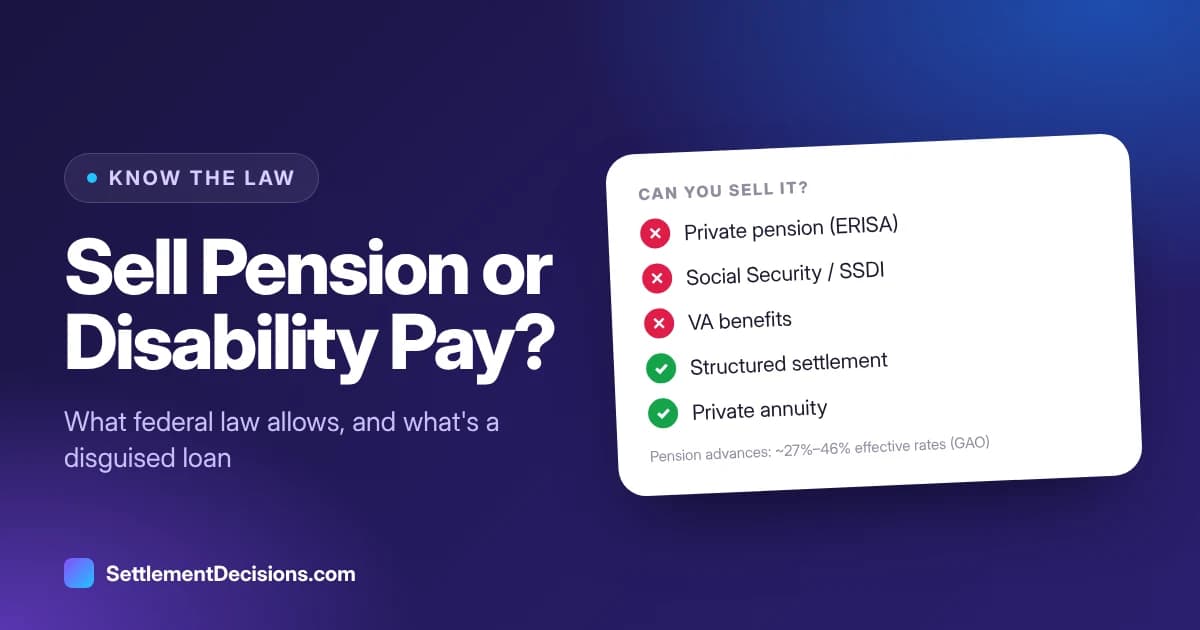
| Type of payment | Can you sell it? | Rule |
|---|---|---|
| Private employer pension (ERISA plan) | Generally no | 29 U.S.C. § 1056(d) |
| Social Security retirement, SSDI, SSI | No | 42 U.S.C. § 407 (SSI by cross-reference) |
| VA disability compensation and VA pension | No; agreements to sell are void | 38 U.S.C. § 5301 |
| Federal civil service retirement (CSRS/FERS) | Generally no | 5 U.S.C. §§ 8346 and 8470 |
| State and local government pensions | Usually no; varies by state | State retirement statutes |
| Structured settlement from a lawsuit | Yes, with court approval | State protection acts; 26 U.S.C. § 5891 |
| Private annuity you purchased | Usually yes | Contract terms and state law |
Private pensions: ERISA's anti-alienation rule
Most private employer pension plans are governed by the Employee Retirement Income Security Act (ERISA). Section 206(d), codified at 29 U.S.C. § 1056(d), requires every covered plan to provide that benefits may not be assigned or alienated. The tax code has a matching rule for qualified plans in 26 U.S.C. § 401(a)(13). A plan that ignored the rule could lose its tax-qualified status.
There are narrow exceptions, and none of them is "sell your pension to an investor":
- Qualified domestic relations orders (QDROs). A divorce court can award part of a pension to a former spouse or child.
- A small voluntary, revocable assignment. Once payments have started, the law allows a revocable assignment of up to 10% of a benefit payment. Because it can be revoked, it is useless to a buyer.
- Plan loans, where the plan itself allows them, which mainly applies to defined contribution plans such as a 401(k).
The practical effect is simple. Your plan will keep paying you, not a third party, regardless of what any outside contract says.
Social Security and SSDI: 42 U.S.C. § 407
Section 207 of the Social Security Act, at 42 U.S.C. § 407, says the right to future payments is not transferable or assignable, at law or in equity, and protects the money from levy, garnishment and similar legal process, with limited exceptions such as federal tax debts and child support. That covers Social Security retirement and SSDI. SSI has the same protection by cross-reference.
So there is no lawful way to sell future Social Security or SSDI checks. If someone asks you to sign over your benefit, redirect your direct deposit or hand over your bank login so they can collect your payments, treat it as a red flag.
VA benefits: agreements to sell are void
Veterans' benefits have some of the strongest protections. Under 38 U.S.C. § 5301, VA benefits are not assignable, and the statute specifically addresses arrangements where someone pays cash now in exchange for a veteran's future benefit payments. Those agreements are prohibited and void.
The VA Office of Inspector General issued a fraud alert on "pension poaching" in June 2025. Its red flags include anyone promising guaranteed eligibility for a benefit, upfront fees or a percentage of an award for filing a claim, advice to move assets into trusts or buy annuities to qualify, and attempts to redirect VA deposits to an account the beneficiary does not control.
If your income comes from a military or VA source, our VA disability and military structured settlement guide explains which payments can and can't be sold.
What "pension buyout" offers really are
Because pensions can't be sold, companies that advertise "pension buyouts" or "pension advances" usually do something else. You receive a lump sum, and in return you agree to send the company a fixed monthly amount for a set number of years, often by redirecting your pension deposit into an account they control.
Regulators have looked at this closely:
- The U.S. Government Accountability Office reviewed the market in GAO-14-420 (June 2014). It identified at least 38 pension advance companies, at least 21 of them affiliated with each other in ways that weren't apparent to consumers. Effective interest rates on offers GAO received were roughly 27% to 46%, at times two to three times state limits on certain personal credit.
- In September 2018 the Consumer Financial Protection Bureau sued Future Income Payments, LLC, its owner and related entities. The CFPB alleged the company told consumers its pension advances were not loans and had no interest, when they were loans with rates well above credit cards, and that it failed to disclose the cost of credit as a yearly rate.
The math on a typical advance
Here is an illustration, not an actual offer. Suppose a company advances $10,000 and you agree to pay it $350 a month for 48 months. You repay $16,800 in total. The annual percentage rate on that deal works out to about 28%, in the range GAO found. A personal loan or a credit union loan will often cost far less, even for borrowers with weak credit.
Rule of thumb: If someone gives you cash now and you repay a fixed amount every month, it is a loan, whatever the contract calls it. Ask for the APR in writing and compare it with a personal loan before you sign.
How to spot a pension advance pitch
Pension advance offers rarely use the word "loan". Watch for:
- "Sell your pension" or "pension buyout" advertising, especially online or by mail.
- A request to redirect your pension deposit to a new bank account or a company-controlled account.
- A life insurance requirement naming the company as beneficiary, to protect it if you die before repaying.
- No APR on the paperwork, or a claim that there is "no interest".
- Affiliated companies handling different steps, so it's hard to tell who you're dealing with. GAO found that 21 of the 38 companies it identified were affiliated with each other.
If you've already signed one and are struggling with the payments, contact your state attorney general's consumer protection office or file a complaint with the CFPB.
Payments you can legally sell
If you need a lump sum, look at income streams that can be transferred:
- Structured settlements from personal injury, wrongful death, workers' comp or similar cases. These can be sold with court approval in every state. The judge checks that the sale is in your best interest and that you received a disclosure statement. See the court approval process.
- Private annuities you bought. Many buyers purchase annuity payments, subject to the contract and state law.
- Lottery prize installments, in states that allow assignment with court approval. See selling lottery payments.
Even with these, sell only what you need. A sale trades future income for less cash today. Run the numbers in the payout calculator first.
Better options when you need cash
Before you sign any pension-advance contract, check these:
- Ask your plan about lump-sum options. Some pensions let you take a lump sum at retirement or offer a one-time buyout window. Ask the plan administrator in writing.
- 401(k) or 403(b) loans or hardship withdrawals. If you have a defined contribution plan, a plan loan may be far cheaper. Hardship withdrawals have tax costs, so ask a tax professional first.
- A personal loan or credit union loan. Compare APRs. Many credit unions offer small-dollar loans to members.
- Benefits counseling. Veterans can work with a VA-accredited representative at no charge. State aging and benefits offices can help with others.
- Nonprofit credit counseling. An agency approved by the U.S. Trustee Program or affiliated with the National Foundation for Credit Counseling can help negotiate debts.
Bottom line
Pension, Social Security, SSDI and VA benefits are protected by federal law so they can't be sold out from under the people who depend on them. Companies offering to buy them are almost always offering expensive loans. If you have a structured settlement or a private annuity, those can be sold through a regulated process. Whatever you decide, compare the true cost in writing and talk to a qualified financial advisor who has nothing to gain from the transaction.