

Can you sell payments to fix your house?
Yes. Every state's structured settlement protection act lets you sell payments if a judge finds the sale is in your best interest (or your family's). Urgent repairs, such as a failing roof, mold or no heat, are among the stronger reasons, because leaving them can cost more than the discount. But judges look hard at how much, for what, and whether there's a cheaper way.
Three denied cases and why
| Case | What the payee wanted | Why the judge said no |
|---|---|---|
| Stone Street Capital v. VanHousen (Tioga County, Aug. 9, 2016) | $43,000 for one $216,186 payment due in 2038, at a 7.64% rate, for "significant repairs" to her homes after black mold forced the family out | Four earlier petitions denied, a prior sale hadn't improved her finances, no account of how earlier money was spent, and this was her last future income (decision) |
| Seneca One v. Barr (Queens County, Sept. 11, 2012) | $48,566 for $163,002 of payments, partly for a $10,000 to $15,000 home addition | No documents for the amounts, no income or debt details, and no record of how a previous sale's $65,021 was spent (decision) |
| Novation Capital v. Knight (N.Y. Sup. Ct. 2008) | Part of his monthly payments, for debts and renovations | Couldn't specify the renovations, and five children relied on the income (summary) |
Notice that the VanHousen deal had a fair rate (7.64%) and was still denied. A good price doesn't rescue a weak plan.
What to bring to the hearing
- Two or three written contractor estimates for the specific work.
- Proof of the problem: photos, an inspection report, a code violation notice or an insurance denial letter.
- Proof you own the home: a deed or mortgage statement.
- Your budget: income, bills and how you'll manage with lower payments afterward.
- Proof you tried cheaper options: a loan denial or program waitlist letter.
- A plan to pay the contractor directly, so the money goes where you said it would.
Sell only enough to cover the estimates. See partial sales and the 7 questions judges ask.
Check cheaper ways to pay for repairs first
| Option | Who it's for | Key terms |
|---|---|---|
| USDA Section 504 repair loan | Rural homeowners with very low income who can't get credit elsewhere | Up to $40,000 at 1% fixed for 20 years (USDA) |
| USDA Section 504 grant | Same, and 62 or older | Up to $10,000, lifetime; combined with a loan, up to $50,000 |
| FHA 203(k) loan | Buying or refinancing a home that needs work | Rolls repair costs into one FHA-insured mortgage (HUD) |
| Weatherization Assistance Program | Lower-income households | Energy repairs through your state agency (DOE: how to apply) |
| Homeowners insurance claim | Sudden damage (storm, burst pipe) | File before you sell anything |
What the difference costs
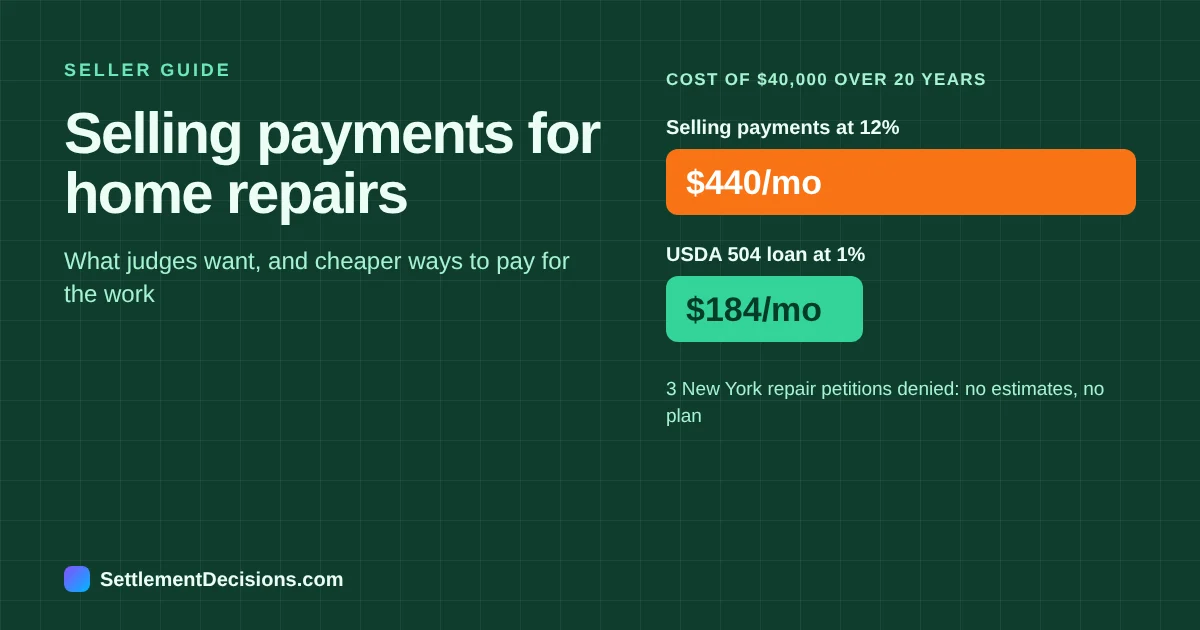
To raise $40,000:
- Selling payments at 12% means giving up about $440 a month for 20 years, about $105,700 in total.
- A USDA 504 loan at 1% costs about $184 a month for 20 years, about $44,150 in total.
Our calculation, level monthly payments over 240 months. Your rate depends on your offer.
If you do sell
- Get your estimates first, then ask for offers on only that amount.
- Get three written offers for the same payments and compare them with our court deal benchmark.
- Check the rate with the discount rate calculator.
Talk to a qualified financial advisor who doesn't profit from the sale before you decide.