
Business funding strategy
Can You Sell a Structured Settlement to Start a Business?
Compare startup capital, operating reserves, business financing and the long-term cost of transferring future payments.
Direct answer
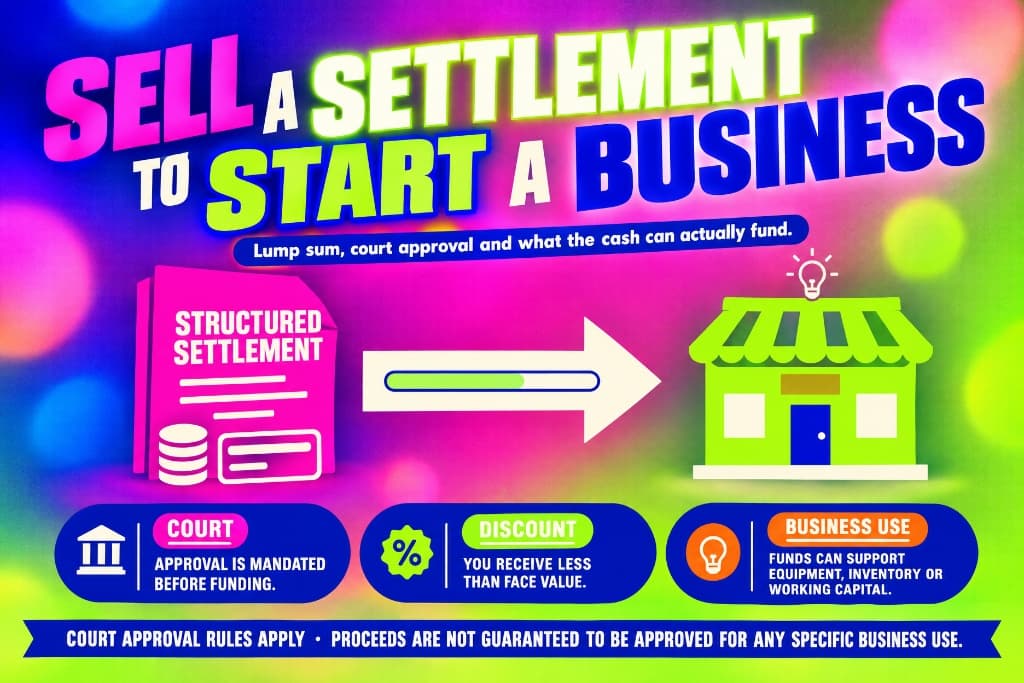
You may be able to transfer a portion of future structured settlement payments to fund a startup or business acquisition, subject to applicable law and advance approval. Before doing so, compare the permanent loss of guaranteed payments with business loans, partner capital, grants and starting at a smaller scale.
Interactive planning tool
Business Funding Planner
Estimate a startup-capital target, operating reserve and illustrative number of settlement payments involved. This is not a purchase offer, business forecast or prediction of court approval.
Estimated funding target
$116,000
Free educational review. Actual value depends on verified payment details, transaction terms and applicable law.
Why This Decision Requires More Than a Cash Estimate
A business may fail, take longer than expected to become profitable or require additional capital. Structured settlement payments, by contrast, are scheduled income. Transferring them replaces a predictable asset with an uncertain business outcome.
The decision should therefore answer two separate questions: how much capital the business reasonably needs and how much guaranteed future income the household can safely surrender.
Four Funding Strategies to Compare
1. Preserve the settlement and start smaller
A lower-cost launch, pilot program or part-time operation can test demand before significant settlement income is transferred. This reduces the amount at risk if the original assumptions are wrong.
2. Use business financing
Traditional loans, SBA-related programs, equipment financing and lines of credit preserve the settlement but create repayment obligations. Compare total interest, collateral, personal guarantees and monthly cash flow—not merely the advertised rate.
3. Combine financing with a limited partial sale
A smaller transfer might fund a down payment, essential equipment or required working capital while preserving other settlement payments. The remaining income may provide household stability during the startup period.
4. Transfer a larger payment stream
A larger lump sum may reduce borrowing, but it increases the future income permanently transferred. Calculate the business capital needed, operating reserve, household reserve and amount left after every expense before considering this option.
Startup Cost Is Not the Complete Funding Target
Equipment, inventory and formation costs are only the beginning. A realistic business budget may also include:
- Licensing, permits and professional fees
- Insurance and security deposits
- Technology, equipment and maintenance
- Inventory and supplier deposits
- Marketing and customer acquisition
- Payroll and contractor expenses
- Rent, utilities and working capital
- A reserve for slower-than-expected revenue
- A separate household emergency reserve
The Business Funding Planner deliberately adds an operating reserve instead of assuming the company becomes profitable immediately.
Partial-Sale Example
Suppose a business requires $100,000 and the owner already has $20,000. Expected expenses are $6,000 per month, and the plan calls for six months of operating reserves. The actual funding target is therefore $116,000—not $80,000.
The next step is not automatically to transfer $116,000 worth of payments. Compare a smaller launch, financing part of the purchase, negotiating seller financing and limiting the transfer to a specific payment period.
- ✓ Exact payment dates transferred
- ✓ Total future payments transferred
- ✓ Gross advance amount
- ✓ Itemized deductions and expenses
- ✓ Net cash delivered
- ✓ Effective discount rate
- ✓ Payments retained afterward
- ✓ Repricing and expiration terms
Use the transfer disclosure statement guide to understand the transaction figures.
What May Matter During Approval
Federal law addresses qualified orders for structured settlement factoring transactions, while state law controls the applicable approval process. The reviewing authority generally considers whether the proposed transaction satisfies the governing legal requirements and is in the payee's best interest.
A documented business plan is more useful than a general statement that the funds will be invested in a company. Helpful materials may include:
- A detailed use-of-funds schedule
- Vendor estimates or a business purchase agreement
- Evidence of relevant experience
- Conservative revenue and expense projections
- A household budget after the transfer
- Alternative financing decisions
- A plan for preserving some settlement income
Warning Signs
Slow down if the proposed business depends on:
- Guaranteed or unusually fast investment returns
- Pressure to transfer payments immediately
- Paying a promoter before receiving complete documents
- Revenue projections unsupported by customers or contracts
- Using every settlement payment with no household reserve
- A business opportunity you do not independently control
- Borrowing additional money immediately after the transfer
When Keeping the Settlement May Be Better
Preserving the payments may be the stronger option when the business model is untested, household expenses depend on the settlement, the proposal requires nearly every future payment or the entrepreneur has not compared other financing.
It may also be reasonable to postpone a transfer until the business demonstrates demand through actual customers, deposits or a successful small-scale launch.
Questions to Ask Every Settlement Purchaser
- Which exact payments does the quote purchase?
- What is the total future amount being transferred?
- What is the net advance after every deduction?
- Can the transaction be limited to a smaller amount?
- Which settlement payments will remain?
- What can cause the quoted amount to change?
- What documents are needed for the approval process?
- When will the net funds actually become available?
If an estimate changes after document review, read why structured settlement payout offers change.
Frequently Asked Questions
Can I sell structured settlement payments to start a business?
You may seek to transfer some or all future payment rights for a current lump sum, subject to applicable law and advance approval through a qualified court or administrative order. Approval is not automatic, and a speculative business idea may receive closer scrutiny than a documented plan.
Can I sell only enough payments for startup costs?
A proposed transaction may involve only a defined portion of future payments. A partial sale can preserve remaining income, but the exact payment dates, net advance, discount rate, expenses and retained payments should be compared in writing.
Is selling payments better than a business loan?
Not necessarily. A loan preserves the settlement but creates debt and repayment obligations. A settlement transfer avoids a traditional loan payment but permanently gives up specified future income. Compare the total cost, risk and cash-flow effect of both.
Will a judge approve a transfer for a new business?
No outcome can be guaranteed. The reviewing authority applies the requirements of applicable law and generally considers the payee's best interest. A detailed business plan, realistic budget and protected household reserve may help explain the proposed use of funds.
Is the Business Funding Planner a guaranteed offer?
No. It provides an educational present-value illustration. A real offer depends on the verified payment schedule, payment type, transaction expenses, pricing and other legal or financial details.
Bottom Line
Selling structured settlement payments to fund a business is not simply a question of whether enough cash is available. Compare the smallest practical partial transfer with financing, partner capital and a smaller launch. Protect both a business operating reserve and the household income needed if the company takes longer than expected to succeed.
Private payment review
Compare the Cost Before Transferring Payments
Estimate your payment value and compare a partial transaction with your documented business funding target.
Authoritative References
- 26 U.S.C. § 5891 — Structured settlement factoring transactions
- Consumer Financial Protection Bureau guidance
- U.S. Small Business Administration funding programs
This article provides general educational information and is not legal, tax, investment or business advice. Requirements and individual circumstances vary.