

Who is SenecaOne?
SenecaOne is the trade name of Seneca One Finance, Inc., a Maryland corporation based in Bethesda. A 2016 federal court opinion describes its business as buying "for a lump sum all or a portion of structured settlement annuities or other deferred payment plans" from people "throughout the United States."
Its BBB profile lists the business as incorporated on January 3, 2002, and shows a Maryland license number (02-1054).
SenecaOne doesn't only buy payments. Its own terms of use say "All loans are made by Seneca One, LLC" and that loan amounts and rates "may vary based on state law." So you may be offered either a sale of some payments or a loan backed by them. These are different products with different rules. Our guide to loans versus selling explains the trade-off.
The other names it uses
Paperwork, ads or court petitions may use a different name. The terms page lists these companies as subsidiaries of MMS IP, LLC, and the BBB profile lists several of them as alternate names:
| Name you might see | Where it's listed |
|---|---|
| Seneca One, LLC | SenecaOne terms; BBB; court petitions |
| Lump Sum Capital, LLC | SenecaOne terms; BBB |
| Freedom First Capital, LLC | SenecaOne terms; BBB |
| Guaranteed Funding, LLC | SenecaOne terms |
| Direct Capital, LLC | SenecaOne terms |
| Structured Settlement Processing Group | BBB |
If a company with one of these names calls you, you are dealing with the same group. Ask for the exact legal name of the buyer in writing. That's the name that will appear on the court petition.
Is SenecaOne legit? BBB and licensing
BBB. The BBB profile for Seneca One Finance, Inc. states: "This business is NOT BBB Accredited." When we checked on November 14, 2026, the version of the page we could load didn't show a letter grade, complaint count or review average, so we don't quote one. Check the live BBB profile yourself before deciding. For how to read a BBB page, see our J.G. Wentworth BBB breakdown.
California license history. California's Department of Financial Protection and Innovation (DFPI) has an enforcement page for "Seneca One, LLC", the same name SenecaOne's terms give for its lending company. It lists these documents:
| Date | DFPI document |
|---|---|
| June 7, 2010 | Order Revoking California Finance Lenders License |
| April 4, 2014 | Order Conditionally Granting |
| June 24, 2014 | Order Granting and Reinstating License |
| July 11, 2018 | Settlement Agreement |
| April 3, 2020 | Order Summarily Revoking |
The page lists the documents without summarizing what they allege, and we haven't seen the orders themselves. Treat this as a history of license actions by California, not proof of any particular wrongdoing. If you live in California and are offered a loan, ask which license it is made under.
Registration. Some states require structured settlement buyers to register. Check our list of registered buyers by state.
What judges said about SenecaOne offers
Every sale needs a judge's approval under your state's protection act, and some judges publish their decisions. These are the five published decisions with full numbers that we found on SenecaOne petitions. They are older (2006 to 2013), and published decisions lean toward denials, so they don't show how SenecaOne prices deals today. They do show how courts judge an offer.
| Decision | Payments sold | Price offered | Share of payments | Rate | Result |
|---|---|---|---|---|---|
| Seneca One, LLC v Stevens, Nassau County, NY, June 21, 2011 | $150,000 of a $250,000 lump sum due in 2021 | $40,000 | about 27% | 13.70% | Denied |
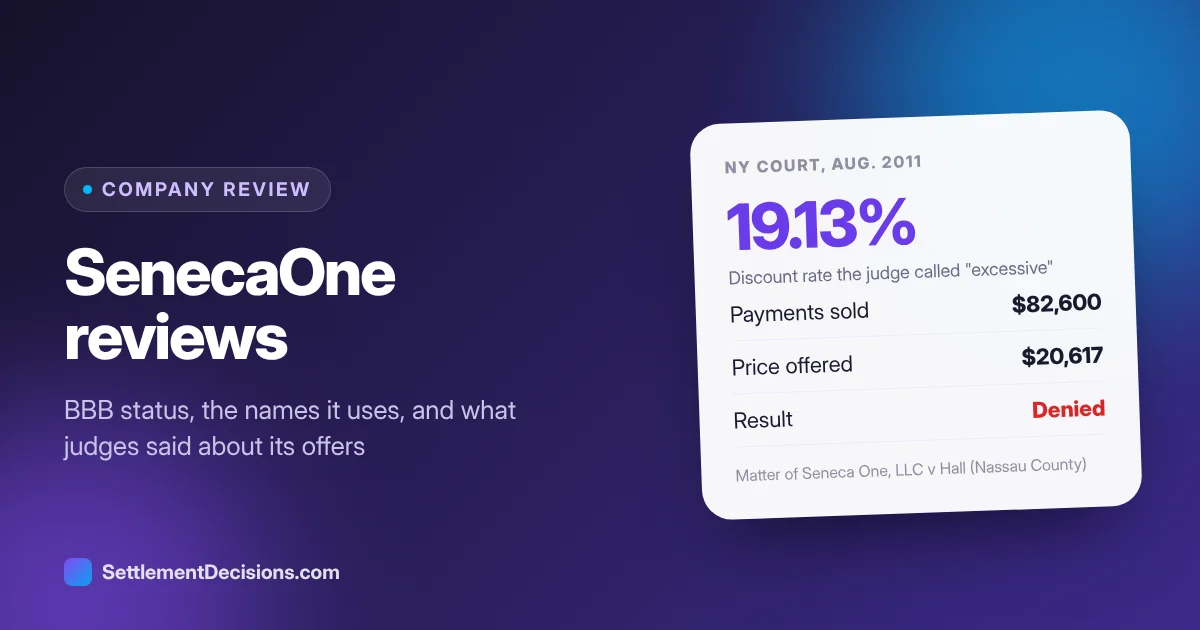
| Seneca One, LLC v Hall, Nassau County, NY, Aug. 12, 2011 | 59 payments of $1,400 = $82,600 | $20,617.36 | about 25% | 19.13% | Denied |
| Seneca One, LLC v D.C., Bronx County, NY, Feb. 15, 2012 | 146 payments of $375 = $54,750 | $18,552.32 net | about 34% | not quoted | Partly granted |
| Seneca One LLC v Ramos, Kings County, NY, Feb. 21, 2013 | $11,866.66 (2018) + $72,163.97 (2023) = $84,030.63 | $16,021 | about 19% | not stated | Denied |
| In re Seneca One, LLC, Massachusetts, heard Nov. 17, 2006 | 6 payments of $9,955 = $59,730 | $9,478.67 | about 16% | 16.02% | Denied |
"Share of payments" is our arithmetic: the price divided by the total payments sold. It isn't a rate, because money due later is worth less today.
What the judges focused on:
- The rate. In Hall, the court called a 19.130% discount rate "excessive" and noted the price was "less than half" of the payments' present value of $64,859.07. In the Massachusetts case, the judge called a 16.021% effective rate "punishingly high"; the price was 38.802% of the payments' estimated current value.
- Repeat sales. Hall had already made four earlier transfers. Courts look hard at sellers who keep coming back. See how many times you can sell.
- Notice and paperwork. In Stevens and Hall, the courts also found that the required notice or service was defective.
- Selling only what's needed. In the Bronx case, the seller was facing foreclosure. The court approved only enough to cover three months of mortgage payments and let the parties come back later. That is the logic behind a partial sale.
- Proof that the price is fair. In Ramos, the court said there was "nothing to indicate that the discount rate is fair" and found the deal wasn't in the seller's best interest.
For more on why petitions fail, see when courts deny a transfer.
Who funds the deals?
In a 2010 dispute with a funding partner, a Maryland federal court described SenecaOne's role as "essentially that of a broker," with the money for purchases coming from outside sources. The case concerned higher discount rates on 18 deals and 26 deals left unfunded.
That matters for you in one way: the company you talk to may not be the one that ends up owning your payments. The price you're quoted can depend on what its funders will pay. Get every offer in writing, with the net cash after all fees.
How to check a SenecaOne offer
- Get the exact legal buyer name and the payments being sold (dates and amounts) in writing.
- Ask whether it's a sale or a loan. A loan backed by your payments isn't the same as a court-approved sale.
- Find the effective rate. Enter the payments and the net cash in our discount rate calculator, then compare with approved deals in the court deal benchmark.
- Get at least two competing written offers for the same payments. Our DRB Capital vs J.G. Wentworth vs SenecaOne comparison and the companies directory list other buyers.
- Read the court petition before the hearing, and get independent advice. Many states require it, and judges ask.
Talk to a qualified financial advisor before you sign anything.