

Is there a list of licensed structured settlement buyers?
Not a national one. No federal agency licenses structured settlement purchase companies. The main federal safeguard is a tax rule: under 26 U.S.C. § 5891, a buyer owes a 40% excise tax on the discount unless a state court approves the transfer in a "qualified order." Every state has a structured settlement protection act that sets out how that approval works.
On top of court approval, some states require buyers to register with a state office before they can buy payments from residents or file transfer petitions there. Registration usually comes with a surety bond, an annual renewal and a public record you can check. That's the closest thing to a license list that exists.
Which states require registration
These are the state programs we verified from official sources. Other states may have their own rules, so check with your state attorney general or secretary of state if yours isn't listed.
| State | Who registers buyers | Fees | Bond | Public list? |
|---|---|---|---|---|
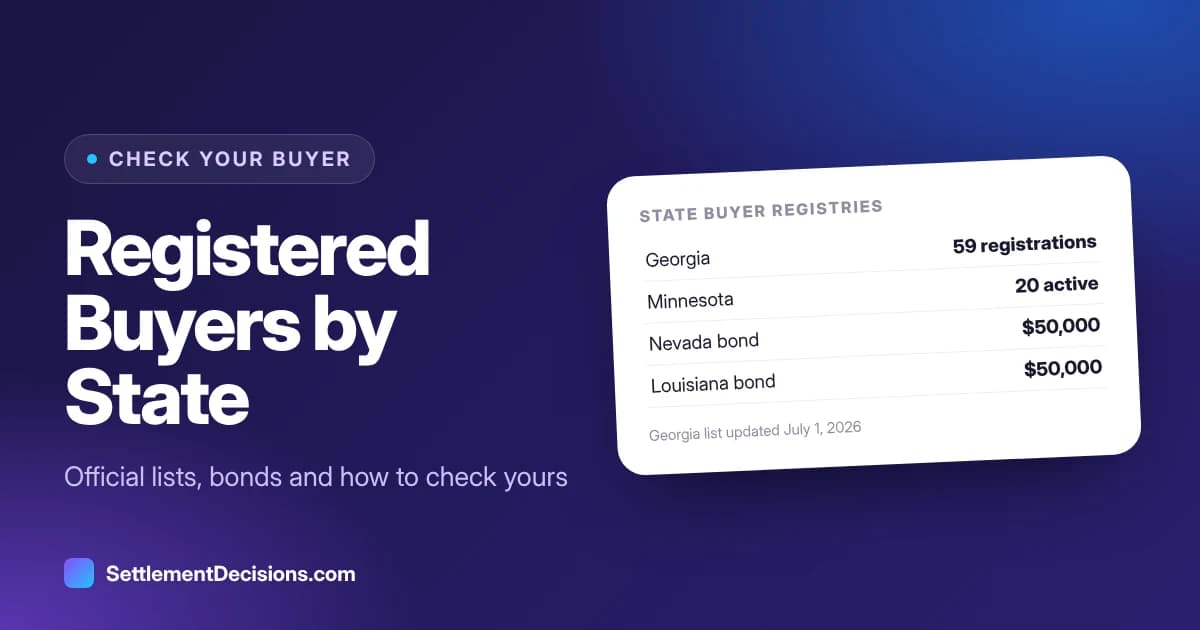
| Georgia | Secretary of State | See the state's application | Required | Yes: registered purchase companies, 59 registrations as of July 1, 2026 |
| Minnesota | Secretary of State (Minn. Stat. § 549.35) | $700 initial, $200 renewal | Surety bond payable to the state, kept at least 3 years after registration ends | Yes: active list, 20 companies on the version we checked |
| Nevada | Consumer Affairs Unit (NRS 42.340) | $250 application; $375 late renewal; $500 reinstatement | $50,000 surety bond or letter of credit, kept 3 years after registration ends | Ask the Unit |
| Louisiana | Secretary of State (R.S. 9:2713.2) | $600 initial, $250 renewal (form SS2713) | $50,000 surety bond, letter of credit or cash bond | Ask the office |
A few details are worth knowing:
- Registrations expire. Nevada and Minnesota registrations last one year. Louisiana requires annual renewal with a new bond. A buyer that was registered last year may not be today.
- The bond protects the state and consumers. In Nevada and Minnesota it must stay in force for three years after a registration ends, so there is something to claim against if a buyer breaks the rules.
- Registration is tied to the legal entity. Brand names and legal names often differ. Stone Street Capital registers as Stone Street Originations, LLC, and J.G. Wentworth as J.G. Wentworth Originations, LLC.
Who is on the Georgia and Minnesota lists
Georgia's list, last updated July 1, 2026, has 59 registration numbers covering about 46 distinct company names. Some companies hold more than one registration. Minnesota's active list we checked had 20 companies.
These buyers appear on both lists (shown by legal name; a dash means the brand is the same or we didn't confirm a different one):
| Legal name on the lists | Brand name, where different |
|---|---|
| J.G. Wentworth Originations, LLC | J.G. Wentworth |
| Peachtree Settlement Funding, LLC | Peachtree Financial |
| Stone Street Originations, LLC | Stone Street Capital |
| CBC Settlement Funding, LLC | CBC |
| Catalina Structured Funding, Inc. | Catalina |
| Genex Capital Corporation | — |
| American Settlement Funding, LLC | — |
| Structured Settlement Capital, LLC | — |
| Stratcap Investments, Inc. | — |
| Bentzen Financial, LLC | — |
| Redstone Capital, LLC | — |
| Black Square Financial, LLC | — |
| Intelifund, LLC | — |
| BIFCO, LLC | — |
| Law First Finance LLC | — |
| Blue Wave Funding LLC | — |
Both lists also include two life insurers, Transamerica Life Insurance Company and Wilcac Life Insurance Company, which buy payment rights as investors. Several buyers registered in Georgia, such as WePayMore Funding, Novation Funding and Rightway Funding, did not appear on the Minnesota list we checked. That doesn't mean anything is wrong; a company only needs to register where it does business. But if you live in Minnesota, it's a question worth asking.
The lists change. Treat the tables above as a snapshot and open the official PDF yourself before you rely on it.
Rule of thumb: Search the official list for the exact legal name printed on your contract, not the brand name in the ads. If the names don't match, ask the buyer to explain in writing.
What registration does and doesn't tell you
Registration is a floor, not a seal of approval.
It does tell you that the company filed with the state, posted a bond, gave a physical address and keeps its paperwork current. In Minnesota, registration also matters to the transfer itself, because the statute ties a valid transfer order to the buyer being registered.
It doesn't tell you whether the price is fair. Every company on these lists still sets its own discount rate, and the difference between offers on the same payments can be tens of thousands of dollars. Registration also doesn't say anything about complaint history. For that, check the BBB profiles of structured settlement companies and search your state's court records.
How to check your buyer in five minutes
- Find the legal name. It's on the purchase agreement and the court petition.
- Open your state's list. Use the links in the table above, or ask your state's secretary of state or consumer affairs office.
- Match the name exactly. Note the registration number and expiration date if shown.
- Check the BBB and court records. Look for patterns of complaints or denied petitions.
- Confirm the court order. After the hearing, call the clerk with your case number to confirm the signed order. Fake orders are rare, but the Stone Street case history shows they have happened.
If your state doesn't require registration, the court approval process is still your main protection. Our court approval guide and state laws tool explain what your judge will look at.
What if your buyer isn't on the list?
Don't panic, but don't sign yet either. There are innocent explanations:
- Your state may not require registration. Many states rely on court approval alone.
- The company may use a different legal name. Ask for the exact entity on the contract and search again.
- The list may be out of date, or the registration may have just been renewed. Ask the buyer for its registration number and expiration date, then call the state office to confirm.
If your state does require registration and the buyer can't show it, walk away. In Nevada, for example, a company must be registered with the Consumer Affairs Unit before acting as a transferee, acquiring payments from a Nevada payee or filing a transfer proceeding there. An unregistered buyer may be unable to get your deal approved, and you'd have wasted weeks.
States without a registry: what still protects you
In states without buyer registration, the protection comes from the court process itself:
- Mandatory disclosures. Protection acts require a written disclosure of the total payments, the price, the present value and the effective discount rate, usually days before you sign.
- Independent advice. Many states require or encourage advice from a professional who isn't paid by the buyer.
- The best-interest finding. A judge must find the sale is in your best interest, considering your dependents.
- Notice to interested parties. The annuity issuer and others get notice and can raise problems.
Use our state laws tool to see the rules where you live.
Use the lists to build a shortlist
The registration lists are also a handy way to find buyers to compare. Pick three registered companies, ask each for a written offer on the same payments, and compare:
- the purchase price and the payments being sold,
- the effective discount rate from the disclosure statement, and
- the net cash after any fees.
For a sense of scale, a $50,000 payment due in five years is worth about $32,500 at a 9% discount rate, $28,400 at 12% and $24,900 at 15%. These are illustrations, not quotes. That spread is why comparing matters even among registered buyers. You can model your own payments in the payout calculator or start with the instant offer estimator.
Bottom line
There is no national license for structured settlement buyers, but Georgia, Minnesota, Nevada and Louisiana make them register and post a bond, and Georgia and Minnesota publish who's on the list. Check that your buyer's legal name is registered where you live, then compare offers on price and discount rate, not on registration alone. Before your hearing, talk to a financial advisor or attorney who is independent of the buyer.