

The short answer
The FAFSA looks at two things: income (from your 2024 federal tax return, for the 2026-27 award year) and assets (what you own on the day you sign the form). A structured settlement can touch both, but in most cases the payments themselves don't show up anywhere. Cash from selling them does.
This guide is about the federal FAFSA and the 2026-27 Federal Student Aid (FSA) Handbook. Some private colleges also use their own aid forms with stricter rules, so always ask the school.
Are structured settlement payments income on the FAFSA?
For a personal injury settlement, generally no.
The FAFSA pulls income from the IRS. Under 26 U.S.C. § 104(a)(2), damages received "on account of personal physical injuries or physical sickness" are not taxable, whether paid "as lump sums or as periodic payments." Workers' compensation benefits are excluded too, under § 104(a)(1). Because these payments aren't taxable, they aren't in your adjusted gross income (AGI).
Since the FAFSA Simplification Act, the form asks for only a short list of untaxed items. The 2026-27 Handbook's Chapter 2 lists:
| Untaxed item the 2026-27 FAFSA uses | Where it comes from |
|---|---|
| Tax-exempt interest income | Form 1040, line 2a |
| Untaxed portion of IRA distributions | Form 1040, line 4a minus 4b |
| Untaxed portion of pensions | Form 1040, line 5a minus 5b |
| Earned income credit | Form 1040, line 27 |
| Foreign earned income exclusion | Schedule 1, line 8d |
Tax-free injury settlement payments are not on that list. The Handbook doesn't mention structured settlements at all.
Two exceptions. If part of your settlement was taxable (punitive damages, interest, or an emotional-distress award with no physical injury, for example), that part is in your AGI and counts like other income. And the Handbook says "an insurance settlement may count as income if it is included in the student's AGI." See our structured settlement tax guide for what is and isn't taxable.
Is the structured settlement an asset?
The Handbook defines an asset as "property that the family owns and has an exchange value," reported "as of the day the FAFSA form is signed."
Under Excluded Assets, it lists retirement and life insurance plans, including "401(k) plans, pension funds, annuities, noneducation IRAs, Keogh plans, etc." Those aren't reported as assets, though "distributions do count as income."
Two facts about structured settlements matter here:
- You usually don't own the annuity. In most settlements the defendant's obligation is transferred to an assignment company in a "qualified assignment" under 26 U.S.C. § 130. That company owns the annuity. You are the payee, with a right to the scheduled payments. See owner, payee and beneficiary explained.
- The Handbook doesn't address a payee's right to future payments. It names annuities as excluded assets but says nothing about structured settlements specifically. If you aren't sure whether to report anything, ask your school's financial aid office before you sign, and keep a note of their answer.
Court-restricted money. The Handbook says that if a trust "has been restricted by court order," the beneficiary "should not report it." Its example is a trust "set up by court order to pay for future surgery for the victim of a car accident." Settlements for minors often go into court-controlled arrangements, so tell the aid office if yours is restricted. More on that in our guide for minors' settlements.
What changes if you sell your payments
Selling turns a stream of payments into cash. Cash and bank balances are ordinary assets on the FAFSA, and they are reported as of the day you sign the form.
The 2026-27 Handbook (Chapter 3) sets how much of those assets count in the Student Aid Index (SAI):
| Whose assets | How they count in the SAI |
|---|---|
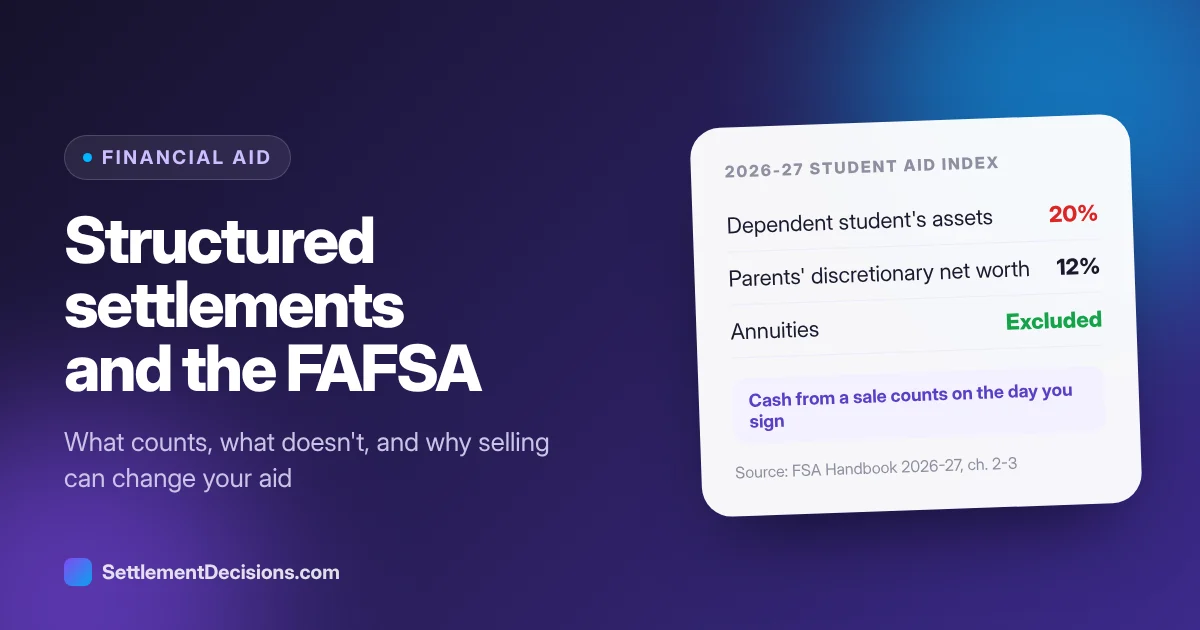
| Dependent student | Net worth "multiplied by the conversion rate of 20%" |
| Parents of a dependent student | Discretionary net worth (after an asset protection allowance) "multiplied by the conversion rate of 12%" |
| Families exempt from asset reporting | Assets aren't reported (see the next section) |
An illustration, not a prediction. If a dependent student sells payments for $40,000 and still has the full amount in the bank on the day the FAFSA is signed, 20% of it is $8,000 added to the student's contribution from assets. If the same $40,000 sat in a parent's account, at most 12% of whatever is left after the asset protection allowance would count. Your actual SAI depends on everything else on the form.
The sale itself generally isn't taxable income for an injury settlement, but confirm that with a tax professional for your own case.
Before you sell, also remember what a sale costs. Buyers pay well under face value, and every sale needs a judge's approval. Our court deal benchmark shows real approved prices, and the discount rate calculator finds the rate in any offer.
Who doesn't have to report assets at all
Many families never answer the asset questions. Under the 2026-27 Handbook, a dependent student is exempt from asset reporting if any of these is true:
- The student qualifies for a maximum Pell Grant.
- The parents' 2024 combined AGI is less than $60,000, they don't file Schedule A, B, D, E, F or H, and they either don't file Schedule C or file one with net business income of no more than a $10,000 gain or loss.
- Someone in the family received a benefit from a means-tested federal program during 2024 or 2025.
Independent students use the same three tests with their own (and their spouse's) AGI. The exemption doesn't apply if a dependent student's parents live outside the U.S. or don't file U.S. taxes when they're required to.
If your family is exempt, cash from a sale wouldn't be reported on the FAFSA. Means-tested benefits are their own question, though: a lump sum can affect SSI and Medicaid. Read how structured settlements affect SSI and Medicaid first.
If you're a student or parent thinking about selling
- Find out whether you're exempt from asset reporting. If you are, the FAFSA question mostly goes away, though your school's own aid form may still ask.
- Call the financial aid office before you sign anything. Ask how they treat structured settlement payments, a payee's right to future payments, and cash from a sale. Get the answer in writing if you can.
- Look at timing. Assets are counted on the day the FAFSA is signed. Money that is already spent on the bills you sold for isn't in the bank that day.
- Sell only what you need. A partial sale keeps future payments coming and leaves less cash sitting in an account.
- Compare alternatives first. Federal student loans, school payment plans, or a loan instead of a sale may cost less than a discounted sale.
- Get independent advice. Talk to a qualified financial advisor, and a tax professional if any part of your settlement was taxable.
This article explains federal rules in general terms. It isn't financial, tax or legal advice, and financial aid offices can use professional judgment in individual cases.