

Five ways out of debt, side by side
| Option | How it works | Typical credit impact | Main cost or risk |
|---|---|---|---|
| Sell settlement payments | A buyer pays a lump sum for future payments, with court approval | None directly, because there's no credit check or new account | The discount: you give up more future money than you receive |
| Debt consolidation loan | A new loan pays off several debts at one rate | A hard inquiry and a new account, which can help if you pay on time | Needs decent credit, and fees and rates vary |
| Debt management plan (nonprofit credit counseling) | The agency negotiates lower rates and you make one monthly payment, usually for 3 to 5 years | Accounts are usually closed, and the effect is often modest | A small monthly fee and a commitment to the plan |
| Debt settlement | You stop paying and a company negotiates to settle for less | Serious damage: late payments, collections, possible lawsuits | Fees, damaged credit, and forgiven debt can be taxable |
| Bankruptcy (Chapter 7 or 13) | A court discharges debts, or sets a 3- to 5-year repayment plan | Severe, and stays on credit reports for years | Legal costs, and some assets may be at risk while others are protected |
There's no single right answer. The best option depends on how much you owe, what it costs, your credit and whether your income is steady.
The math: one $25,000 debt, four ways
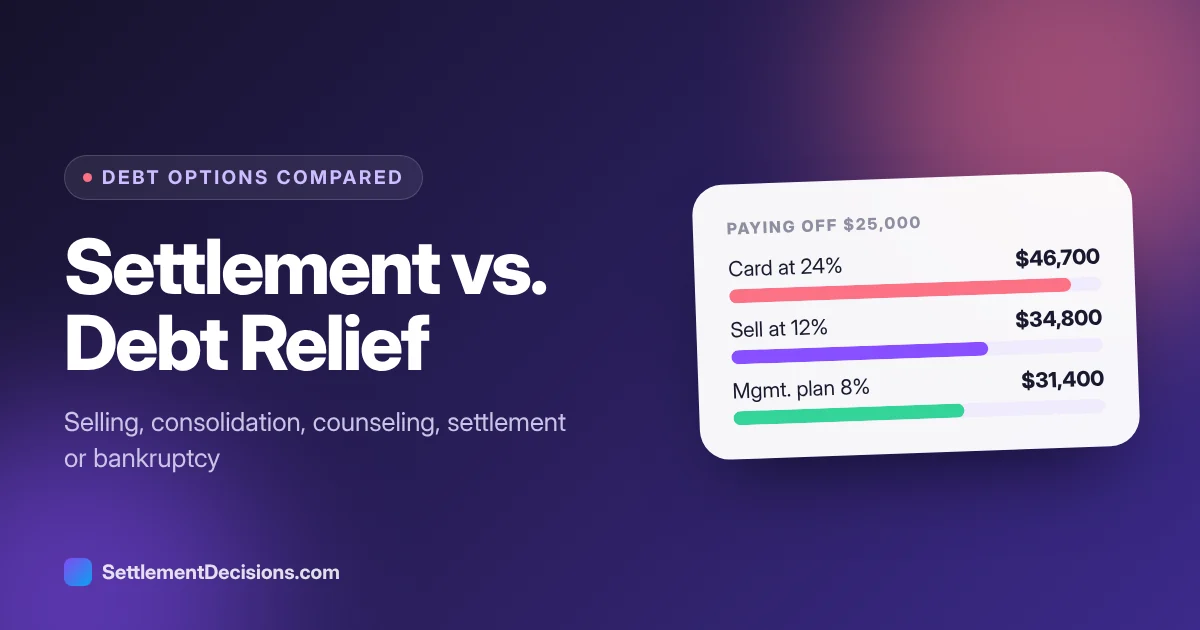
Say you owe $25,000 on credit cards at 24% APR and receive $500 a month in structured settlement payments. Here's how four approaches compare over about 70 months. The rates are illustrations, not offers.
| Approach | What you pay or give up | Total cost |
|---|---|---|
| Keep paying the card at 24% | About $667 a month for 70 months | About $46,700 |
| Sell settlement payments at a 12% discount rate | Just under 70 payments of $500 | About $34,800 |
| Consolidation loan at 12% | About $498 a month for 70 months | About $34,900 |
| Debt management plan at an 8% negotiated rate | About $448 a month for 70 months, plus small fees | About $31,400 |
What this shows:
- Selling beat the 24% card by about $11,800 in this example, because the buyer's 12% rate was half the card's rate.
- Selling only matched a 12% loan. In that case it gives up a guaranteed income stream without saving anything.
- The debt management plan was cheapest, if you can stick to it.
- If the offer's discount rate were 18%, selling would cost more and the advantage over the card would shrink.
Use the instant offer estimator to see your own range, and ask lenders and counselors for their real rates before deciding.
When selling payments is the better choice
- The debt is very expensive. Payday loans, title loans and high-rate cards can carry rates far above a typical discount rate.
- Your credit rules out cheaper options. Selling payments doesn't depend on a credit score, so it can work when a consolidation loan isn't available. See selling with bad credit.
- You face a deadline with real consequences, such as foreclosure, repossession or a judgment. The cost of waiting can exceed the discount.
- You can sell only what you need. A partial sale clears the debt and keeps the rest of your income.
For a deeper look at this one path, read selling a structured settlement to pay off debt.
Debt settlement: the hidden tax and credit costs
Debt settlement companies promise to cut what you owe. The trade-offs are often bigger than the marketing suggests:
- You usually have to stop paying your creditors while the company saves up money to negotiate. That brings late fees, collection calls and sometimes lawsuits.
- Your credit takes a serious hit, and the late payments stay on your report for years.
- Forgiven debt is generally taxable income. If a creditor cancels $600 or more, you'll usually get a Form 1099-C. The IRS has an exception if you were insolvent, meaning your debts exceeded your assets, which you claim on Form 982.
- Fees can't be charged upfront. Under the FTC's Telemarketing Sales Rule, for-profit debt relief companies generally can't collect fees until they've actually settled a debt. A company asking for money first is a red flag.
Compared with that, selling payments has a clearer cost. The discount is stated in writing, the court reviews it, and your credit isn't affected.
Bankruptcy and your structured settlement
Bankruptcy can wipe out or restructure debts, and your structured settlement may be better protected than you think.
- Federal exemptions. The bankruptcy code exempts certain personal injury payments, up to $31,575 for payments on account of personal bodily injury under 11 U.S.C. § 522(d)(11)(D). Compensation for lost future earnings is exempt to the extent it's reasonably needed for support. These amounts took effect April 1, 2025.
- State exemptions. Many states protect structured settlement payments more broadly, and some states require you to use state exemptions instead of federal ones. See structured settlement creditor protection.
- Selling during bankruptcy is complicated. Once you file, your property generally becomes part of the bankruptcy estate. Selling payments usually needs the trustee's or bankruptcy court's involvement, on top of the state court approval every sale needs.
- Selling right before filing can backfire. Turning protected payments into cash just before bankruptcy can leave that cash unprotected and available to creditors.
Before you sell or file, talk to a bankruptcy attorney. Many offer free consultations. Our guide to selling with liens, child support, tax debt or bankruptcy covers the details.
Which option fits you?
| Your situation | Often worth looking at first |
|---|---|
| Good credit, steady income, high-rate debt | Consolidation loan or 0% balance transfer |
| Fair or poor credit, steady income | Nonprofit debt management plan |
| Urgent deadline such as foreclosure or repossession | A partial sale of settlement payments, compared against a hardship plan with the lender |
| Debt far larger than income could ever repay | Talk to a bankruptcy attorney before selling anything |
| Collection lawsuits already filed | A consumer or bankruptcy attorney |
Whatever you choose, talk to a qualified financial advisor or a nonprofit credit counselor first. Counselors affiliated with the National Foundation for Credit Counseling (NFCC) can review your budget at low or no cost.
Steps before you sell to pay debt
- List every debt with its balance, interest rate and minimum payment.
- Get a counselor's view. A nonprofit credit counselor can tell you whether a debt management plan would work.
- Check consolidation offers if your credit allows it.
- Get at least three written quotes for the payments you'd sell, and compare the effective annual rate with your debt's interest rate.
- Sell only what clears the debt. Keep the rest of your income.
- Ask creditors for a payoff letter before the sale closes, so you know the exact amount to pay.
- Be ready to explain the plan to the judge. Courts look favorably on sales that clearly reduce costly debt. Use the court approval readiness check to prepare.