How structured settlement payment design works
A structured settlement begins with a legal obligation to pay damages or qualifying compensation. Instead of delivering the entire recovery as unrestricted cash, the parties agree that part of the value will be paid on specified future dates. An assignment company commonly assumes the periodic-payment obligation and purchases an annuity to fund it.
The claimant, attorney and structured settlement professional can design a schedule around anticipated needs before the agreement becomes final. The schedule may provide current income, future income, major lump sums, lifetime protection or a combination.
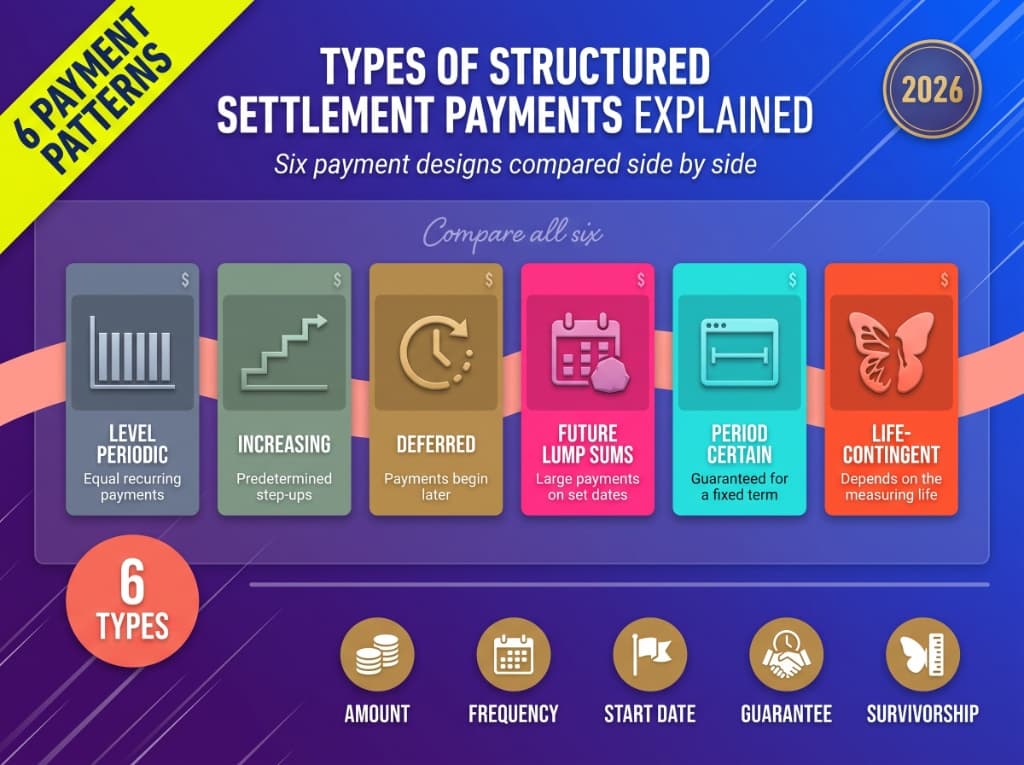
NSSTA explains that payment schedules can provide equal payments at regular intervals and can also include larger payments at selected times. Prudential similarly describes regular periodic payments, prescheduled lump sums and combinations designed around life events.
The flexibility exists primarily during settlement planning. Internal Revenue Code Section 130 describes qualified periodic payments as fixed and determinable as to amount and time and provides that the recipient cannot accelerate, defer, increase or decrease them.
1. Level periodic payments
Level periodic payments deliver the same nominal amount at regular intervals. Monthly payments are common, but a schedule can use quarterly, semiannual or annual intervals. For example, a recipient might receive $2,500 on the first day of every month for twenty years.
The main advantage is predictability. Recurring income can be matched with housing, food, utilities, insurance, transportation and ongoing medical expenses. The recipient knows the stated amount and frequency without managing a portfolio or deciding how much to withdraw.
The main limitation is inflation. If a $2,500 payment remains fixed for decades, it can buy less as prices rise. A level schedule may still be suitable when other assets address inflation or when the structured payments cover costs expected to remain relatively stable.
Frequency and guarantee are different characteristics. A payment can be monthly and guaranteed, monthly and life-contingent, or monthly with a guaranteed minimum term followed by life-only income.
2. Increasing structured settlement payments
Increasing payments rise according to a formula established in the original schedule. A stream might increase 2% annually, step up by a fixed dollar amount every five years or move between predetermined payment levels at specified ages.
Increases can help address future living costs, but they are not a variable cost-of-living adjustment unless the documents expressly use such a formula. A fixed 2% annual increase remains 2% whether actual inflation is 1%, 4% or 8%.
Increasing future payments typically require a tradeoff. For the same amount available to fund an annuity, a schedule with larger later payments may begin with less current income than a level-payment schedule. The design should therefore account for both present needs and future purchasing power.
A scheduled increase is not interest added to a recipient-controlled account. The increasing amounts are part of the original contractual payment obligation.
3. Deferred payments
A deferred payment begins after a waiting period. The first payment may be months or years after the settlement is completed. Deferral can be useful when the recipient has current resources but expects a later income gap.
Examples include income beginning at retirement, payments starting when a child reaches adulthood, or future support beginning after another benefit ends. Deferral may also allow a given funding amount to purchase a larger future payment because the insurer has more time before the obligation begins.
The tradeoff is that no payment from that deferred stream arrives during the waiting period. The household needs another plan for current expenses. Inflation can also reduce the purchasing power of a fixed future payment.
Deferred does not mean unfinished. A finalized settlement can create enforceable payment rights even when the first scheduled payment will not arrive for years.
4. Future lump-sum payments
A structured settlement can include one or more large payments on specified future dates. These are sometimes designed around college, a home purchase, replacement of an adapted vehicle, anticipated medical equipment, business needs or retirement.
A child’s schedule might include $50,000 at age eighteen, $75,000 at age twenty-one and $100,000 at age twenty-five. An adult’s schedule might combine monthly income with larger payments every five years.
Future lump sums can reduce the risk that the entire settlement will be spent immediately. They also create concentrated payment events, so recipients should prepare for banking, tax documentation, benefit-program rules and financial decisions before each date.
Every lump sum should be reviewed for a survival condition. A guaranteed lump sum can remain payable even if the measuring person dies before its date. A life-contingent lump sum may disappear if that person does not survive to the scheduled date.
5. Guaranteed or period-certain payments
A guaranteed payment does not require the measuring life to survive until the payment date. A period-certain arrangement guarantees payments for a defined term, such as ten, twenty or thirty years.
If the payee dies before the guarantee expires, eligible remaining payments may continue to the valid beneficiary or estate. The documents determine who receives them and whether any commutation or alternative death benefit is available.
Guarantees are important for recipients supporting spouses, children or other dependents. They create a known minimum duration, but they can affect annuity pricing. Adding a longer guarantee can change the amount of lifetime income available from the same funding amount.
“Guaranteed” does not eliminate every risk. Payment obligations remain subject to the terms of the arrangement and the claims-paying ability of the responsible insurer.
6. Life-contingent payments
Life-contingent payments depend on a specified person—the measuring life—remaining alive. A lifetime stream can continue no matter how long that person lives, protecting against the risk of outliving income.
The corresponding limitation is that pure life-only payments stop at death. A beneficiary designation cannot make those payments continue if no guaranteed benefit survives.
Life-contingent pricing considers age, payment start date and other permitted actuarial factors. Two recipients receiving the same lifetime monthly amount can have different funding costs because the expected duration differs.
A settlement can combine lifetime income with a guaranteed period. For example, $3,000 per month may be payable for life with twenty years guaranteed. If the payee dies during the guaranteed period, the remainder may continue to the beneficiary. If the payee survives beyond it, payments continue for life but generally stop at death.
Comparing all six payment patterns
| Type | Pattern | Example | Common planning use | Death-related question |
|---|---|---|---|---|
| Level periodic | Equal payments at regular intervals | $2,500 every month for 20 years | Predictable recurring expenses | Guaranteed only if the schedule says so |
| Increasing | Payments rise on a predetermined schedule | $2,000 monthly, increasing 2% each year | Long-term costs and inflation planning | Guarantee and increase are separate features |
| Deferred | Payments begin on a future date | $4,000 monthly beginning at age 60 | Retirement or future care | Can be guaranteed or life-contingent |
| Future lump sum | Large payment on one or more specified dates | $75,000 at ages 25, 30 and 35 | College, housing or major future costs | Check whether each lump sum is guaranteed |
| Period certain | Payments guaranteed for a defined term | $3,000 monthly for 15 years guaranteed | Income with a known minimum duration | Remaining guarantee may pass to beneficiary |
| Life-contingent | Payments depend on a measuring life | $3,000 monthly for life | Protection against outliving income | Pure life-only payments stop at death |
One settlement can combine multiple payment types
A well-designed structure rarely needs to choose only one pattern. Immediate cash can cover attorney fees, debt or near-term expenses. Monthly payments can support recurring costs. Future lump sums can address known milestones, and lifetime income can protect against longevity risk.
Consider a hypothetical settlement with the following design:
- $75,000 paid immediately for accessible home modifications.
- $2,000 monthly for twenty years guaranteed.
- A 2% scheduled annual increase after the fifth year.
- $50,000 lump sums in years five, ten and fifteen.
- $1,500 monthly lifetime income beginning at age sixty-five.
Each component solves a different problem. The immediate amount addresses a current need. Monthly payments provide stability. Increases recognize future costs. Lump sums create planned capital, and lifetime income protects later years.
Complexity also creates documentation risk. Every payment date, guarantee, survival condition and beneficiary instruction should be understood before finalization.
Payment frequency is not the same as payment type
Monthly, quarterly, semiannual and annual describe frequency. Level, increasing, deferred, guaranteed and life-contingent describe other characteristics. One payment can carry several labels simultaneously.
For example, “quarterly payments beginning in five years, increasing 2% annually, payable for life with fifteen years guaranteed” describes frequency, start date, growth pattern, lifetime condition and guarantee in one stream.
When reviewing a schedule, break each stream into separate questions:
- How much is each payment?
- How often is it paid?
- When does it begin and end?
- Does the amount increase?
- Is it guaranteed or life-contingent?
- Who receives guaranteed payments after death?
Immediate payments versus structured payments
Not every dollar of a settlement must be structured. The parties may allocate part to immediate cash and part to future payments. Immediate cash provides flexibility but places spending and investment responsibility on the recipient.
Structured payments reduce liquidity but can provide predictable long-term support. The correct allocation depends on current obligations, emergency reserves, future care, financial experience and access to independent advice.
A plan that structures every dollar can leave too little cash for immediate needs. A plan that pays everything immediately can expose long-term funds to spending, investment and market risks. The allocation should be designed before the settlement is finalized.
How taxes relate to payment type
Payment frequency by itself does not determine tax treatment. The nature of the underlying claim and what the damages were intended to replace are central.
Internal Revenue Code Section 104 can exclude qualifying damages received on account of personal physical injury or physical sickness, whether paid as a lump sum or periodic payments. Other damages, punitive awards and separately earned investment income can receive different treatment.
Do not assume that every payment called a structured settlement is tax-free. Preserve the complaint, settlement agreement, allocation, court order and tax advice supporting the treatment.
Which payment types may be transferable?
Guaranteed payment rights are generally easier to value because they do not depend on survival. Life-contingent payments can require proof of life and may produce lower offers because the buyer assumes mortality risk.
Deferred payments and distant lump sums can be transferable in some circumstances, but their current value is reduced by the time before payment. A future dollar is worth less today when the buyer must wait years to receive it.
A proposed transfer usually requires disclosures and court approval under applicable structured settlement protection law. The court reviews specified payment rights, not a vague percentage of an imaginary account balance.
A partial transfer can preserve payments outside the transaction. The order should identify dates and amounts precisely so the seller, buyer and annuity issuer understand which payments remain.
How to identify your payment type from the documents
Begin with the current payment schedule, not memory or a buyer’s summary. Look for terms such as “guaranteed,” “period certain,” “for life,” “life contingent,” “provided the measuring life is living,” “commencing on” and “increasing annually.”
Create a list of every payment stream. Record the amount, frequency, first payment date, last payment date, increase formula, guarantee and measuring life. Identify separate future lump sums.
If language is unclear, contact the annuity issuer or authorized servicer through an official channel and request a current benefits or payment letter. Do not send complete contract records to an unverified company.
Choosing payment types during settlement planning
The best schedule begins with needs rather than products. List current expenses, emergency reserves, medical costs, replacement equipment, housing, education, retirement and support for dependents. Estimate when each need will occur and whether the amount is predictable.
Then test multiple structures under different inflation, lifespan and expense scenarios. Compare the certainty of guaranteed payments with the potentially higher lifetime income available through life-contingent designs.
Consider what happens after death. A person with dependents may value a guaranteed period differently from a person whose primary concern is maximizing personal lifetime income. Beneficiary and estate plans should match the payment design.
Finally, retain enough accessible funds for emergencies. A structured settlement is intentionally difficult to alter after completion. Predictability works best when paired with appropriate liquidity.
Questions to ask before agreeing to a schedule
- Which payments are guaranteed and which depend on survival?
- What happens if the recipient dies before payments begin?
- Does the schedule include annual increases?
- How does the increase compare with possible inflation?
- Are future lump sums guaranteed?
- Who is the measuring life for each contingent payment?
- Who receives remaining guaranteed payments after death?
- Is an immediate cash reserve sufficient?
- How do the payments coordinate with public benefits?
- Has an independent professional reviewed the full design?
Common payment-type mistakes
Assuming every monthly payment is guaranteed
Monthly describes frequency, not survivorship. Read the guarantee and life-contingency language.
Calling every future payment a lump sum
A deferred monthly stream and a one-time future payment are different structures with different cash-flow and valuation effects.
Believing scheduled increases can be added later
Increases generally must be designed and funded before the structure is finalized. An administrative request does not rewrite the schedule.
Ignoring inflation
A fixed payment can remain contractually reliable while losing real purchasing power. Compare nominal dollars with future expenses.
Ignoring beneficiary consequences
A high lifetime payment may contain less survivor protection than a lower payment with a long guarantee. Neither is automatically better; they solve different risks.