

The short answer
Who files and who pays aren't the same thing.
- The buyer files. Under the National Conference of Insurance Legislators (NCOIL) model act, which most state Structured Settlement Protection Acts are based on, the application for court approval "shall be made by the transferee", meaning the buyer. The buyer's attorneys prepare the petition and usually appear at the hearing.
- You usually pay, indirectly. Court filing fees, the buyer's legal costs and other transaction expenses are typically deducted from your lump sum before you receive it.
- You pay nothing upfront. A legitimate buyer shouldn't ask you for money to start the process.
So the real question isn't "who pays?" but "how much is being taken out, and is it disclosed?"
Cost by cost: who pays and where it shows up
| Cost | Who usually bears it | Where you'll see it |
|---|---|---|
| Court filing fee | Deducted from your payout | Itemized transfer expenses in the disclosure statement |
| Buyer's attorney fees for the court petition | Usually deducted from your payout | The buyer's best estimate, shown in the disclosure statement |
| Escrow, processing or administrative fees | Deducted from your payout | Itemized transfer expenses |
| Annuity issuer's transfer processing fee (if any) | Varies by buyer and issuer | Ask the buyer, since it may be listed or absorbed |
| Your own independent attorney, CPA or adviser | You, unless you waive advice where allowed | Paid directly to your adviser |
| Your original injury lawyer's fee | Already paid from the original settlement | Not part of the sale |
| Federal excise tax on unapproved transfers | The buyer, which is why buyers insist on court approval | Not charged to you |
The exact rules vary by state, so check your state's law with the state laws tool.
What the disclosure statement must show
Before you sign, the buyer must give you a written disclosure statement, often at least a few days in advance. Under the NCOIL model act it includes:
- The total amount and due dates of the payments you're selling.
- The discounted present value of those payments, calculated using the federal Applicable Federal Rate.
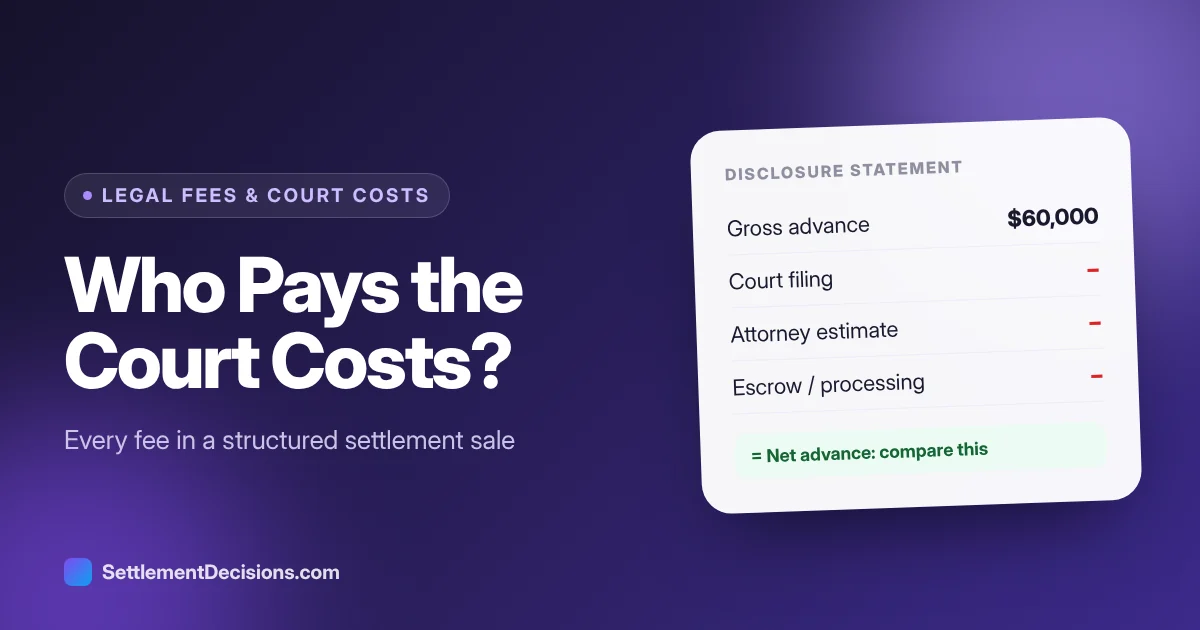
- The gross advance amount, the price before expenses.
- An itemized list of all transfer expenses, such as court filing fees, attorney fees and escrow fees. Attorney fees for the buyer's court application are excluded from the itemized list, but the buyer must give its best estimate of them.
- The net advance amount, what you actually receive after expenses.
- The effective annual interest rate, which tells you the true cost.
- Any penalties or liquidated damages you'd owe if you breached the agreement.
Our transfer disclosure statement guide walks through a sample line by line.
Compare offers on the net advance amount, not the headline number. A $60,000 offer with $4,500 of expenses pays less than a $58,500 offer with $1,500 of expenses.
What if the judge says no?
The model act protects you here. It says that no payee proposing a transfer "shall incur any penalty, forfeit any application fee or other payment" to the buyer because the transfer fails to meet the act's conditions. The model act also makes compliance "solely the responsibility of the transferee".
In practice, that means a buyer generally can't bill you for its legal costs if the court denies the sale. Before you sign, ask the buyer to confirm in writing that you'll owe nothing if the transfer isn't approved, and check your state's version of the law.
If you received an advance before approval, read that agreement carefully. Advances have their own terms. See cash advances before court approval.
Paying for independent professional advice
Most states require the buyer to advise you in writing to get independent professional advice from an attorney, CPA, actuary or other licensed professional. Depending on your state, the court must find either that you received that advice or that you knowingly waived it in writing.
- This advice is usually your cost, paid directly to the professional you choose.
- Independence matters. The adviser should work for you, not the buyer. If a buyer offers to arrange or pay for "your" lawyer, ask whether your state allows it and whom the lawyer represents.
- It's often worth the fee. An hour or two with a professional can catch problems in the agreement, tax issues or a better structure, such as a partial sale.
Read more in independent professional advice explained and do I need a lawyer to sell my structured settlement?.
Fees that are red flags
- Upfront "application" or "processing" fees before anything is filed.
- Expenses that appear for the first time at closing and weren't in the disclosure statement.
- Vague line items such as "miscellaneous" or "administrative" with no explanation.
- A refusal to put the effective annual rate and the net advance in writing.
- Pressure to sign before you've had time to get advice. Many states require a waiting period between disclosure and signing for exactly this reason.
If something doesn't match, don't sign. Ask for a corrected disclosure, or take your payments to another buyer. Our red flags guide lists more warning signs.
How to keep more of your payout
- Get at least three written quotes, each with a full disclosure statement or a fee breakdown.
- Line them up by net advance amount and effective annual rate. The offer analyzer can help.
- Ask each buyer to cap or absorb expenses. Buyers competing for your payments will sometimes cover filing or processing costs.
- Ask for the attorney fee estimate in writing, and ask whether it could change.
- Talk to a qualified financial advisor or attorney who isn't affiliated with any buyer before you sign.
For a broader look at every cost in a sale, read the true cost of selling a structured settlement.