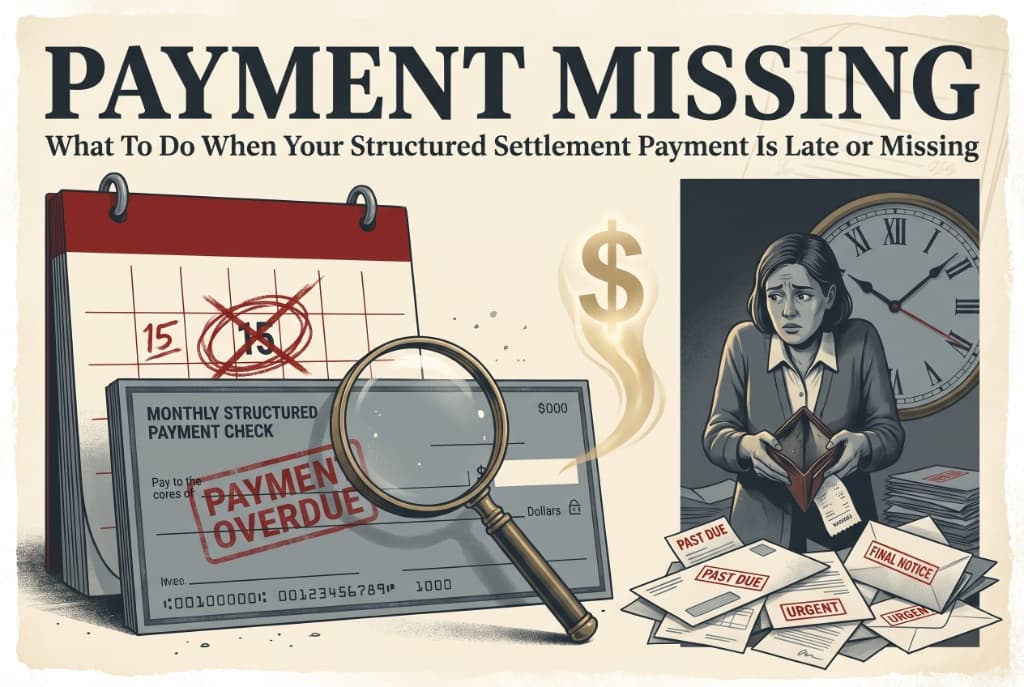
Is the payment actually late?
A payment can feel late before it is technically overdue. Your bank balance may normally change on the first morning of every month, but the controlling document may identify a different effective date. Weekends, federal holidays, processing cutoffs and postal delivery can also change when money becomes visible without changing the underlying payment obligation.
Start with the structured settlement agreement, annuity contract, benefits letter or payment schedule. Find the exact amount, frequency and scheduled date. Distinguish between a payment that is due on a particular calendar date and one described as payable monthly, quarterly or annually. If you cannot find the paperwork, review a previous deposit description, check image, tax document or letter to identify the legal insurance company and any current servicing company.
New York Life explains that electronic payments may post on different calendar dates depending on the number of days in the month, weekends and holidays. Its public guidance tells electronic-payment recipients to contact the company when a payment has not arrived by its effective date. For paper checks, New York Life advises allowing five business days beyond the effective date for postal delivery. Other insurers may use different procedures, so this is an example rather than a universal waiting rule.
Never rely on a phone number from an unsolicited text or email
Use the number printed on recent issuer correspondence or navigate independently to the insurer's official website. A delayed payment creates urgency, and scammers use urgency to obtain bank details, identification documents and account credentials.
A five-minute check before contacting the issuer
A short review can prevent unnecessary calls and give the service representative the information needed to investigate. Do not post contract numbers, bank information or personal identification in a public forum. Keep the review private and record only what is necessary.
- Confirm the scheduled payment date. Use the contract or current payment schedule rather than relying entirely on when the previous payment appeared.
- Check the payment method. Determine whether you receive an electronic funds transfer, ACH deposit or paper check.
- Review recent changes. Consider whether you moved, changed banks, closed an account, changed your legal name or submitted new servicing forms.
- Look for issuer correspondence. Search your mail and email for requests involving identity, address, banking, beneficiary or life-status verification.
- Compare the missing payment with your schedule.Confirm that the payment was not previously transferred, replaced or changed under a court-approved order.
Why electronic structured settlement payments can be delayed
Electronic deposits eliminate postal delivery, but they do not remove every possible interruption. The issuer sends payment instructions, banking networks process them and the receiving bank posts the money. A problem at any point can change when the deposit appears.
The bank account was changed or closed
If you recently opened a new account, do not assume that notifying your bank automatically notified the annuity issuer. The insurer may require its own electronic funds transfer form, a voided check or other account verification. If a payment was sent to a closed account, it may be rejected and returned to the issuer. That process can take time, and the issuer may not release a replacement until the return is confirmed.
Ask whether the payment was released, which account ending digits were used and whether the deposit was returned. Do not ask a customer service representative to read a complete account number aloud. The last few digits are usually enough to confirm whether the correct instructions were used.
The receiving bank has not posted the payment
A payment can be transmitted but not yet visible in the available balance. Banks differ in how they display pending ACH transactions, and posting may be affected by weekends, holidays and internal processing windows. Contact the issuer first to determine whether the payment was released. If it was, ask whether a trace number or payment reference is available for your bank.
The deposit information did not match
A routing-number error, incorrect account type or ownership mismatch can cause a rejection. This is especially relevant after marriage, divorce, guardianship changes, inheritance or a legal name change. Correcting the information may require a signed form and supporting identification. Use only the forms provided through the insurer's verified service portal.
A servicing or verification hold was placed on the account
An issuer may need additional information before continuing certain payments. The exact requirements depend on the contract and payment type. Possible issues include returned mail, an incomplete address change, identity verification, guardianship documentation, beneficiary processing or confirmation connected to a life-contingent payment. A hold does not automatically mean that the payment rights have disappeared, but it does require direct communication with the authorized servicer.
Why a paper structured settlement check can be missing
Paper checks create additional points of delay. The insurer must print and release the check, the postal service must deliver it, and the recipient must deposit it before expiration. A check can be delayed, forwarded, damaged, delivered to an old address or stolen.
Your address changed
Postal forwarding is not a substitute for updating the insurer. Some financial mail may not be forwarded, and forwarding orders expire. If you moved recently, confirm the address currently stored by the issuer. Ask when the change became effective and whether the missing check was sent before or after the update.
If the check went to an old address, do not assume the issuer can immediately send another one. The company may first determine whether the original check was negotiated. If it remains outstanding, the issuer may require a stop-payment period, written declaration or replacement request.
The mail is delayed
Postal delivery is not guaranteed on the payment's effective date. Follow the insurer's stated waiting period. New York Life's public structured settlement guidance, for example, advises paper-check recipients to allow five business days beyond the effective date. Corebridge provides its own stop-payment process and notes that an annuitant who has not moved may request a stop payment after the company's stated waiting period.
The original check may have been negotiated
If the issuer says the check cleared but you did not deposit it, treat the matter seriously. Ask for the issuer's fraud or altered-check procedure. You may be asked to complete an affidavit and provide identification. Consider notifying your bank and local law enforcement when appropriate. Do not accuse a neighbor, family member or caregiver without evidence; request the check image and follow the formal investigation process.
Life-contingent payments require special attention
Some structured settlement payments continue only while a named measuring life remains alive. These are called life-contingent payments. Others are guaranteed for a defined period or number of installments. A payment stream can contain both features, so the answer may not be obvious from the amount alone.
An issuer may periodically request proof that the measuring life is alive. If the request is overlooked, payments may be suspended while verification is completed. Contact the issuer immediately and ask what documentation is required. Do not send medical records or sensitive identity documents to an unverified address.
When the original payee has died, beneficiaries should not assume every remaining payment automatically continues. Guaranteed payments may pass to a named beneficiary or estate according to the governing documents. Life-contingent payments may end at death. The insurer may require a death certificate, beneficiary claim form, tax certification, estate documents or proof of authority before releasing guaranteed benefits.
Could a previous sale explain the missing payment?
A court-approved structured settlement transfer identifies the exact payments assigned to a purchaser. It might transfer every payment, a percentage of each payment, a limited number of monthly payments or one future lump sum. Payments not included in the order should remain with the original payee.
Confusion sometimes occurs when a transfer begins, especially if the schedule contains multiple overlapping payment streams. Compare the qualified court order with the current issuer schedule. Check payment dates, amounts and the start and end dates of the transferred portion. A purchaser cannot resolve an issuer servicing error unless it is the authorized recipient of the disputed payment.
If a payment you retained appears to have been redirected, notify the issuer in writing and include only the relevant pages of the transfer order. Ask the issuer to confirm which payment rights are assigned and which remain payable to you. Keep copies of every response.
What to say when you contact the annuity issuer
A clear, organized request is more effective than repeatedly stating that the money is missing. Before calling, have the contract number, scheduled date, expected amount, payment method and recent change history available. Keep those details private until you verify that you reached the correct company.
Suggested payment-trace request
“I am the payee on a structured settlement annuity. A payment scheduled for [date] in the amount of [amount] has not arrived. My payment method is [electronic deposit or paper check]. Please confirm whether the payment was released, where it was directed, whether it was returned or negotiated, and what written steps are required to trace or replace it.”
Write down the date and time, the representative's name or identifier, the case or reference number and each promised next step. Ask when you should follow up. If documents are required, request the official form and submission instructions rather than relying on an address supplied through an unexpected message.
How to escalate an unresolved missing payment
Most payment problems should begin with the issuer or authorized servicer. Escalation is appropriate when the company cannot confirm whether a payment was issued, repeatedly misses promised follow-up dates, refuses to provide a trace or gives conflicting explanations. Escalate methodically rather than sending the same complaint to unrelated organizations.
- Request a supervisor or written case review. Give the original reference number and summarize the unresolved issue.
- Send a written notice. Include the payment date, amount, contract identifier, prior contacts and the resolution you are requesting. Do not send original documents.
- Contact the appropriate state insurance department.The National Association of Insurance Commissioners provides a directory of state regulators and consumer complaint resources.
- Consult an attorney when ownership is disputed.Legal help may be appropriate when the problem involves probate, guardianship, divorce, fraud, a prior transfer order or conflicting claims to the payments.
A regulatory complaint should be factual. Attach the relevant schedule, correspondence and payment history. State what happened, what the insurer said and what remains unresolved. Avoid overstating the issue or including unrelated complaints, because a focused record is easier to investigate.
Protect yourself from missing-payment scams
A legitimate issuer may need to verify your identity, but you should control how the contact begins. Search independently for the insurer's official website, compare it with your contract and use the published servicing channel. Do not click a shortened link from a text message claiming that your payment is frozen.
- Never provide an online banking password, debit-card PIN or one-time security code.
- Do not pay a fee to “release” a scheduled structured settlement payment.
- Do not sign a transfer agreement merely to trace a missing payment.
- Do not send complete identity documents through ordinary, unencrypted email unless you independently verified the process.
- Be cautious when someone claims to represent both the issuer and a company offering to purchase your payments.
Documents worth keeping in one secure file
Missing-payment problems are easier to resolve when the governing records are organized. Keep the structured settlement agreement, qualified assignment document, annuity contract, current payment schedule, beneficiary information, bank-change confirmations, address-change confirmations and any court-approved transfer orders. Retain copies of recent checks or deposit descriptions without sharing them publicly.
Create a simple payment log with the scheduled date, amount, actual receipt date and method. A log helps distinguish a one-time postal delay from a repeating pattern. It also gives the issuer or regulator a precise record instead of a general statement that payments are often late.
Should you switch from checks to direct deposit?
Electronic payment can reduce postal risks, but it requires accurate bank information and careful account maintenance. If your issuer offers electronic funds transfer, obtain the form directly from its official website. MetLife, for example, maintains a forms library that includes structured settlement servicing materials. Other issuers provide their own forms and requirements.
Before changing payment methods, confirm the effective date of the change and ask whether any payment is already in process. Keep the old account open until the issuer confirms the new instructions when that is practical. Review the first deposit carefully and preserve the confirmation.
A missing payment is not automatically a reason to sell
Selling future structured settlement payments is a separate, court-supervised transaction. It does not repair a lost check, incorrect address or rejected deposit. Resolve the servicing issue first so that you know which payments you own and what the current schedule contains.
Once the payment record is accurate, you can separately evaluate whether keeping, partially selling or fully selling future payments fits your needs. Compare net proceeds, retained income, discount rates, court requirements and long-term consequences. Do not let the frustration of one delayed payment rush you into transferring years of future income.
Official servicing resources
Frequently asked questions
This article provides general educational information and does not constitute legal, tax, financial or insurance advice. Payment procedures differ by issuer, contract and payment method. Verify instructions through the insurance company's official website or authorized servicer.