

What a qualified settlement fund is
A qualified settlement fund (QSF) is a trust or segregated account that a court creates to hold settlement money. It's also called a 468B trust, after section 468B of the Internal Revenue Code. The defendant pays the money into the fund, and the fund pays it out to claimants, lawyers and lienholders later.
Every court order we reviewed opens the same way. The order in the University of Michigan abuse settlement (E.D. Mich., Sept. 16, 2022) says the fund "is established as a Qualified Settlement Fund within the meaning of Treasury Regulation § 1.468B-1." The same order says that under Treas. Reg. § 1.468B-1(c)(1) the court "must exercise continuing jurisdiction over the Fund."
In plain terms, the fund sits between the defendant and you. A judge keeps control over it until the money is gone.
Why cases use one
The fund lets a defendant pay once and walk away while claimants' shares are still being worked out. The Michigan order says that once the money was deposited, the released defendants had no responsibility for managing or investing it. The six orders we read come from drug and medical-device MDLs, a university abuse settlement and a school-district case: settlements where many claimants, fees or liens had to be sorted out after the defendant paid.
When you actually get paid
Being in a QSF doesn't mean your money is ready. The orders show the usual gates:
- The settlement must take effect. The Abilify MDL order (N.D. Fla., Feb. 21, 2019) says the fund "must be held in trust and is not to be distributed" before the settlement's Effective Date, which depended on 90% of claimants accepting.
- Conditions in the settlement agreement. The Allergan Biocell order (D.N.J., Dec. 24, 2025) says the administrator "shall not make any distributions of settlement proceeds except upon the satisfaction of all conditions precedent set forth in any settlement agreements."
- Liens. The Abilify order lets the administrator pay "any lien, subrogation claim, claim to reimbursement for conditional payments" out of the claimant's share. The Allergan order appoints a separate lien administrator for medical liens.
- A second court, for some claimants. In a Cincinnati school case (S.D. Ohio, June 8, 2021), no money could leave the fund "without an Order from the Probate Court" of Hamilton County.
The administrator also decides timing. The Abilify order lets the administrators "determine the timing of payments to eligible Claimants from the QSF."
You can't demand the money early
The Michigan order says claimants have no right to demand the escrowed funds. It's written to keep claimants from being in "constructive receipt" of the money. That matters for one reason: it keeps your options open (see the structured settlement section below).
Who pays the fund's fees and taxes
In every order that addresses it, the fund pays its own costs. That money comes out of the settlement before it is divided, so in practice claimants bear it.
| Case (court, date) | Administrator | How fees and taxes are paid |
|---|---|---|
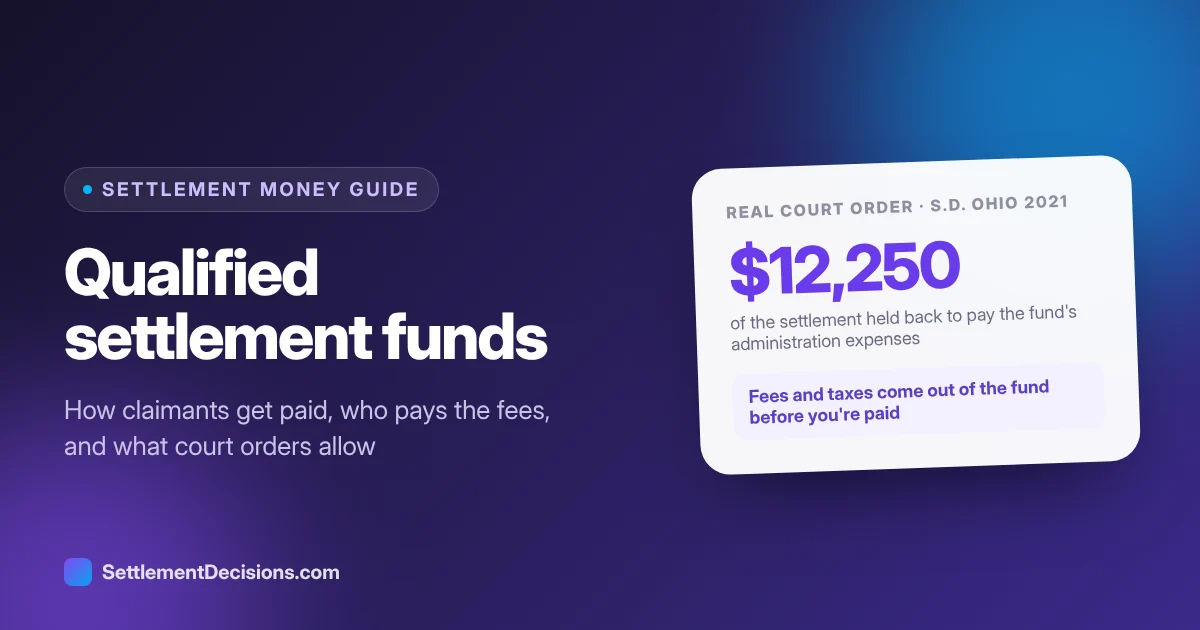
| Meyers v. Cincinnati Bd. of Educ. (S.D. Ohio, 2021) | K.D. Meyers & Associates | $12,250 of the settlement held back for administration expenses; interest also pays administrator fees |
| Doe MC-1 v. Univ. of Michigan (E.D. Mich., 2022) | ARCHER Systems (with ARX Management as investment advisor) | Compliance expenses and taxes on fund income "paid from the Fund" |
| In re Abilify MDL 2734 (N.D. Fla., 2019) | BrownGreer, Edgar C. Gentle III, ARX Management | "Reasonable fees and expenses of QSF administration" paid from the common fund; QSF pays its own taxes |
| In re Allergan Biocell MDL 2921 (D.N.J., 2025) | BrownGreer (lien administrator: Wolf Global Compliance) | Taxes and administration costs paid from the QSF, as set in settlement agreements |
| In re Boston Scientific Pelvic Repair MDL 2326 (S.D. W. Va., 2018) | Providio MediSolutions | Administrator distributes attorneys' fees and litigation expenses |
| In re Yasmin/Yaz MDL 2100 (S.D. Ill., 2013) | Signature Bank | Administrator distributes attorney fees and expenses, including structured attorney fees |
Only the Ohio order states a dollar figure. The rest leave fees to the settlement agreement, so the order alone won't tell you what you're paying. Ask your lawyer for the agreement terms.
Taxes in these orders are taxes on what the fund earns while it holds the money. They are separate from whether your own share is taxable. That depends on what your claim was for. Our settlement tax guide covers the basics, and a tax professional should confirm your situation.
Can you take a structured settlement from a QSF?
Often, yes, and the fund is usually your last chance to choose one.
- Michigan (2022): "Claimants may elect a structured settlement annuity." The fund may buy and assign structured settlements, "qualified" or "non-qualified." Any qualified structured settlement must come from a life insurer with an NAIC 1 issuer credit rating.
- Abilify (2019): authorizes qualified assignments under section 130(c) and funding special needs trusts.
- Boston Scientific (2018) and Yasmin/Yaz (2013): allow qualified assignments of structured settlement liabilities.
- Cincinnati (2021): allows periodic payments once the probate court signs off.
- Allergan (2025): doesn't address it; the settlement agreements control.
Once your share is paid to you as cash, the fund can no longer buy an annuity for you. Our guide on what to do after settlement money is paid explains why. If you want monthly payments, a trust for a child or a special needs arrangement to protect SSI or Medicaid, say so to your lawyer before the administrator releases your share.
What to do if your settlement goes into a QSF
- Get the court order. Ask your lawyer for the order that created the fund. It names the administrator, the bank and the court in charge. Many are on public dockets.
- Ask for your settlement breakdown in writing: gross award, attorney fees, case expenses, QSF administration costs, and each lien. Compare it line by line.
- Ask who resolves your liens (medical providers, health plans, Medicare, Medicaid) and how long it is taking. Liens are a common reason payment is held up.
- Decide lump sum or payments before release. If you want a structured settlement, an annuity's issuer, rating and payment schedule should be in writing before you sign.
- Watch for cash-advance offers. A long wait can make a pre-settlement funding offer tempting. Get the full repayment cost in writing first.
- Talk to a qualified financial advisor and a tax professional about your share. This guide is general information.
If you already receive structured payments and are thinking about selling some, a judge must approve that too. Check any offer against real deals with our court deal benchmark.