
Settlement timing

Can You Set Up a Structured Settlement After Your Settlement Is Paid? Timing, Trust Accounts and QSFs

Once settlement money reaches you or your lawyer's trust account, it is usually too late to create a tax-free structured settlement. Here's why, the narrow window before that point, and what to do if you missed it.

Med F., Settlement AnalystMed F. Settlement Analyst Updated 9 min read
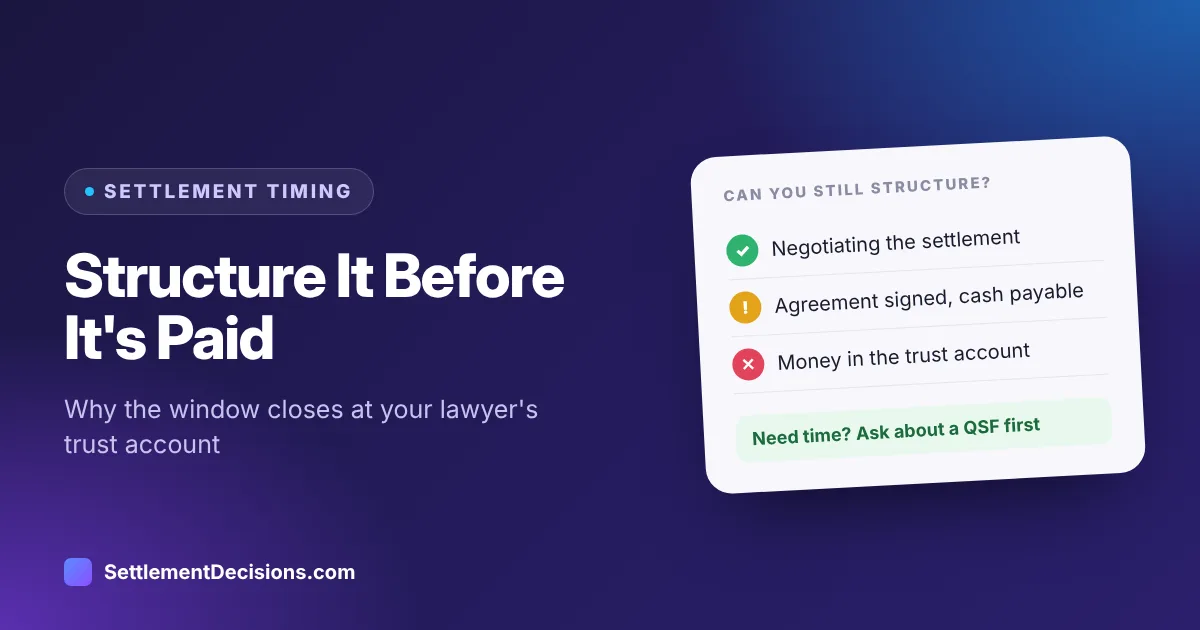
Timeline thumbnail showing the window to set up a structured settlement closing once funds reach the lawyer's trust account

Key takeaway

A tax-free structured settlement has to be agreed before the settlement is final and paid. Once the money lands in your lawyer's trust account, the IRS generally treats it as yours, so it's too late to structure. If you need time to decide, ask your lawyer about a qualified settlement fund before the money is paid out.

Quick answer: Usually no. For a structured settlement to keep its tax benefits, the defendant or its insurer must fund the annuity directly under the settlement agreement. Tax lawyers warn that settlement money held in your lawyer's trust account is presumed already received by you, which ends the option. You can still buy an annuity with the cash, but it won't be a structured settlement. A qualified settlement fund (QSF), set up before payout, can preserve the choice.
In this guide (5 sections)
  1. Why timing matters
  2. The trust account problem: constructive receipt
  3. If you need more time: a qualified settlement fund
  4. Missed the window? Your options
  5. Questions to ask your lawyer before you settle

Why timing matters

A structured settlement is not something you buy after a case ends. It's a way of being paid that's written into the settlement agreement itself.

Here's how a real one is set up:

  1. The settlement agreement says part of the money will be paid as periodic payments.
  2. The defendant or its insurer sends that money directly to an assignment company, which buys an annuity from a life insurer.
  3. You receive the payments over time. For a physical injury case, they're generally tax-free under IRC § 104(a)(2), including the growth built into the annuity.

The key word is directly. You never had the right to take the cash, so the IRS doesn't treat you as having received it.

The trust account problem: constructive receipt

Tax law has a rule called constructive receipt. If you have an unrestricted right to money and could take it, you're taxed as if you did, even if you leave it sitting somewhere.

For settlements, tax attorney Robert W. Wood puts it plainly in the ABA's Business Law Today: "Presumptively, settlement monies in the hands of the lawyer are already received by the client for tax purposes." He adds that once lawyers receive funds in their trust account, "it is too late to structure."

That's why the timeline matters:

StageCan you still structure?
Negotiating, before anything is signedYes. This is the best time
Agreement drafted but not signedUsually yes. The structure terms can still be added
Agreement signed, money payable to youRisky. You may already have a right to the cash
Money in your lawyer's trust (IOLTA) accountGenerally no. The money is treated as yours
Money paid out to youNo. It's ordinary cash now

"Can't the lawyer just send it back to the insurer?"

Rarely. Once a case is settled and paid, the defendant has no reason to reopen it, and undoing a payment to fix taxes is a gray area. Don't count on it.

If you need more time: a qualified settlement fund

A qualified settlement fund (QSF), also called a 468B trust after the tax code section, is the main tool for buying time.

The defendant pays the settlement into the QSF and is released. The money then sits in the fund while you and your advisors decide how to take it, including a structured settlement funded from the QSF.

A Plaintiff Magazine article on QSFs lists three requirements:

  • It must be established or approved by a judge and stay under court supervision.
  • Its purpose must be to resolve or satisfy claims.
  • It must qualify as a trust under state law.

A QSF needs an administrator, a bank account, its own tax ID and tax filings, so it has real costs. It makes the most sense for larger settlements, cases with several plaintiffs, or when liens and government benefits still need to be sorted out. It has to be set up before the money is paid to you or your lawyer.

Missed the window? Your options

If the money is already in your hands, you can still turn it into income. It just won't be a structured settlement.

OptionWhat it isTax on the growth
Buy a regular income annuityYou pay an insurer a lump sum for monthly paymentsThe interest part of each payment is taxable
Keep it in safe accountsCDs, Treasury bills, high-yield savingsInterest is taxable each year
Special needs trustProtects means-tested benefits like SSI and MedicaidDepends on the trust type
Pay off high-rate debtRemoves interest you'd otherwise oweNo tax on the payoff itself

The settlement money itself stays tax-free if it was for physical injuries. What changes is the tax on the earnings from here on.

If you receive SSI or Medicaid, get advice fast. A lump sum can affect eligibility in the month after you receive it. See how structured settlements affect SSI and Medicaid.

Questions to ask your lawyer before you settle

  1. "Can part of this settlement be paid as a structured settlement, and who will quote it?"
  2. "When will the money reach your trust account, and is it too late to structure after that?"
  3. "Would a qualified settlement fund make sense for my case, and what would it cost?"
  4. "Do I have liens, Medicare or benefit issues to settle first?"
  5. "Can your structured settlement consultant show me two or three payment schedules side by side?"

A structure locks your payments in. You can't change the schedule later, and selling payments requires a court's approval. Decide how much flexibility you need before you sign. Talk to a financial advisor who isn't paid on what you choose.

Sources we checked

Figures were checked on November 9, 2026. Limits and rules change, so confirm the current numbers with the source or a qualified professional.

Prefer to talk it through?

Get a free quote on your settlement, by phone

  • Free and no obligation
  • Know your rate before you sign
  • Questions about court approval

Calls are free. Nothing is sold or signed on a call; any sale of settlement payments needs a judge's approval. Talk to a qualified financial advisor before you decide.

Free quote check

Already have structured payments?

If you're receiving structured settlement payments and need cash now, tell us about them. We'll help you compare written offers side by side, with no obligation.

  • No cost to you
  • You choose whether to sell
  • Rates and fees in writing

Tell us where to send your quotes

Takes under a minute. We'll only use your details for this request.

Your details are sent securely. No cost, no obligation.

Keep reading

Related guides and tools

FAQ

Frequently asked questions

Can I set up a structured settlement after my lawyer receives the money?
Generally no. Tax attorneys warn that settlement money in your lawyer's trust account is presumed already received by you, so it's too late to create a tax-free structured settlement. You can still buy a regular annuity with the cash, but its earnings will be taxable.
When is the deadline to choose a structured settlement?
Before the settlement is final and the money is paid. The structure has to be written into the settlement agreement so the defendant or its insurer funds the annuity directly.
What is a qualified settlement fund?
A court-approved trust (also called a 468B trust) that receives the settlement from the defendant. The defendant is released, and the money waits in the fund while you decide how to take it, including as a structured settlement. It must be set up before the money is paid to you.
Is a regular annuity the same as a structured settlement?
No. A structured settlement annuity is funded by the defendant under the settlement and, for physical injury cases, its payments are generally tax-free. An annuity you buy with your own cash taxes the interest part of each payment.
Does losing the structure option make my settlement taxable?
Not the settlement itself. Damages for personal physical injuries stay tax-free. What becomes taxable is the interest or growth you earn on the money from now on.
Can my lawyer structure their own fee?
Yes, but the same timing rule applies. A structured attorney fee has to be arranged before the fee is earned and paid. Once it's in the trust account, it's too late.

This guide is for education only. It is not legal, tax, investment or financial advice, and it does not promise any offer, rate or return. Rules differ by state and by your settlement documents. Before you sell payments or change a financial plan, talk to a qualified financial advisor and, where it applies, a tax professional or attorney who is independent of any buyer.

Free quote · no obligation(484) 286-5757Call now