

Why the payments matter more near retirement
When you're 30, a structured settlement is one income stream among several. At 60 it can become one of the few income sources you can count on for life. Payments that arrive on a fixed schedule, from an insurance company, regardless of what the stock market does, are the kind of income retirement planners try to build on purpose.
Three features make them especially useful once you stop working:
- They are predictable. The amount and the dates are fixed in your settlement agreement, so you can plan a budget around them.
- They are often tax-free. Payments from a physical injury or physical sickness case are generally excluded from income under 26 U.S.C. § 104(a)(2). That means every dollar you receive can go to spending. A $1,500 payment can stretch further than $1,500 of taxable pension or IRA income. Check your own settlement with a tax professional, because workers' comp, wrongful-death and other case types can be taxed differently.
- They don't depend on markets. If stocks fall 30% the year you retire, the payments still arrive. That protects you from "sequence risk", the danger of selling investments at a loss early in retirement.
So the question near retirement isn't only "how much cash can I get?" It's also "what am I giving up, and what would it cost to replace it?"
What a buyer pays vs. what replacing the income would cost
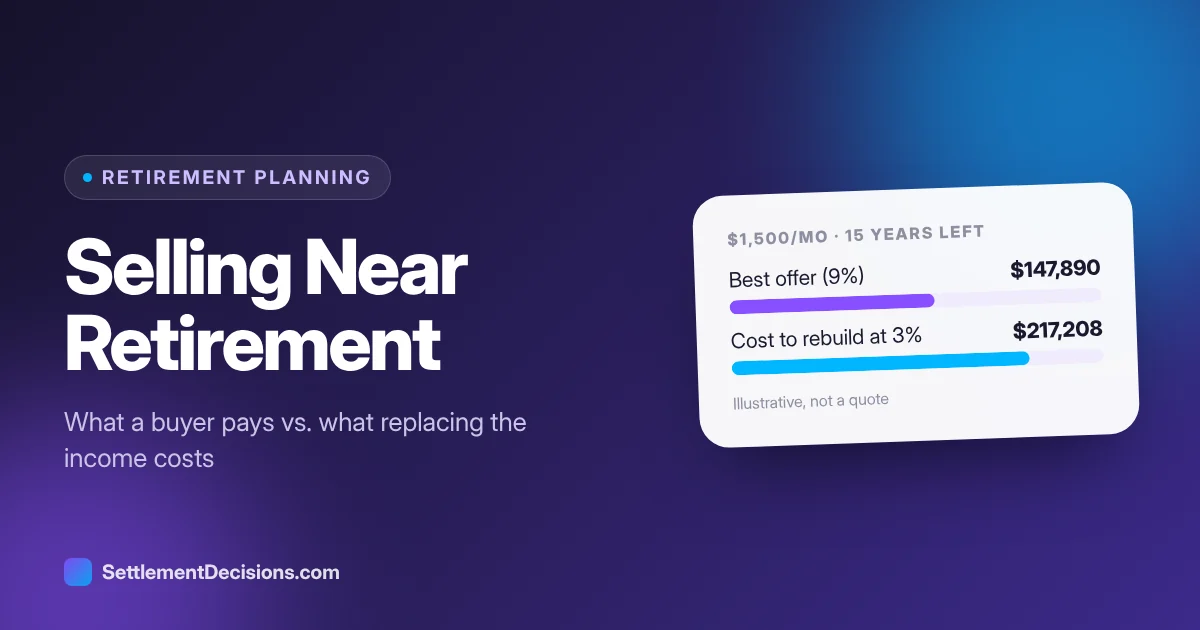
Take a 62-year-old who receives $1,500 a month for 15 more years. That's 180 payments, or $270,000 in total. Buyers price payments by discounting them back to today. Here is what that stream is worth at three illustrative discount rates. These are not quotes.
| Discount rate | Lump sum (approx.) | Share of the $270,000 |
|---|---|---|
| 9% (strong offer) | $147,890 | 55% |
| 12% (middle) | $124,982 | 46% |
| 15% (weak offer) | $107,174 | 40% |
Now flip it around. Suppose the same person sold, then wanted to recreate $1,500 a month for 15 years from their own savings. If that money earned a steady 3% a year, the starting balance would need to be about $217,000. At 4% it would be about $203,000. Those rates are illustrations, not a forecast or a promise.
That gap, roughly $55,000 to $110,000 in this example, is the real price of selling. A sale can still be the right move. But it should solve a problem that is worth that price.
Rule of thumb: If you would use the lump sum to pay off a debt, compare the debt's interest rate with the discount rate on your offer. Paying 12% to clear a 22% credit card balance can make sense. Paying 12% to clear a 3% mortgage usually doesn't.
You can run your own numbers in the cash payout calculator or see the full range of offers in the instant offer estimator.
When selling near retirement can make sense
There are good reasons to sell, even late in your working life. The common thread is that the cash fixes something the monthly payments can't.
- Making a home safe to age in. Accessibility work such as a ramp, a walk-in shower or a stair lift often has to happen all at once. Spreading it over monthly payments isn't practical.
- Clearing expensive debt before income drops. Entering retirement with high-interest balances can drain fixed income for years. If the debt costs more than your discount rate, paying it off can come out ahead. See selling to pay off debt for the math.
- A medical or family emergency. Courts look closely at hardship, and a documented need tends to carry weight at the approval hearing.
- Payments that end before retirement starts. If your schedule finishes at 64 and you plan to retire at 67, those payments don't fund retirement anyway. They may be better used to pay down debt or fund savings now.
When it usually doesn't
- The payments are your main guaranteed income. If Social Security plus your settlement covers your basic bills, selling the settlement swaps a guaranteed floor for a pot of money that has to last.
- The plan is "invest it and beat the discount rate". To come out ahead, your investments would need to earn more than the rate the buyer charged, every year, after fees and taxes. That's a high bar, and nobody can promise it.
- The payments are life-contingent. Payments that stop when you die are harder for buyers to price, and offers usually reflect that. The older you are, the bigger that discount can be. Read selling life-contingent payments before you get quotes.
- The money is for wants, not needs. Judges ask why you're selling. A vacation or a car upgrade is a weak reason to give up retirement income, and courts can and do deny transfers.
Smarter options: partial sales and timing
You rarely have to choose between "sell everything" and "sell nothing". Most buyers can structure a partial sale:
- Sell a fixed dollar amount. Raise exactly what you need, such as $40,000, and keep everything else.
- Sell a slice of each payment. For example, sell $500 of each $1,500 payment and keep $1,000 a month for life.
- Sell the payments you don't need. Sell the early payments that fall before you retire and keep the later ones that fund retirement. Or do the reverse if your other retirement income is strong.
Payments that come sooner are usually discounted less, because the buyer waits less time. Selling the nearest payments can therefore get a better effective rate than selling distant ones. Ask buyers to quote more than one structure.
Taxes, Social Security and Medicare
Income tax. If your payments are tax-free under § 104(a)(2), the lump sum from a court-approved sale is generally treated the same way. Once you invest that money, though, the interest, dividends and gains it earns are taxable. Tax-free monthly income can turn into taxable investment income. Our structured settlement tax guide covers the details.
Social Security. Structured settlement payments are not wages, so they don't count against Social Security's earnings test if you claim before full retirement age. Keeping the payments can also help you delay claiming. Benefits grow for each year you wait past full retirement age, up to 70. The Social Security and SSDI guide explains how settlement income interacts with each benefit.
Medicare premiums. Medicare Part B and Part D premiums rise for people with higher modified adjusted gross income (IRMAA). Tax-free injury payments generally don't add to that income. Taxable investment earnings on a large lump sum can. It's worth asking a tax professional before you sell.
SSI and Medicaid. These programs are means-tested, so a lump sum can affect eligibility. Read how settlements affect SSI and Medicaid first.
A pre-retirement checklist before you sell
- List your retirement income floor. Add Social Security (check your estimate at ssa.gov), pensions and the settlement. Compare the total with your basic monthly costs.
- Name the exact need. Write down what the cash is for and how much it costs. If you can't name it, wait.
- Price the replacement cost. Work out what it would take to rebuild the income you'd give up, as in the example above.
- Get at least three written quotes. Ask each buyer for the effective annual discount rate and every fee in writing. Then compare them on the same payments. Our guide to comparing offers shows how.
- Ask for a partial-sale quote. Compare selling only what you need with selling everything.
- Talk to a qualified financial advisor first. Choose a fee-only advisor who isn't paid by any buyer. A planner can model how the sale changes your retirement income, taxes and Medicare costs.
- Prepare for the court hearing. Every state requires a judge to approve the transfer as being in your best interest. Use the court approval readiness check to see where you stand.
The bottom line
Near retirement, your structured settlement is probably worth more to you as income than it is to a buyer as an asset. That doesn't mean you should never sell. It means the reason should be strong, the amount should be only what you need, and the rate should be the best of several written offers. If the numbers still work after that, a sale can be a sensible part of a retirement plan.