

Two very different things
People often lump a structured settlement in with "retirement money", but legally they have little in common.
- A 401(k) or IRA is an account you own. You put money in, choose investments, and the balance rises and falls with the markets. Tax rules decide when you can take money out and what it costs.
- A structured settlement is a contract. An insurance company (usually through an assignment company) promises to pay you set amounts on set dates. There is no balance to invest and nothing to withdraw early. The only way to get future payments sooner is to sell them, with court approval.
That difference drives everything else in this guide: taxes, access, protection and what happens when you die.
Side-by-side comparison
| Feature | Structured settlement | 401(k) | Traditional IRA |
|---|---|---|---|
| Who controls the money | The annuity issuer pays on a fixed schedule | You, within plan choices | You |
| Income tax on payments | Often tax-free for physical injury cases (IRC § 104) | Taxable when withdrawn (traditional) | Taxable when withdrawn |
| Early access | Only by selling payments, with court approval | Withdrawals before 59½ usually face a 10% penalty, plus loans and hardship options | Withdrawals before 59½ usually face a 10% penalty |
| Required minimum distributions | None. The payment schedule controls | Yes, starting at 73 | Yes, starting at 73 |
| Market risk | None on the payments themselves | Yes | Yes |
| Inflation protection | Only if the schedule includes increases | Depends on investments | Depends on investments |
| Protection if the company fails | State guaranty associations, with limits | ERISA trust rules, plan assets held separately | Depends on the custodian and investments |
RMD ages reflect SECURE 2.0. The starting age is 73 today and is scheduled to rise to 75 in 2033.
Can you roll a structured settlement into an IRA?
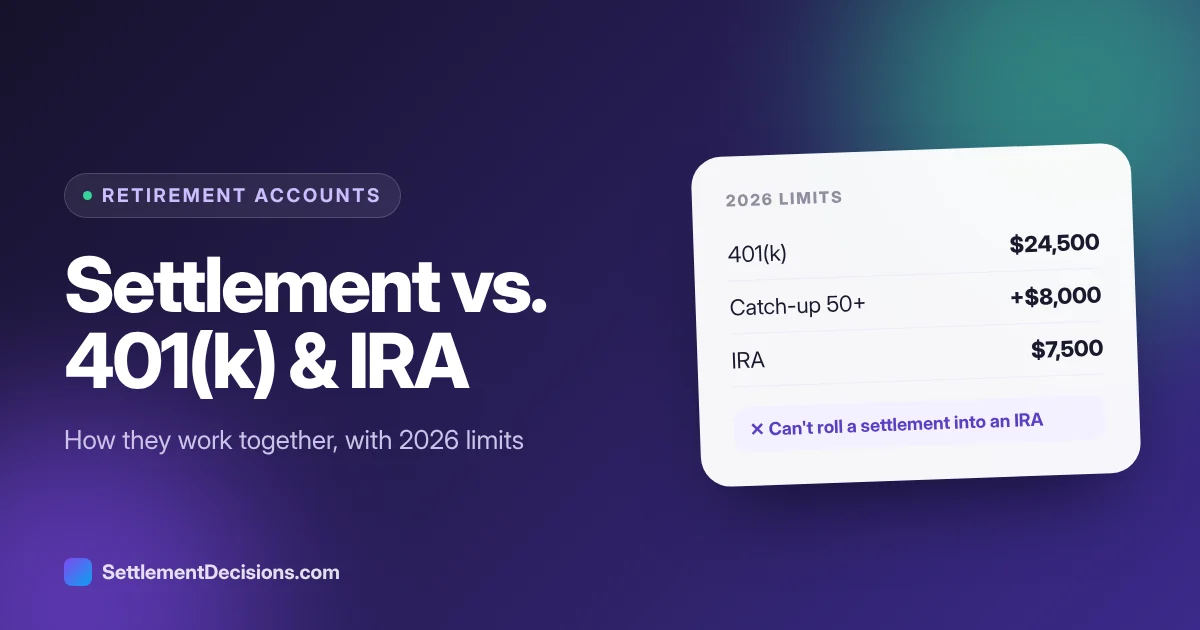
No. Rollovers move money from one retirement account to another. A structured settlement isn't a retirement account, so there's nothing to roll over.
You also generally can't contribute settlement payments to an IRA directly. IRA contributions are limited to your taxable compensation for the year, such as wages, salary or self-employment earnings. Tax-free personal injury payments aren't compensation. If your only income is a tax-free settlement, you usually can't make a regular IRA contribution at all. There's one common exception: a spousal IRA. If you're married, file jointly and your spouse has earned income, contributions can be made for you based on your spouse's earnings. IRS Publication 590-A has the rules.
How to use both together
The settlement can't go into a retirement account, but it can make room for one.
If you work: let the settlement payments cover fixed bills such as rent, utilities and insurance. Then raise your payroll 401(k) contribution with the paycheck money that frees up. For 2026 the limits are:
| 2026 limit | Amount |
|---|---|
| 401(k) employee contribution | $24,500 |
| Catch-up, age 50 and older | +$8,000 |
| Higher catch-up, ages 60 to 63 | +$11,250 (instead of $8,000) |
| IRA contribution | $7,500 |
| IRA catch-up, age 50 and older | +$1,100 |
Limits come from IRS Notice 2025-67. Contributions are capped by your compensation.
In retirement: guaranteed settlement payments act like a small pension. Because they cover part of your spending, you may be able to withdraw less from your 401(k) or IRA in bad market years. That can help the accounts last longer. A qualified financial advisor can model the right withdrawal order for you.
Need cash? Comparing a 401(k) withdrawal with a settlement sale
Suppose you're 45, you need $30,000 now, and you have both a 401(k) and a structured settlement paying $500 a month. Here's a rough comparison. Your numbers will differ.
Option A: 401(k) early withdrawal. Say you're in the 22% federal bracket, pay 5% state tax and owe the 10% early-withdrawal penalty. About 37% of what you withdraw goes to tax and penalty, so you'd need to take out roughly $47,600 to net $30,000. That money also stops growing for retirement.
Option B: sell settlement payments. At an illustrative 12% annual discount rate, netting $30,000 means selling about 92 monthly payments of $500. That's roughly $46,000 of future payments.
Option C: 401(k) loan. Many plans let you borrow the lesser of $50,000 or half your vested balance and repay it through payroll, with interest going back into your own account. There's no tax or penalty if you repay on time. If you leave your job, though, an unpaid balance can become a taxable distribution.
In this example A and B cost about the same, and C is often cheaper, if your plan allows loans and your job is stable. The point isn't that one option always wins. It's that you should price them side by side before you sign anything. Use the payout calculator for your settlement and your plan's loan rules for the 401(k).
Protection from creditors and insurer failure
401(k)s are generally protected from creditors under federal ERISA rules. IRAs have strong protection in bankruptcy, with a federal cap for contributory IRAs of over $1.7 million.
Structured settlement payments are protected differently. Many states shield them from creditors by statute, and the federal bankruptcy code has a limited exemption for personal injury payments. See structured settlement creditor protection. If the annuity issuer fails, state life and health insurance guaranty associations step in. According to NOLHGA, structured settlement annuities are usually covered up to $250,000 in present value per payee, typically through your state of residence. Read what happens if the insurer goes bankrupt for the full picture.
Taxes, side by side
- Settlement payments from a physical injury case are generally tax-free, and so is the lump sum from a court-approved sale of them. Earnings on that lump sum, once invested, are taxable. See the structured settlement tax guide.
- Traditional 401(k) and IRA withdrawals are taxed as ordinary income. Before 59½ they usually also face a 10% penalty unless an exception applies.
- Roth accounts can be tax-free in retirement if the rules are met, but contributions still require earned income.
Which should you rely on in retirement?
You don't have to pick one. The steadiest retirements usually combine guaranteed income (Social Security, pensions, settlement payments) with flexible savings (401(k)s and IRAs). The settlement covers the floor. The accounts cover everything else and grow over time.
Selling a settlement to "invest it in a 401(k)" isn't possible, and selling it to invest elsewhere means you'd need to beat the buyer's discount rate every year, after fees and taxes, just to break even. Before you sell, talk with a fee-only financial advisor who isn't paid by any buyer, and compare at least three written quotes.