

The short version by program
Each benefit program asks a different question, and that question decides whether your settlement matters.
| Program | What it looks at | Do settlement payments count? |
|---|---|---|
| Social Security retirement | Work earnings, through the earnings test | Generally no. Annuity and settlement income isn't counted |
| Social Security survivor or spouse benefits | Work earnings, through the earnings test | Generally no, for the same reason |
| SSDI (disability insurance) | Ability to work and work earnings | Generally no, except workers' comp and some public disability benefits, which can trigger an offset |
| SSI (Supplemental Security Income) | Income and resources | Yes. Payments count as unearned income, and cash you keep counts as a resource |
| Medicaid | Varies by state and program | Often yes for means-tested programs |
The rest of this guide explains each line and what changes if you sell some or all of your payments.
Social Security retirement and the 2026 earnings test
If you claim retirement benefits before your full retirement age and keep working, Social Security may hold back part of your benefit. The 2026 limits, from SSA's annual figures, are:
| Situation | 2026 earnings limit | What is withheld above it |
|---|---|---|
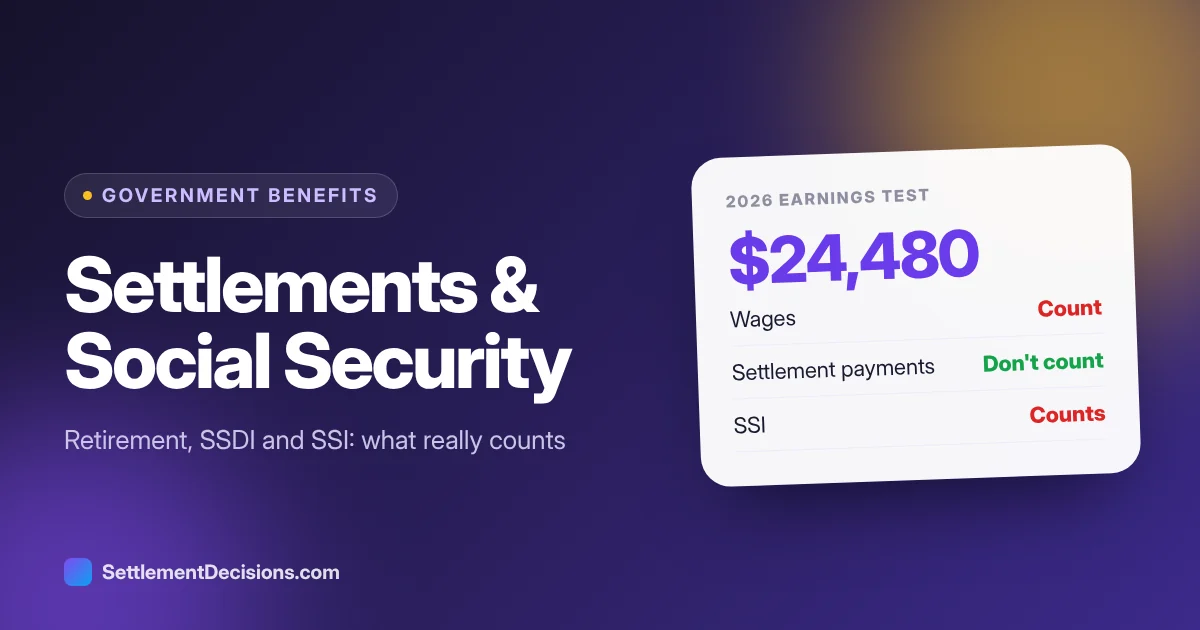
| Under full retirement age all year | $24,480 | $1 for every $2 earned |
| The year you reach full retirement age | $65,160 (before the month you reach it) | $1 for every $3 earned |
| From the month you reach full retirement age | No limit | Nothing |
Only wages and net self-employment income count. SSA's rules say pensions, annuities, investment income, interest, and IRA or 401(k) withdrawals do not. Structured settlement payments fall on the not-counted side.
Example. Dana is 63, earns $34,480 from a part-time job, and receives $18,000 a year in settlement payments. Only the wages count, so she is $10,000 over the limit, and SSA withholds $5,000 of benefits for the year. The settlement payments add nothing to that calculation. Withheld amounts aren't lost for good either. SSA recalculates the benefit at full retirement age to credit the months it withheld.
Can keeping the payments help you claim later?
Often, yes. For people who reach full retirement age and wait, Social Security adds delayed retirement credits up to age 70, which raise the monthly benefit permanently. Guaranteed settlement payments can cover living costs during those waiting years.
That's one reason to think twice before selling payments in your early 60s. The settlement may be what lets you wait for a larger lifetime Social Security check. Your personal benefit estimates at each age are in your my Social Security account at ssa.gov.
SSDI: when a settlement does and doesn't matter
SSDI is insurance you paid for through payroll taxes. It isn't means-tested, so your savings, investments and personal injury settlement payments don't reduce it. What matters for SSDI is whether you can work. Settlement payments aren't earnings, so they don't count toward the "substantial gainful activity" limit either.
The workers' comp offset
There's one important exception. Under federal law (42 U.S.C. § 424a), if you receive workers' compensation or certain public disability benefits, SSDI can be reduced. The reduction applies when your combined benefits exceed 80% of your average current earnings before you became disabled.
- Periodic workers' comp payments, including a structured workers' comp settlement, are counted as they're paid.
- Lump-sum workers' comp settlements are usually prorated over a period of time, so they can still trigger the offset. The wording of the settlement can affect how SSA prorates it.
- A few states use a "reverse offset", where the state reduces the workers' comp benefit instead of SSA reducing SSDI.
Private personal injury settlements, such as from a car accident or medical malpractice case, generally don't trigger this offset. If your structured settlement comes from workers' comp, read workers' comp structured settlements and talk to a benefits attorney before you change anything.
If you sell workers' comp payments
Selling workers' comp payments can change how and when SSA counts them. You're required to report changes in workers' comp benefits to SSA. Get advice from an attorney or accredited representative who handles SSDI offsets before the court hearing, and make sure the judge is told about your benefits.
SSI: where settlements matter most
SSI is a needs-based program, and it treats structured settlement payments very differently:
- Payments count as unearned income. Federal rules list "annuities, pensions, and other periodic payments" as unearned income (20 CFR § 416.1121). After a small general exclusion, they reduce your SSI benefit dollar for dollar.
- Cash you keep counts as a resource. The SSI resource limit is $2,000 for an individual and $3,000 for a couple. A lump sum from selling payments can push you over that limit.
- Special needs trusts can help. Settlements are often paid into a special needs trust to protect eligibility. Selling payments that flow into such a trust raises its own legal questions.
We cover this in depth in how structured settlements affect SSI and Medicaid. Read it before you request quotes if you receive SSI or Medicaid.
Will settlement payments make your Social Security taxable?
Up to 85% of Social Security benefits can be taxed if your "provisional income" is high enough. Provisional income is your adjusted gross income plus tax-exempt interest plus half your benefits. The base thresholds are $25,000 for single filers and $32,000 for joint filers, and they aren't adjusted for inflation.
Tax-free personal injury payments under IRC § 104(a)(2) aren't part of adjusted gross income, so they generally don't push more of your benefit into tax. If you sell and invest the lump sum, the interest and dividends it earns do count. Ask a tax professional to run both scenarios.
What changes if you sell your payments?
| Benefit | Keeping the payments | Selling the payments |
|---|---|---|
| Social Security retirement | No effect through the earnings test | Usually no effect. Investment income from the lump sum isn't counted in the earnings test, but it can make benefits taxable |
| SSDI (non-workers' comp settlement) | No effect | No effect on eligibility |
| SSDI with workers' comp | Offset may apply as payments arrive | The offset may be recalculated, so get advice first |
| SSI | Reduces benefits each month | A lump sum can exceed the resource limit and end benefits |
| Medicaid | Depends on state rules | A lump sum can affect eligibility |
Before you sell, confirm the rules for your own benefits. Call SSA or work with an accredited representative, and speak with a qualified financial advisor about how the sale fits your wider plan.
Checklist before you sell
- List every benefit you receive, including Social Security, SSDI, SSI, Medicaid, VA and state programs.
- Find the source of your settlement. Personal injury, workers' comp and wrongful death payments are treated differently.
- Ask SSA how a change would be counted, and keep notes of who you spoke to and when.
- Tell the court about your benefits. Judges consider the effect on you and your dependents when deciding whether a sale is in your best interest.
- Get several written quotes, and consider a partial sale that keeps you under benefit limits.