
Home purchase strategy
Can You Sell a Structured Settlement to Buy a House?
Compare a down-payment sale, mortgage payoff, cash purchase and keeping your guaranteed payments before transferring future income.
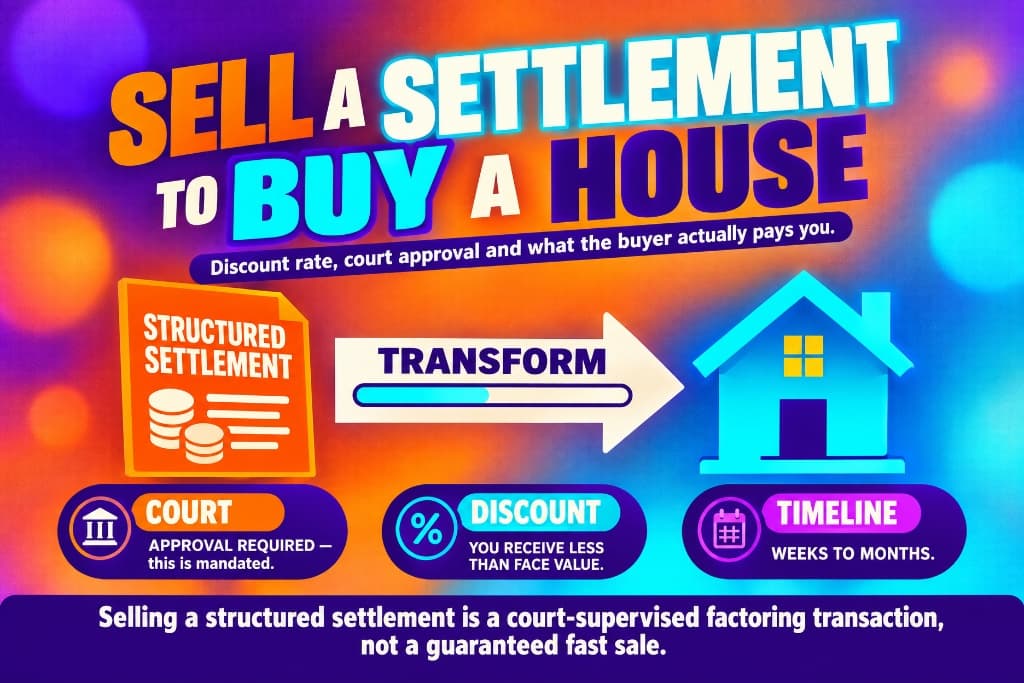
Direct answer
You may be able to sell a portion of future structured settlement payments to fund a house down payment, closing costs or mortgage payoff. The transfer normally requires advance approval under applicable law. The central financial question is whether the housing benefit justifies giving up a larger amount of guaranteed future income.
Interactive planning tool
Home Purchase Funding Planner
Estimate how many monthly payments could be involved in funding a down payment and closing costs. This is an educational estimate—not a purchase offer or promise of court approval.
Estimated funding target
$70,500
Free educational review. No obligation. Your actual value depends on verified payment dates, transaction terms and applicable law.
Three Ways a Structured Settlement Can Help With a Home
A structured settlement and a home purchase can interact in three materially different ways. Treating them as interchangeable can lead to selling more payments than necessary.
1. Keep the payments and apply for a mortgage
Some lenders may consider documented recurring settlement payments when evaluating income, provided the payments meet the lender's duration and verification requirements. Start by asking a mortgage professional what documentation is required.
Read our separate guide to structured settlement income and mortgage qualification.
2. Sell only enough payments for upfront costs
A partial transfer may be designed around the down payment, closing costs and a reasonable reserve. This can preserve remaining payments while reducing the mortgage amount.
3. Sell a larger stream to buy or pay off the home
A larger transfer could eliminate or reduce mortgage debt, but it also gives up more guaranteed future income. Compare the mortgage interest avoided with the difference between the transferred future payments and the net cash received today.
Partial-Sale Example
Assume a buyer needs $70,000 for a down payment and closing costs after using available savings. The settlement pays $2,500 per month for another 15 years.
The correct comparison is not simply "$70,000 now versus $70,000 later." The seller should identify the exact payments proposed for transfer, the total future amount of those payments, the disclosed net advance and the payments that remain afterward.
- ✓ Exact payment dates transferred
- ✓ Total future payments transferred
- ✓ Gross advance amount
- ✓ Itemized expenses and deductions
- ✓ Net cash delivered to you
- ✓ Effective discount rate
- ✓ Payments retained after the transfer
- ✓ Offer expiration and repricing terms
Review these figures using the structured settlement transfer disclosure statement guide.
Down Payment Versus Cash Purchase
Selling enough payments to buy a home outright may remove a monthly mortgage obligation, but it can consume a much larger share of the settlement. A down-payment strategy preserves more future payments but adds mortgage interest, property taxes, insurance and maintenance obligations.
Compare at least four scenarios:
- Keep every settlement payment and continue renting.
- Keep the payments and seek mortgage qualification.
- Transfer only enough payments for upfront housing costs.
- Transfer enough payments to reduce or eliminate the loan.
Using a Transfer to Pay Off an Existing Mortgage
Paying off expensive or delinquent mortgage debt can create an immediate monthly cash-flow benefit. But the comparison should include the mortgage rate, remaining loan term, prepayment terms, amount of future income surrendered and the household's need for ongoing settlement payments.
If other debts are part of the decision, use the broader structured settlement debt-payoff guide before combining every balance into one proposed transfer.
What the Reviewing Court May Examine
Federal law addresses qualified orders for structured settlement factoring transactions, while state law supplies the applicable approval process and required findings. Requirements vary, but the reviewing authority generally examines whether the proposed transaction is in the payee's best interest.
A specific, documented housing plan is more informative than a general statement that the money will be used for a house. Relevant documents may include:
- A purchase contract or realistic target price
- A lender prequalification or underwriting explanation
- Down-payment and closing-cost estimates
- The current mortgage payoff statement, if applicable
- A post-purchase household budget
- The settlement payment schedule
- Written offers based on the same payment stream
When Selling May Not Make Financial Sense
A transfer may deserve additional scrutiny when the home would still be unaffordable after closing, the sale would eliminate income required for basic expenses, the quote transfers far more payments than the housing need requires, or lower-cost financing alternatives have not been compared.
The Consumer Financial Protection Bureau advises consumers to understand how much future income they are giving up, compare alternatives and obtain professional advice before exchanging settlement payments for a lump sum.
Questions to Ask Every Purchaser
- Which exact payments are included in this quote?
- What is the total undiscounted amount transferred?
- What is the net amount I receive after every deduction?
- Can the transaction be reduced to only the amount needed?
- What causes the offer to change or expire?
- Which payments will I keep?
- Who handles the applicable approval process?
- May I review the disclosure before committing?
If an initial and final number differ, see why a structured settlement cash payout offer can change.
Frequently Asked Questions
Can I sell structured settlement payments to buy a house?
You may seek to transfer some or all future structured settlement payment rights for a lump sum, subject to applicable law and advance approval through a qualified court or administrative order. Approval is not automatic, and the reviewing authority generally considers whether the proposed transfer is in your best interest.
Can I sell only enough payments for a down payment?
A proposed transfer can involve only a portion of future payments. A partial transaction may allow you to raise a defined amount while retaining other scheduled payments, although pricing, documents and court approval still apply.
Can structured settlement payments help me qualify for a mortgage?
A lender may consider recurring settlement payments when they are documented, expected to continue for the required period and acceptable under that lender's underwriting rules. The lender—not the settlement buyer—decides whether the income qualifies.
Is the calculator result a guaranteed cash offer?
No. The calculator is an educational present-value illustration. An actual written offer depends on the verified payment schedule, payment type, dates, transaction expenses, purchaser pricing and other terms.
Will selling payments affect the tax treatment of my settlement?
Tax consequences depend on the origin and structure of the settlement and the details of the transfer. Federal law addresses structured settlement factoring transactions and qualified orders, but individual circumstances should be reviewed with a qualified tax or legal professional.
Bottom Line
Selling structured settlement payments for a house can be structured as a limited down-payment transaction, a mortgage payoff or a larger home purchase. The safest comparison identifies the smallest payment stream that meets the documented need while preserving as much future income as practical.
Private payment review
Compare the Cost Before Transferring Payments
Estimate your current payment value and compare alternatives based on your home-purchase target.
Authoritative References
- 26 U.S.C. § 5891 — Structured settlement factoring transactions
- Consumer Financial Protection Bureau guidance
This article provides general educational information and is not legal, tax, mortgage or financial advice. Rules and individual circumstances vary.