
Court-approved money

Do You Have Full Control Over a Court-Approved Settlement? Blocked Accounts, Structures and Trusts Explained

If a judge approved your settlement, part of the money may be in a blocked account, a structured settlement or a trust you can't freely spend. Here's who controls each one, how to get money out, and when control passes to you.

Med F., Settlement AnalystMed F. Settlement Analyst Updated 10 min read
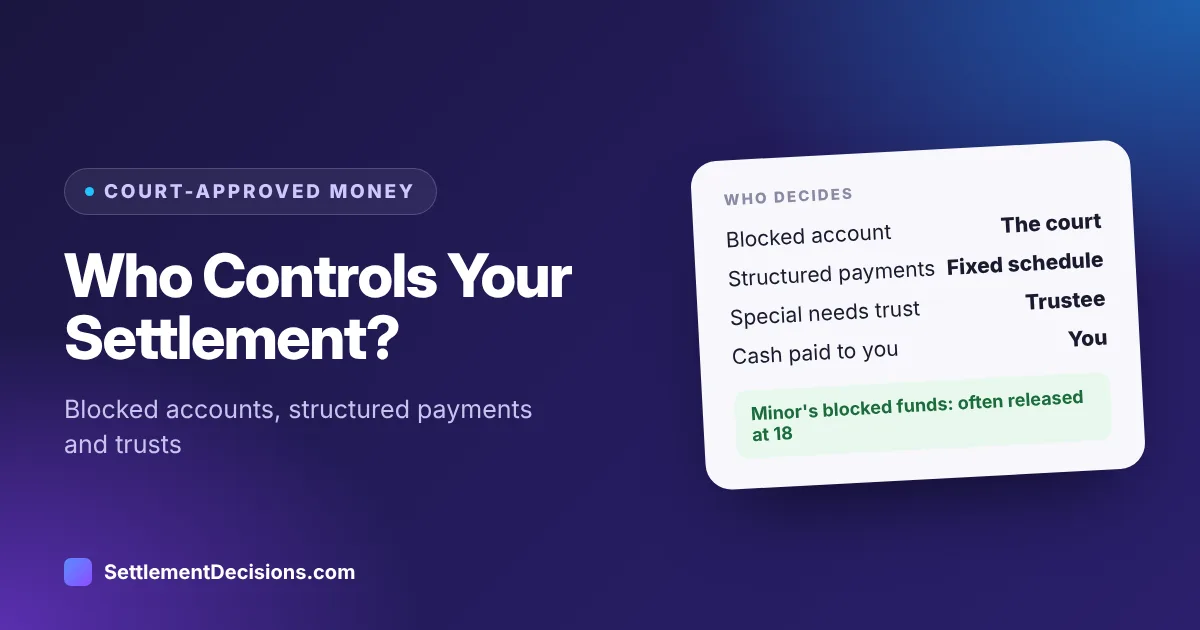
Thumbnail comparing who controls a blocked account, a structured settlement and a special needs trust

Key takeaway

Court-approved settlements often come with limits. Money in a blocked account needs a judge's written order to withdraw, structured payments arrive on a fixed schedule, and a trust is run by its trustee. Adults who settled their own case usually control their cash share. Minors get control of blocked funds at 18.

Quick answer: Not always. It depends on where the court put the money. A blocked account can't be touched without a signed court order, though in California a minor can withdraw the funds without a new order once they turn 18. Structured settlement payments come on a fixed schedule, and only a court can approve selling them. A special needs trust is controlled by its trustee. Cash paid to an adult with no court restriction is yours to manage.
In this guide (6 sections)
  1. Why courts put limits on settlement money
  2. Who controls each type of court-approved money
  3. Blocked accounts: how they work
  4. Structured settlement payments
  5. Special needs trusts
  6. When you do have full control

Why courts put limits on settlement money

Most adults who settle their own injury case get their share with no strings attached. Courts step in when the person receiving the money needs protection, such as:

  • A minor (anyone under 18 in most states)
  • An adult under guardianship or conservatorship
  • Someone on means-tested benefits like SSI or Medicaid, where a lump sum could cost them eligibility
  • Wrongful death cases where the money is split among family members

In those cases a judge approves the settlement and decides where the money goes. That decision controls what you can do with it later.

Who controls each type of court-approved money

Where the money wentWho controls itHow to get money out
Blocked bank accountThe courtA signed, file-stamped court order. For minors, often paid out at 18
Structured settlementThe annuity contractPayments arrive on the set schedule. Selling them needs a new court approval
Special needs trustThe trusteeThe trustee pays for your needs under the trust's rules
Guardianship or conservatorship accountThe guardian or conservator, with court oversightCourt approval for many spending decisions, plus regular accountings
Cash paid to you directlyYouNo limits

Your court order lists exactly which of these applies. Ask your lawyer or the court clerk for a copy of the order approving the settlement and read the section on "disposition of funds."

Blocked accounts: how they work

A blocked account is an insured bank account that can't be withdrawn from without a judge's permission.

California's official form, MC-355 (Order to Deposit Funds in Blocked Account), shows how strict it is. The funds "must be deposited in one or more interest-bearing, federally insured blocked accounts," and "no withdrawal of principal or interest may be made" without a written court order signed by a judicial officer and file-stamped by the court.

For a minor, the same California form allows the bank to pay the money directly to the former minor once they turn 18, without another court order.

Other states use similar accounts under different names, such as "restricted accounts" or "court-controlled accounts." The rules come from your state's laws on minors' and incapacitated persons' settlements.

How to request a withdrawal before 18

  1. Write down the need. Courts usually approve spending that benefits the minor and that parents can't reasonably cover, like medical costs, education or special equipment.
  2. File a petition in the same case, with the case number from the original order.
  3. Attach proof: quotes, bills or school costs.
  4. Get the signed order and give a certified copy to the bank.

Courts tend to say no to everyday expenses that parents are legally expected to pay.

Structured settlement payments

If the court approved a structured settlement, the money isn't in an account at all. A life insurance company makes payments on dates fixed in the annuity contract.

  • You can't change the amounts or dates. See whether payment schedules can be changed.
  • You can sell some or all of the payments for a lump sum, but every state's structured settlement protection act requires a judge to approve the sale.
  • If the payee is a minor, a parent or guardian usually can't sell the payments on the child's behalf without court approval, and many courts refuse.

For more, see the court approval process and our guide for parents of minors.

Special needs trusts

A special needs trust holds settlement money for someone who receives or may need SSI or Medicaid. Because the person doesn't own the money directly, it generally doesn't count against benefit limits.

The trade-off is control. The trustee decides each payment, and payments must follow the trust's rules and benefit program rules. A first-party trust funded with the person's own settlement usually has to repay Medicaid from what's left when the beneficiary dies.

If you're the beneficiary and disagree with how the trustee spends, ask for an accounting. If that doesn't resolve it, a lawyer can ask the court that oversees the trust to review it.

When you do have full control

You have full control when:

  • You're an adult who settled your own case, and the order doesn't restrict the funds.
  • A minor's blocked account has been released at 18.
  • A guardianship or conservatorship has ended.
  • The money was paid to you after liens, fees and costs were taken out.

Even then, the tax rules and any government benefits still apply. Before spending a large sum, talk to a financial advisor who doesn't earn a commission from what you choose.

Sources we checked

Figures were checked on November 9, 2026. Limits and rules change, so confirm the current numbers with the source or a qualified professional.

Prefer to talk it through?

Get a free quote on your settlement, by phone

  • Free and no obligation
  • Know your rate before you sign
  • Questions about court approval

Calls are free. Nothing is sold or signed on a call; any sale of settlement payments needs a judge's approval. Talk to a qualified financial advisor before you decide.

Free quote check

Receiving structured payments as an adult?

If your structured settlement payments are yours and you need cash, tell us about them. We'll help you compare written offers and understand the court approval step.

  • No cost to you
  • You choose whether to sell
  • Rates and fees in writing

Tell us where to send your quotes

Takes under a minute. We'll only use your details for this request.

Your details are sent securely. No cost, no obligation.

Keep reading

Related guides and tools

FAQ

Frequently asked questions

Can I withdraw money from a court-ordered blocked account?
Only with a written court order. California's form MC-355 says no withdrawal of principal or interest may be made without an order signed by a judicial officer and file-stamped by the court. You request it by petitioning in the same case and showing what the money is for.
When does a minor get their settlement money?
Usually at 18. In California, the bank may pay a blocked account directly to the former minor once they reach 18, without another court order. Structured settlement payments follow the dates in the annuity, which may start at 18 or later.
Can a parent spend a child's settlement?
Not freely. Money in a blocked account needs a court order, and courts generally expect parents to cover normal living costs themselves. Requests for the child's medical, educational or special needs are more likely to be approved.
Can I sell my court-approved structured settlement?
You can ask to. Every state requires a judge to approve a sale of structured settlement payments and to find it is in the seller's best interest. Sales by or for minors are rarely approved.
Who controls a special needs trust?
The trustee named in the trust. The trustee pays for the beneficiary's needs under the trust's rules so the beneficiary can keep SSI or Medicaid. A first-party trust usually must repay Medicaid from what's left when the beneficiary dies.
How do I find out what the court ordered?
Ask your lawyer or the court clerk for the order approving the settlement. The section on disposition of funds lists the blocked account, structured settlement, trust or direct payment that applies to you.

This guide is for education only. It is not legal, tax, investment or financial advice, and it does not promise any offer, rate or return. Rules differ by state and by your settlement documents. Before you sell payments or change a financial plan, talk to a qualified financial advisor and, where it applies, a tax professional or attorney who is independent of any buyer.

Free quote · no obligation(484) 286-5757Call now