

Two very different things with the same word
People search "structured settlement debt collection" for two reasons:
- A debt collector offered to "settle" a debt in installments, and they want to know what that means.
- They receive structured settlement payments and are worried a collector can take them.
This guide covers the first. If you're worried about the second, read can creditors take a structured settlement?.
| Structured settlement | Debt settlement or payment plan | |
|---|---|---|
| Who gets paid | You receive payments | You pay the collector |
| Where it comes from | An injury, wrongful death or workers' comp case | Credit cards, medical bills, loans or other debts |
| Who's behind it | A life insurance company | A creditor, debt collector or debt buyer |
| Taxes | Generally tax-free for physical injury | Forgiven debt can be taxable income |
| Approval | Selling payments needs a judge | A written agreement between you and the collector |
The two ways to resolve a debt with a collector
1. A settlement (paying less than you owe). You offer a reduced amount, often as one lump sum, sometimes over a few months. The collector agrees to accept it as payment in full. The rest of the debt is forgiven.
2. A payment plan (paying the full balance over time). You pay the whole debt in monthly installments. Nothing is forgiven, so there's no tax issue, but it takes longer.
A mix is also common: a reduced total paid over 3 to 12 months.
Before you agree to anything
The Consumer Financial Protection Bureau (CFPB) recommends these steps:
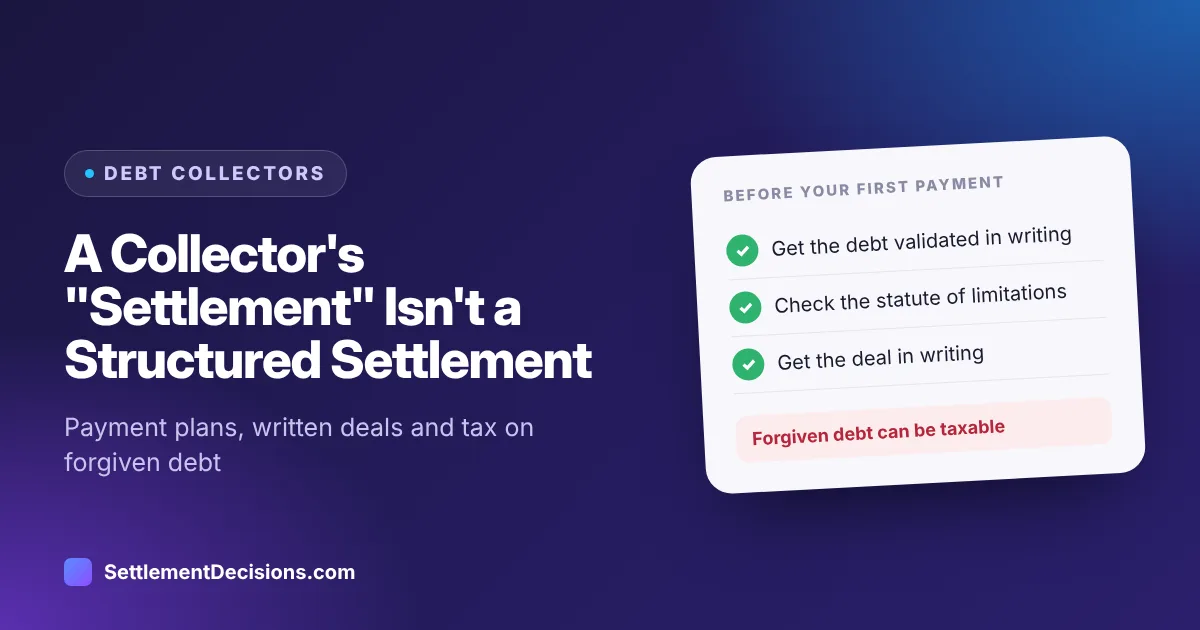
- Get the debt details in writing. Ask for the amount owed, the name of the creditor and how to dispute it. Get this written notice before you agree to pay or negotiate.
- Dispute it if something's wrong. Write to dispute all or part of the debt, and the collector has to send verification.
- Check the statute of limitations. The CFPB warns: "Before making a payment or agreeing to a payment plan for a debt that is old, find out what the statute of limitations is." A payment can affect your options on an old debt.
- Work out what you can really afford. Base the plan on your budget, not the collector's first demand.
- Get the agreement in writing before you pay. It should say the amount, the schedule, that the payment settles the debt in full, and how it will be reported to credit bureaus.
Keep copies of every letter, email and payment receipt.
What a good written agreement says
- The exact total you'll pay and the due dates
- That the debt is "settled in full" or "paid in full" once you finish
- That the collector won't sell the remaining balance to another collector
- How the account will be reported to the credit bureaus
- What happens if you miss a payment
Taxes on forgiven debt
If you settle a debt for less than you owe, the forgiven part is generally taxable income.
- The IRS says you "must include the canceled amount in gross income unless you meet an exclusion or exception."
- Creditors generally send Form 1099-C when they cancel $600 or more. You owe tax on taxable canceled debt whether or not you get the form.
- Exclusions include debt canceled in a bankruptcy case and debt canceled while you're insolvent (your debts are more than your assets). To use one, you generally file Form 982.
Example: you owe $8,000 and settle for $4,500. The $3,500 that's forgiven may be added to your taxable income for that year, unless you were insolvent.
Watch out for debt settlement companies
Some companies offer to negotiate for you. The CFPB says dealing with them "can be risky," that some "promise more than they can deliver," and that some creditors won't work with them. Its advice: avoid companies that charge money in advance to settle your debts.
You can usually negotiate directly with the collector yourself, for free. A nonprofit credit counselor is another lower-cost option.
If you have a real structured settlement and big debts
If you receive structured settlement payments and are being pursued for debt:
- Your payments are often protected from creditors by state law and anti-assignment clauses. See structured settlement creditor protection.
- Selling some payments to pay off debt is possible but rarely the cheapest option. Compare the discount rate on a sale with the interest rate on the debt first. See selling a structured settlement to pay off debt.
- Compare all your options, including bankruptcy and debt relief, in selling vs. debt relief or bankruptcy.
Any collector who calls and offers to "buy" your structured settlement payments is a buyer, not a creditor. Read why structured settlement companies keep calling you before sharing anything.