

Does settlement income count?
Generally, yes. Lenders and landlords want to know two things: how much comes in and whether it will keep coming. Structured settlement payments often answer both better than a paycheck, because the amount and schedule are fixed in a contract with an insurance company.
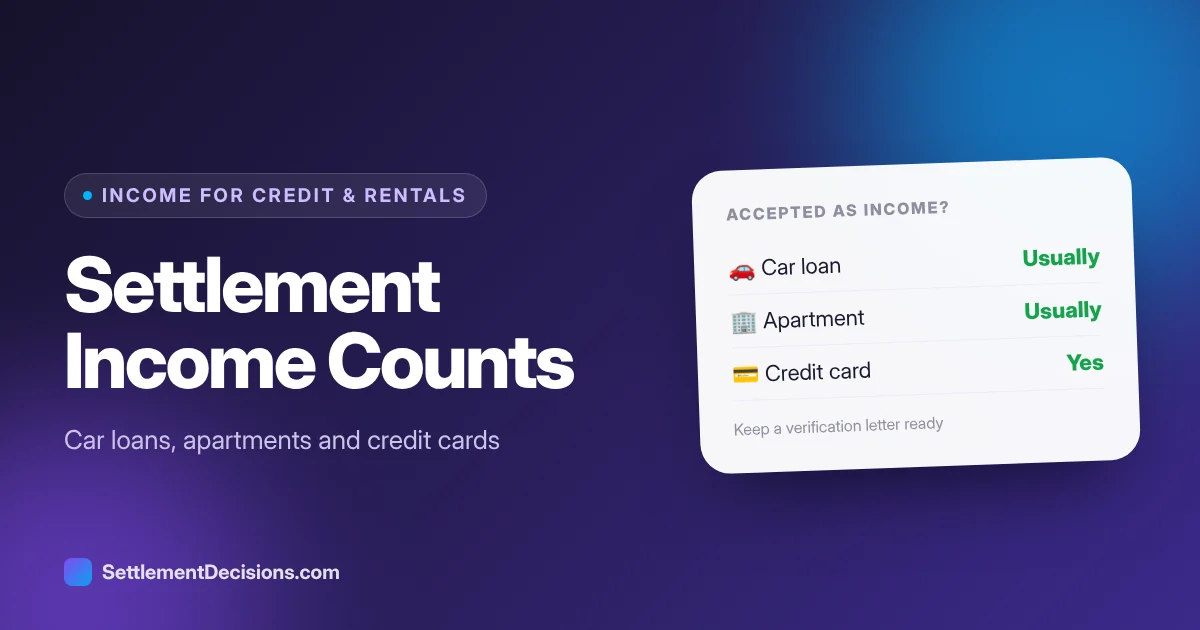
What varies is how each type of lender treats it:
| Application | Usually counts settlement income? | What they typically look for |
|---|---|---|
| Mortgage | Yes, under agency rules | Proof of the payments and continuance for at least 3 years (Fannie Mae) |
| Car loan | Usually, at the lender's discretion | Recent statements or deposits, sometimes a verification letter |
| Apartment rental | Usually, as part of income screening | Proof of monthly income, often compared with the rent |
| Credit card | Yes, if you list it | Your stated total income, which the issuer may verify |
| Personal loan | Often | Documentation similar to a car loan |
Mortgages have the most formal rules. See our full guide to using structured settlement income for a mortgage.
Car loans
Auto lenders don't follow a single national rule for non-job income, so each lender decides. In practice, most will consider structured settlement payments if you can document them.
- Bring proof of the payments. That means your annuity statement or settlement schedule, plus two or three months of bank statements showing the deposits.
- Show they'll last. If payments continue for at least the length of the loan, say so. Payments ending in 18 months won't help much with a 72-month loan.
- Watch your debt-to-income ratio. Lenders compare your monthly debt payments, including the new car payment, with your monthly income. Steady settlement income can bring that ratio down.
- Tax-free income may be shown as-is. Some lenders "gross up" non-taxable income because you keep all of it. Mortgage rules allow this. Many auto lenders simply use the amount you receive. Ask.
Paying cash instead? If you're thinking of selling payments to buy a car outright, compare the discount you'd pay with the loan's interest rate. Selling at 14% to avoid a 7% auto loan usually costs more. The instant offer estimator shows what a sale would cost you.
Renting an apartment
Many landlords screen tenants by comparing monthly income with the rent. A common rule of thumb is income of about three times the rent, though it varies by landlord and market.
- Settlement payments usually count toward that income figure.
- Give the landlord something official. An income verification letter from the annuity issuer or your settlement administrator works better than a screenshot. See how to get a structured settlement income verification letter.
- Know your local rules. Some states and cities ban housing discrimination based on a lawful "source of income". If a landlord refuses to count documented settlement income at all, a local fair housing agency can tell you whether your area protects you.
- Offer alternatives if you fall short. A larger deposit, a co-signer or proof of savings can help, depending on the landlord.
Example: Jordan receives $1,800 a month from a structured settlement and earns $1,600 a month part-time, a total of $3,400. For a $1,100 apartment, the three-times rule calls for $3,300 a month, so Jordan qualifies only by counting the settlement.
Credit cards
Credit card issuers must consider your ability to make the payments before opening an account or raising a limit. That requirement comes from the CARD Act and the CFPB's Regulation Z (12 CFR § 1026.51).
- If you're 21 or older, the issuer may consider income or assets you have a reasonable expectation of access to. Your settlement payments count.
- If you're under 21, you generally need your own independent income or a co-signer. Settlement payments made to you are your own income.
- Report the real amount. List what you actually receive. Overstating income on a credit application can have serious consequences.
What lenders and landlords usually ask for
Keep these ready in one folder:
- Your settlement payment schedule or the annuity contract page showing amounts and dates.
- A recent annuity statement or payment history from the issuer.
- An income verification letter confirming the amount, frequency and end date.
- Two to three months of bank statements showing the deposits.
- Any documents showing changes, such as a court order if you previously sold some payments.
Lost something? See how to find or replace lost settlement documents.
How selling payments affects approval
This is the part people overlook. When you sell payments, that income no longer counts, because the buyer receives it, not you.
- Selling before you apply lowers your provable income. The lump sum may help as savings or a down payment, but it won't count as monthly income.
- Selling during a loan application can derail it. If a lender approved you based on payments you then sell, the approval may no longer stand. Always tell the lender about a pending sale. Hiding it can be treated as misrepresentation.
- A partial sale keeps some income in place. Selling only a lump-sum payment due years from now, for example, can leave your monthly income untouched. See partial sales.
- Selling doesn't hurt your credit score directly. Buyers don't report to credit bureaus. The effect is on your income, not your score.
Practical order: if you need both a loan and a lump sum, talk to the lender first. Ask how a sale would change what they'll approve, then decide. A qualified financial advisor can help you weigh the timing.
Are settlement payments "income" everywhere?
Not always. The same payments can count as income for a landlord but not as taxable income for the IRS, and they're treated differently again by benefit programs like SSI. Our guide are structured settlement payments income? explains how each one sees them.