

The short answer
Ask one question first: what is the money for?
- Damages from an injury case → a structured settlement annuity.
- Pay from your job (salary, bonus, commissions) → a deferred compensation plan, if your employer offers one.
- A lawyer's contingency fee → a structured attorney fee.
You can't move injury damages into an employer's deferred comp plan, and you can't turn wages into a tax-free structured settlement. The question usually comes up when someone has both, or when a lawyer is deciding how to take a fee.
Side-by-side comparison
| Structured settlement annuity | Nonqualified deferred compensation plan | |
|---|---|---|
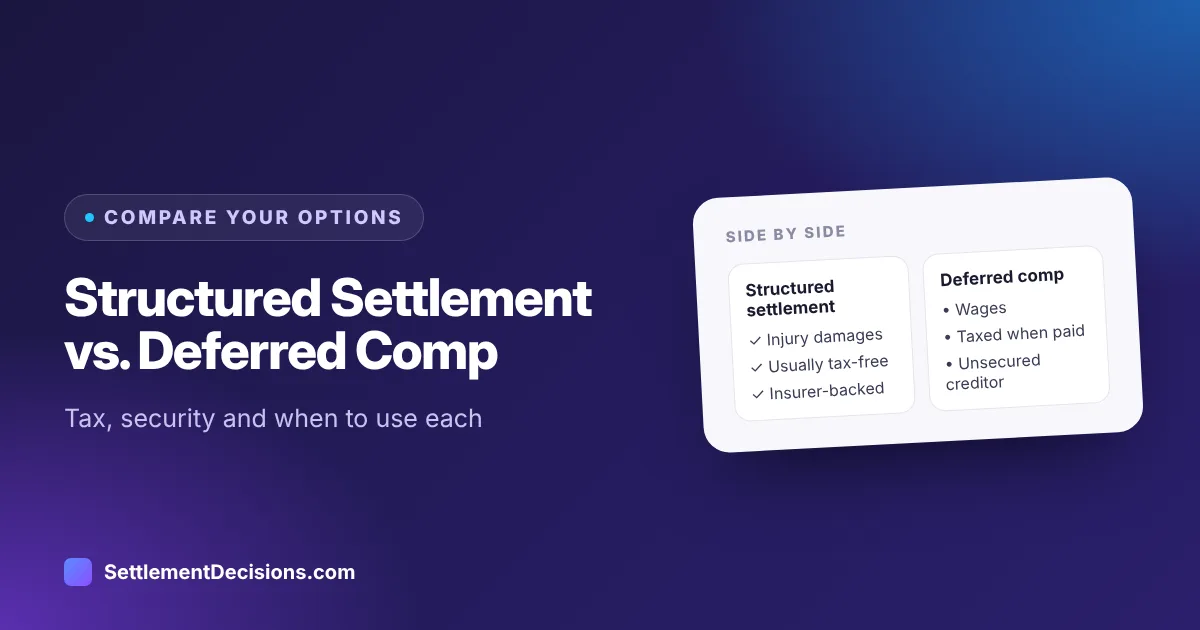
| What money it holds | Damages from a personal injury, wrongful death or workers' comp case | Wages, bonuses or commissions you've earned |
| Who pays you | A life insurance company, through an assignment company | Your employer |
| Income tax | Generally none on payments for physical injury, including the growth (IRC § 104(a)(2)) | Taxed as ordinary income when you're paid |
| If the payer goes bankrupt | Backed by a highly rated insurer, plus state guaranty association coverage up to state limits | You're a general unsecured creditor of the employer |
| Can you change the schedule? | No, it's fixed in the settlement | Only under strict Section 409A rules |
| Can you get cash early? | Only by selling payments with a judge's approval | Usually no. Early access can trigger 409A penalties |
| When you must decide | Before the settlement is signed and paid | Usually before the year you earn the pay |
How a structured settlement works
The settlement agreement says the defendant will pay part of your damages over time. The defendant's insurer sends that money directly to an assignment company, which buys an annuity from a life insurer under IRC § 130. You receive fixed payments on set dates.
Why people choose it:
- Tax-free income for physical injury cases, including the investment growth inside the annuity.
- Guaranteed amounts that don't depend on markets.
- Protection from overspending, because you can't cash it out on impulse.
The catch is flexibility. Once it's set, you can't change it. If you later need a lump sum, you have to sell payments with court approval, usually at a discount.
Timing is strict: a structure has to be built into the settlement before the money is paid. See why it's usually too late once the money reaches your lawyer.
How a deferred compensation plan works
A nonqualified deferred compensation (NQDC) plan lets you postpone part of your pay, usually to retirement, so you pay tax later, ideally in a lower bracket.
What to know:
- It's taxable income when paid. Deferring changes when you pay tax, not whether you do.
- Section 409A sets the rules on when you elect to defer and when you can be paid. Breaking them can bring immediate tax plus penalties.
- You're an unsecured creditor. A plan document typically has to say participants "only have the status of general unsecured creditors of the employer in bankruptcy." If the company fails, your deferred pay can be lost or cut.
A 401(k) or 457(b) plan is different. These are qualified or governmental plans with their own limits and protections. If your employer offers one, it's usually the first place to defer.
Lawyers: structured attorney fees
Contingency-fee lawyers can spread a fee over time with a structured attorney fee. The structure is arranged before the case settles, and the fee is funded through an annuity rather than paid in cash.
According to tax attorney Robert W. Wood, these rest on Childs v. Commissioner (Tax Court 1994, affirmed by the Eleventh Circuit in 1996), and Section 409A does not apply to structured attorney fees under IRS Notice 2005-1. They are taxed as the lawyer receives each payment. The same timing rule applies: once the fee reaches the trust account, it's too late.
Which should you use?
| Your situation | Usually the better fit |
|---|---|
| You're settling a physical injury case and want steady income | Structured settlement for part of it, cash for near-term needs |
| You need flexibility for a home, business or debt payoff soon | Take more as cash, structure less |
| You're a high earner with an employer NQDC plan and a strong employer | Deferred comp can cut taxes, but limit how much you defer |
| Your employer's finances are shaky | Avoid large deferrals into an NQDC plan |
| You're a lawyer with a large contingency fee | Ask a structured settlement consultant about a structured fee before the case settles |
Many people split it: some cash for immediate needs, some structured for long-term income. Talk to a financial advisor and a tax professional who aren't paid based on what you pick.